


 Subscribe


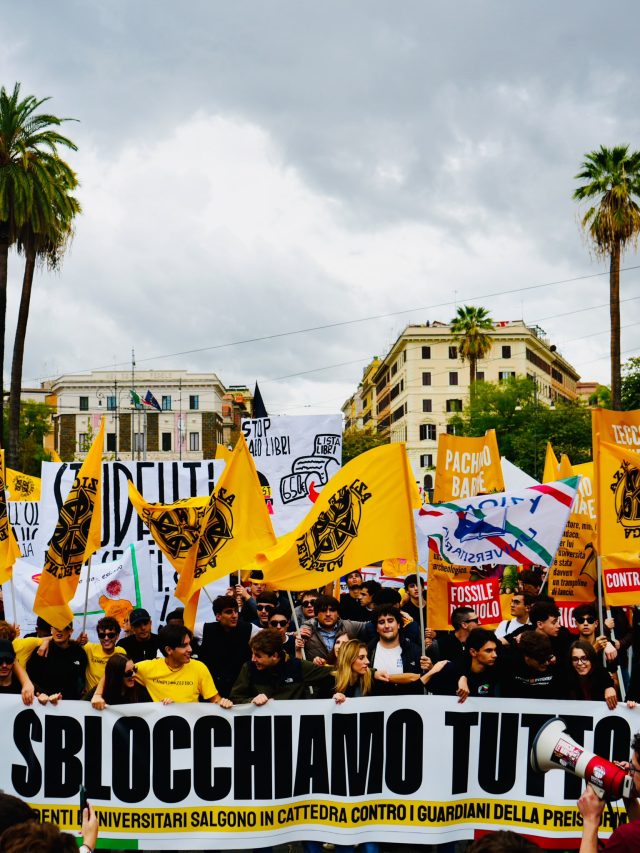
In Turin, Giorgia Meloni’s face goes up in flames. A hooded man climbs the monument to the Duke of Aosta in Piazza Castello and sets fire to a portrait of the prime minister. Around him, applause and insults ring out. In Rome, just hours earlier, other young people marched through the city demanding cheaper textbooks, student grants and protections for interns. Their banner read “Let’s Get Things Moving”. The same Saturday, the same country. Yet the two scenes could hardly have been further apart.
October 24 brought Italy another weekend of unrest. Turin, Rome, Bologna: once again, bottles thrown at police, barricades erected and cities forced to prepare for demonstrations as though bracing for an emergency. The dates change and different groups join the protests, but the familiar figures remain: hooded protesters, police officers under attack and shopkeepers waiting to find out whether they can close for the day without having to count the damage.
In Turin, a protest against war, rearmament and the cost of living found its defining image in the burning of the prime minister’s portrait. Faced with enormous problems, someone sets the enemy’s face alight. People applaud, film it and move on. But what, exactly, is that burning portrait supposed to change in the life of a student or a worker?
By evening, stones, bottles and fireworks were being hurled at police on Corso Principe Oddone. Hooded protesters took materials from a construction site to build makeshift barricades; police responded with water cannons and tear gas. In Rome, at Largo di Santa Susanna, an attempt to push towards government buildings escalated into bottle throwing and police charges. In Bologna, there were barricades, burning rubbish bins and a wrecked cigarette vending machine. Once again, someone else will have to pay the bill for another person’s revolution.
There were also people in those crowds who wanted to demonstrate peacefully. That is precisely why those who turn a protest into a confrontation should be the organisers’ first concern. Instead, the debate too often circles back to the reasons for the anger, as though invoking hardship were enough to make any act understandable. Are rents too high? That is a real problem. Are young people’s prospects uncertain? Equally true. But what answer does a bottle thrown at a police officer provide?
Meanwhile, investigators have identified a name behind one of the groups seeking to channel that anger: Youssef Siher. A 30-year-old Italian of Moroccan descent and a pro-Palestinian activist, he is believed by investigators to be the creator of the October 17 Movement’s Instagram page and Telegram group. On Saturday evening, Milan prosecutors ordered his detention. Reported allegations include incitement to commit crimes, organised violence at public demonstrations and a terrorism-related offence. These are serious allegations, which must be assessed by the courts.
His background deserves attention. Siher studied Communication and Political Science at the University of Milan, where he served as a student representative. In 2024, he undertook a traineeship at the Middle East and North Africa Observatory of the Italian Institute for International Political Studies, ISPI, focusing on political Islam and Islamic movements. The institute has clarified that his work with it ended that year. His career also includes an internship followed by occasional contributions to Fattoquotidiano.it through 2025, and a single article published by Il Foglio in 2022.
His path has taken him through university, research and journalism. That complicates the convenient account of a revolt born solely on society’s margins, among people lacking the tools to understand the world or opportunities to make themselves heard. Here, those tools were available. Ideas, language and political choices must also come under scrutiny.
This does not make the publications Siher wrote for responsible for the alleged conduct. Nor does his suspected role in running the social media channels establish that he organised the previous weekend’s unrest: the October 17 Movement’s page appeared after those disturbances. It did, however, seek to harness their momentum, promoting further protests and announcing that meeting points would be disclosed at the last minute. Its claim to represent that anger must also be measured against the turnout its appeals actually produced, without treating every demonstration on Saturday as part of the same movement.
But while attention focused on the most volatile protests, another story was unfolding in Rome. Azione Studentesca and Azione Universitaria brought their march from Piazza della Libertà to Piazza Risorgimento. More than 1,500 people took part, according to ANSA’s report, which did not attribute the figure to police. These were young people on the right, with a clearly stated political identity and demands addressed, in part, to a government close to their own views.
“Let’s Get Things Moving”: the choice was already there in the slogan. Taking to the streets to demand that things work better. Textbooks families can afford, guidance for students choosing their next step, less university bureaucracy, checks against fraudulent household-income declarations used to obtain student grants, and stronger protections for interns. Their demands also covered sport, civic education and educational trips.
These issues rarely produce spectacular images. Protecting an intern makes less noise than a burning rubbish bin. A proposal to lower textbook costs will never have the visual impact of a face going up in flames. But this is precisely what politics should be for: turning a need into a demand, finding an answer and insisting that it be delivered.
Those young people offered another reminder: the left has no monopoly on youth, street protest or the future. Being a student does not oblige anyone to identify with left-wing collectives, just as being twenty does not mean wanting permanent confrontation. You can belong to the right, support this government and demand that it do more. That is what it means to take the young people you represent seriously.
Italy’s Saturday showed both possibilities. Some chose the burning portrait, the bottle and the barricade. Others went home having taken a proposal into the streets. Telling only the first group’s story grants violence the further privilege of speaking for everyone.