





 Subscribe


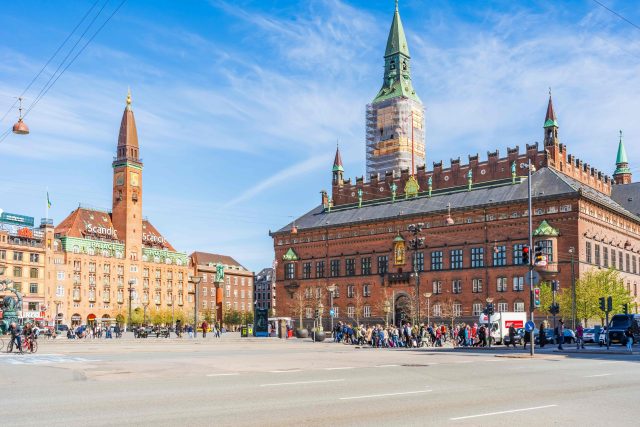
From 1380, when the Norwegian crown passed to the Danish king, Iceland was governed from Denmark’s capital, Copenhagen, until 1918, when Iceland became a sovereign state. Copenhagen therefore holds a special place in Icelandic history. In the nineteenth century, Icelandic students enjoyed privileges at the University of Copenhagen (in compensation for the king’s expropriation of land during the Reformation), and the struggle for independence began there, within the small Icelandic colony. Nothing strengthened national consciousness more than living far from the motherland. Indeed, an Icelandic historian once exclaimed that Iceland had nowhere been loved more passionately than in Copenhagen. I attended the Freedom Summit in this lovely, friendly city on 19 September 2026, organised by the youth movement of the Liberal Alliance and Students for Liberty Denmark, where I presented a book I edited, Conservative-Liberal Thought in the Nordic Countries 946–1945: An Anthology.
Making Freedom Accessible
The programme never had a dull moment. The first speaker, Dr Eamonn Butler, founder of the Adam Smith Institute in London, described, in entertaining detail, his project to make Adam Smith accessible to young people through a short book of carefully designed cartoons. He said his next project would focus on Friedrich von Hayek. In a subsequent panel, Robert Tyler of the Brussels think tank New Direction and Otto Brøns Petersen of the Copenhagen think tank CEPOS (Centre for Political Studies) discussed the future of the European Union. They agreed that the EU’s lack of economic growth, compared with China and the United States, largely stemmed from over-regulation. Regulators might be well-meaning, but their seemingly reasonable regulations often had unintended consequences. Angel Werth of the Objective Standard Institute offered a fascinating interpretation of three modern dystopias by women: Margaret Atwood’s The Handmaid’s Tale, Suzanne Collins’s The Hunger Games, and Ayn Rand’s Anthem. Werth said they all depict attempts by those in power to uproot individual self-esteem, which the protagonists resist. The last speaker, James Tooley, former Vice-Chancellor of the University of Buckingham, gave a lively and sometimes moving account of private, low-cost education in poor countries such as India and Nigeria, where the state provides unreliable and inadequate education.
From Military Conquest to Economic Development
In a panel devoted to my book, I emphasised the strong Danish tradition of the rule of law, even under absolutism. I also noted that the two leading Nordic countries, Sweden and Denmark, had authoritarian as well as libertarian elements in their cultures, but that the authoritarian elements were greatly weakened by defeats: for Sweden, the loss of her Baltic possessions in 1721 and of Finland in 1809; for Denmark, the loss of Norway in 1814 and of Schleswig in 1864. Both countries replaced dreams of military conquest with an emphasis on economic development. The other two panel participants, Robert Tyler of New Direction and Andreas Paulsen of CEPOS, made many interesting observations about the Nordic political tradition, with Tyler comparing it to the British and American traditions and Paulsen discussing the Danish civic spirit articulated by N. F. S. Grundtvig.
Danish Politics
During the coffee breaks, we chatted about Danish politics. In Denmark, as elsewhere, a strange alliance exists between the far left and Islamists, with the far left ignoring the oppression of women and the persecution of gays, which the Islamists support. To the left of centre stand the Social Democrats, under the forceful leadership of Mette Frederiksen, still prime minister despite heavy losses in the last parliamentary elections. The Social Democrats responded to the threat from the anti-immigration People’s Party by simply adopting its anti-immigration policies. Although Denmark has the ninth freest economy in the world, taxes remain high. When Venstre, the traditional liberal party, was seen as doing too little about this, Liberal Alliance formed, now under the charismatic leadership of Alex Vanopslaugh. Another charismatic leader is Morten Messerschmidt of the People’s Party, an effective critic of what he sees as the Islamisation of Europe.