





 Subscribe


A surprising silence has fallen over the persecution of Christians in some Muslim-majority countries, particularly Nigeria, where more than 50,000 Christians have been killed for their faith since 2009. In seven Muslim-majority countries, leaving Islam for Christianity (apostasy) is a capital offence, though the law is enforced only sporadically. But why should we worry? God is dead, said Nietzsche. I can think of six cogent reasons, for the faithful and non-believers alike, to respect and defend our Christian heritage, none of which suggests that Christians should force their religion on others.
Separation of Powers
First, Christianity makes an essential distinction between temporal and spiritual power. We are told to render to Caesar what is Caesar’s and to God what is God’s. In the great conflict between the popes and the princes in the 12th and 13th centuries, the principles were gradually adopted that the Church should not control the State, that a prince rules by consent, and that he can be deposed if he violates the law of the land.
Equal Recognition of All
Second, Christianity extends its moral vision to all mankind. In God’s eyes, everyone is equal—white and black, man and woman, rich and poor, master and servant, Jews and Samaritans. It was no coincidence that Christ chose a Samaritan—a member of a minority many Jews disliked—as the central figure in the parable of moral behaviour, in which the Good Samaritan helped the Jewish traveller who had just been robbed on the road from Jerusalem to Jericho.
Wealth: The Ability to Do Good
Thirdly, the parable of the Good Samaritan implies important political principles. It suggests that a state must be founded to protect us from highwaymen and ensure safe passage between Jerusalem and Jericho, and indeed to all other locations. Moreover, the Good Samaritan was a man of means: we need people who can afford to be generous. He did good at his own expense, not through forced redistribution. Are rulers who rob the rich to give to the poor (and usually keep most of the loot for themselves) any better than the highwaymen who robbed the traveller to Jericho? Again, before the Good Samaritan arrived, two intellectuals, a priest and a Levite, had passed the victim without helping. For most intellectuals, compassion is just a topic for university seminars.
Human Frailty and Ignorance
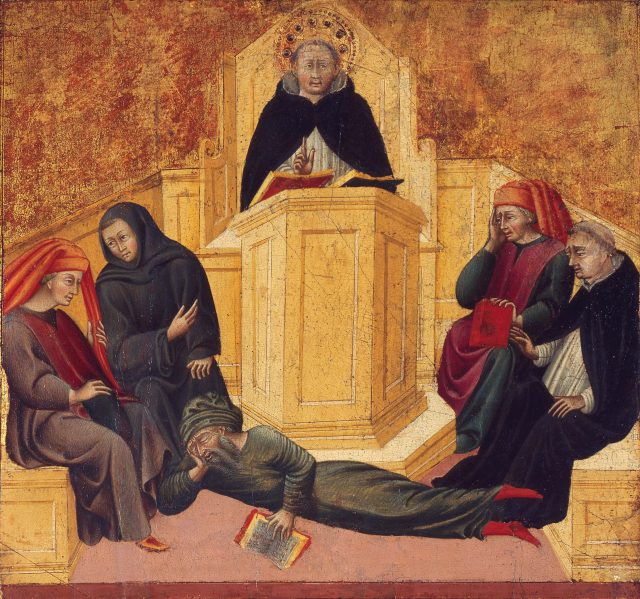
Fourthly, Christianity instils humility in us. It makes us aware of how little we, as individuals, know or control. Italian philosopher St. Thomas Aquinas (shown above, confounding Muslim philosopher Averroes in a painting by Giovanni di Paolo) recognised our moral fragility. We are all sinners, Aquinas taught, but the state should not take on the hopeless task of eliminating sin; it should instead focus only on those sins that harm others, thereby protecting us, in other words, from highwaymen. Moreover, Anglo-Austrian economist Friedrich A. von Hayek presented a fascinating theory of how individual ignorance can be overcome through the transmission of knowledge: in space through the price mechanism and in time through tradition.
Not Everything is Permissible
Fifthly, if God did not exist, everything would be permissible. Russian novelist Fyodor Dostoevsky offered the example of a cruel old general who turned his dogs on a little boy; they chased him down and killed him in front of his mother. It is almost unbearable to think that this evil man could die peacefully in his sleep. Human justice is inadequate. A divine order, a framework of solid moral rules, must be assumed.
A Rational Bet
Sixthly, French philosopher Blaise Pascal proposed a famous wager. Either God exists, or He does not. The potential costs of rejecting Him if He does exist far outweigh the costs of rejecting Him if He does not. Therefore, it is rational to bet on God’s existence and to believe and behave as a devout Christian. We have nothing to lose and much to gain.