





 Subscribe


When Brussels rolled out the Security Action for Europe program last May, the pitch was almost romantic. A €150 billion pool of cheap loans, 45 years to pay it back, and a chance for the EU to stop outsourcing its security. Eastern member states, sitting closest to Russia, were going to be the biggest winners. Eleven months in, that story is fraying. A Polish president vetoed his country out of the largest tranche on offer. An Italian arms maker is publicly accusing Romania’s defense ministry of running a closed shop. And behind the scenes, a familiar pattern is forming: most of the money is heading west.
Poland was supposed to be SAFE’s poster child. Of the €150 billion pot, roughly €43.7 billion had been earmarked for Warsaw, the single largest national allocation. Then in March, President Karol Nawrocki vetoed the bill that would have unlocked it. His reasoning, delivered in a televised address, was blunt. SAFE, he argued, was a “massive foreign loan taken out for 45 years in a foreign currency,” and once interest was added, Poles would end up paying back roughly twice what they borrowed. He raised constitutional questions, talked about Brussels effectively monitoring Polish defense procurement, and warned that the program would chain Warsaw’s spending decisions to bureaucrats in another capital for decades. SAFE rules also cap non-EU components at 35% of any contract’s value. A clause that effectively blocks Poland from buying serious quantities of American or Korean kit, two suppliers that have shaped its post-2022 rearmament. For a country whose defense relationship with Washington is treated as existential, that 35% ceiling looked less like a procurement rule and more like a soft tariff on Polish strategic preferences. Polish opposition politicians have said openly what others only mutter: that SAFE, in practice, is a mechanism to “strengthen the position of Germany and German industry in Europe.”
Romania took a different path. It signed up enthusiastically, securing €16.7 billion in SAFE loans, the second largest allocation after Poland, and pushed through Emergency Ordinance 62/2025 in November to set up the legal scaffolding. Of the 15 procurement deals that Bucharest selected for the first wave, six are heading to a single company: Germany’s Rheinmetall. That’s more than €5.6 billion of the €8.33 billion first tranche concentrated in one supplier for Lynx infantry fighting vehicles, Skynex and Skyranger air defense systems, mountains of ammunition, and the contract that will revive the Mangalia naval shipyard.
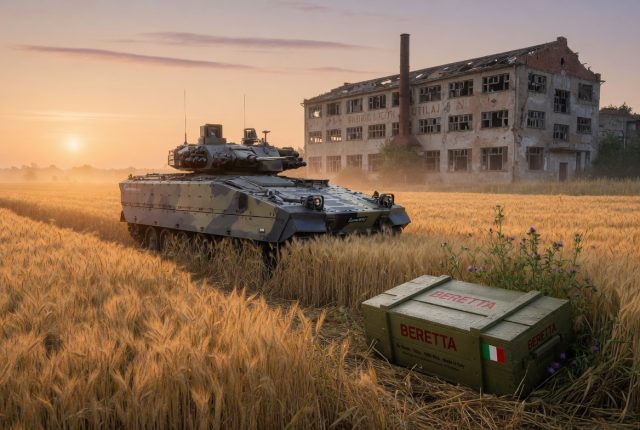
In late April, Italy’s Beretta, the oldest arms manufacturer in Europe, with rifles in the hands of 60+ NATO and allied militaries, went public with a complaint that should have been a normal procurement gripe but instead read like an indictment. Eleven months after the SAFE framework took effect, Beretta said, no formal competitive procedure had ever been launched in Romania for the small arms program. The company received a Request for Information before the OUG even existed. After the ordinance was adopted, Bucharest stopped responding. Total silence. “OUG 62/2025, alongside the EU SAFE Regulation, explicitly requires that procurements be conducted through transparent, competitive and technically grounded procedures. These obligations have not been fulfilled,” Beretta said in its statement. The company is offering immediate local production of assault rifles, grenade launchers and pistols on Romanian soil, full technology transfer, and zero foreign export licenses. None of that, apparently, was enough to get a callback.
The Lynx contract has its own headache. According to defense-industry sources, Rheinmetall is the only company that received the RFI for the €3 billion infantry fighting vehicle program. No competitors invited. Then, with weeks to go before the May 31 deadline, Rheinmetall walked back to the table asking for a price increase of 30%, close to an extra €1 billion. Defense Minister Radu Miruță went public with his frustration, saying he wouldn’t sign a contract 30% more expensive. Other reporting suggests he privately confirmed the Lynx deal will go to Rheinmetall regardless. And the Lynx itself? It is built in Hungary. Romania will assemble some at Automecanica Mediaș eventually. “Eventually” being the key word.
Airbus, the other big SAFE beneficiary in Bucharest with a €852 million helicopter contract, paid roughly €3.6 billion in 2020 to settle bribery investigations in France, the UK and the United States. The Justice Department called it the largest FCPA resolution in history. The conduct spanned a dozen countries and a years-long scheme of paying off officials and airline executives to lock down contracts. Rheinmetall Defense Electronics paid a €37 million fine in Germany in 2014 over bribes connected to Greek defense sales channelled through a Greek middleman across more than a decade. The company’s chairman conceded, in unusually plain language: “Mistakes were made at Rheinmetall for which we take the blame.” Now those same companies are taking home the lion’s share of an EU instrument explicitly designed, in Brussels’ own words, to make Europe more sovereign and more secure.
Europe’s nominal GDP is projected at $32.3 trillion this year and the bulk of it sits in a handful of western capitals. Germany alone produces $5.4 trillion. Add the UK and France and you reach over $13 trillion. More than 40% of the entire continent’s output. The six largest economies in Europe generate over $20 trillion. SAFE, as currently structured, doesn’t disrupt that geography. It reinforces it. Eastern members borrow money backed by EU credit, but repaid by national taxpayers, and route most of it back to manufacturers headquartered in Düsseldorf, Toulouse and Munich.