





 Subscribe


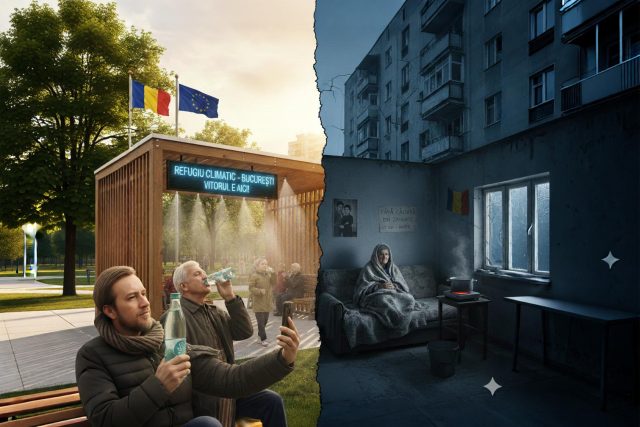
Picture this: It’s a sweltering 36°C afternoon in Bucharest. Under a wooden pergola in a leafy park, retirees sip free chilled water while fine mist sprays from overhead nozzles, cooling the air like some luxurious outdoor spa. Fans whir gently. A digital sign blinks “Climate Shelter” Kids laugh. Someone posts a selfie: “Finally, the future is here!”
Now rewind three months. It’s February 2026, minus 10°C outside. In a Soviet-era block in Sector 3, Elena, 72, shivers under three blankets because the district heating pipe burst again. No hot water for her morning tea. No radiator warmth. Her neighbor downstairs hasn’t had proper pressure since January, when one boiler failure at CET Sud plunged 3,500 apartment blocks into the cold. Welcome to the same city, two parallel realities.
This isn’t dystopian fiction. It’s the latest brainchild from Bucharest’s USR city councilors: a shiny network of “Climate Shelters” to protect citizens from “extreme weather”. The project, unveiled February 16, 2026, calls for at least 80 of these refuges by the end of 2026, doubling to 160 the following year, and full coverage by 2028. But this is Bucharest, where the basics aren’t just broken, they’re legendary for it.
The city’s district heating system is Europe’s second-largest after Moscow, a communist-era dinosaur of 1,000 km of primary pipes and 2,800 km of secondary ones, most installed in the 1960s–80s. It leaks like a sieve. Historical losses hit 2,400 tons of hot water per hour. In August 2025, a single pipeline rupture left half the city (Districts 2, 3, and 4, over 4,000 blocks) without hot water for nearly two weeks. This February, nearly 4,000 blocks again received “deficient thermal agent” or nothing at all because CET Sud couldn’t deliver under proper parameters. One boiler down in January 2026 and boom: 3,500 buildings froze. Residents boiled water on electric stoves (when the power stayed on) or visited relatives. “We’ve become numb to it,” one told Le Monde last year. Numb doesn’t begin to cover the elderly, the infants, the disabled who can’t just pop to a friend’s place.
And electricity? Many of those same crumbling blocks suffer flickering power, overloaded transformers from the 1980s, and occasional neighborhood blackouts when the grid strains under winter demand or summer AC spikes. It’s not dramatic national headlines every day, but for families in Ferentari or Berceni, it’s another layer of “why can’t this city just work?”
Enter the USR party, the self-styled progressive, reformist force that has backed Mayor and now President Nicușor Dan since 2020. They campaigned hard on fixing the thermal network. “Modernization!” they promised. EU millions poured in: 105 km of pipes replaced so far, more planned. Dan signed agreements, set strategies, talked endlessly about efficiency. Yet here we are in 2026, six years later, and the system still collapses from a single point of failure. The same politicians who couldn’t guarantee a hot shower in January are now designing misting stations for July.
The water waste angle is almost poetic in its absurdity. Those outdoor climatic shelters will pump potable water into the air to evaporate: beautiful cooling effect, terrible efficiency. Meanwhile, the district heating pipes lose enough hot water daily to fill swimming pools. Bucharest already struggles with aging water infrastructure; pressure drops and occasional supply cuts hit blocks regularly. Spraying it into the breeze while thousands can’t bathe properly feels less like adaptation and more like performance art.
Critics (and there are plenty on social media) call it classic virtue signaling: green-washing with AI-generated renderings of happy families under pergolas while the real emergency is indoors. The project even includes a “study on climate risks 2030–2050”. Great work, sure, but when your 2030 risk is literally freezing to death in your own flat because the pipes failed again, maybe prioritize the present.
Citizens aren’t asking for luxury climate oases. They want the radiator to click on when the forecast says minus ten. They want hot water without praying to the gods of CET Sud. They want lights that stay on and taps that don’t run dry. The climatic shelters might make for great photos and EU grant applications, but they won’t warm Elena’s bones or let her wash her grandkids’ clothes without boiling pots on the stove.
On February 18, 2026, Bucharest woke up buried under 50 cm of fresh snow from an overnight blizzard that triggered a red alert and multiple RO-ALERT warnings. Streets turned into impassable white trenches, sidewalks vanished under drifts, and public transport ground to a halt, buses stuck on major boulevards, trams frozen on uncleared tracks, trains delayed by hours, flights diverted from Otopeni airport. Thousands shivered in blacked-out homes as power outages hit hundreds of thousands nationwide, while ambulances got snowed in and elderly residents like Elena couldn’t even reach the pharmacy or a neighbor for help. Fallen trees blocked roads, cars abandoned mid-street, and the city administration? Nowhere to be seen with plows or salt trucks in meaningful numbers. Secondary streets and pavements left untouched, turning a predictable winter event into full paralysis.
While the progressives dream of misting pergolas for next summer’s selfies, pensioners slip on icy sidewalks, parents can’t get kids to school (many closed anyway), and the vulnerable freeze in unheated blocks because the basics like clearing snow, keeping transport running, restoring power, remain legendary failures.
This isn’t just poor prioritization. It’s a glaring symptom of a political class more comfortable dreaming about 2030 than fixing 2026. While USR pushes “100 climate-neutral cities” missions and fancy shelters, ordinary citizens are living the real climate emergency inside their freezing or sweltering apartment blocks.
Bucharest isn’t overwhelmed by weather, it’s overwhelmed by incompetence that prioritizes photo ops over people.