





 Subscribe


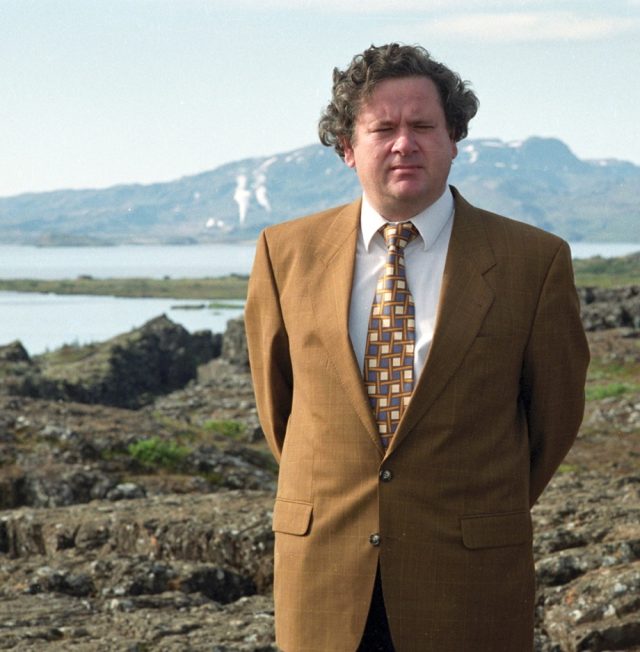
When Iceland’s most influential politician ever, Davíd Oddsson, passed away on 1 March 2026, the journalist Alda Sigmundsdóttir wrote a hostile blog about him. Much is stated incorrectly there, and it is my duty to point out what is more accurate for the benefit of foreigners seeking reliable information on Icelandic politics.
The Privatisation of Two Icelandic Banks
Hinting at impropriety, Alda says that two of Iceland’s three major banks were sold in 2003 to investors with close ties to the two government parties, Davíd’s conservative-liberal Independence Party and the Agrarian Party. This was true of Búnadarbanki (later Kaupthing): its buyers indeed had close ties to the Agrarian Party. But it was not true of Landsbankinn. Only one of the three main investors in the bank was a member of the Independence Party, and he had opposed Davíd within the Party, serving as the manager for Davíd’s chief rival in the Party’s 1982 primary.
Davíd’s Salary and Pension
Having been prime minister for almost fourteen years and foreign minister for a year, Davíd became one of the three governors of the Central Bank in 2009. Alda says that at the Central Bank, Davíd enjoyed not only a comfortable pension as a former prime minister, but also a high salary. I was on the Board of the Central Bank at the time, and Davíd had nothing to do with our decision before he became governor to raise the salary of the three governors in accordance with general wage increases. Moreover, as governor, Davíd did not draw his pension as prime minister. When he was driven out of the Central Bank in 2009, he was under a contract that ran until 2012, but he did not insist on being paid until then. Alda’s assertion is not only petty: it is also wrong.
Davíd in the Bank Collapse
Alda says that a Special Investigation Commission on the Icelandic bank collapse in 2008 found Davíd guilty of gross negligence. But in fact, the two admonitions directed to Davíd and his two colleagues by the Commission were risible: that they had not insisted on sufficient information when rejecting large loans in hard currency, first to Landsbanki in August and then to Glitnir in September. But of course, the governors had no need for access to the two banks’ bookkeeping to find their requests inadvisable. If the Commission’s long report is read carefully, it demonstrates that Davíd warned several times against the reckless expansion of the banks. But the reason why all three Icelandic banks collapsed in 2008 was not only that they had expanded far beyond the capacity of the Central Bank and the Treasury to provide liquidity to them in a crisis, but also that the Central Bank of Iceland was refused the same liquidity support from the U.S. Federal Reserve Board as the central banks of Norway, Sweden, Denmark and Switzerland received, without which many banks in those countries would have collapsed. For details, I refer to my 2018 report to the Treasury.
Two Significant Facts
In 2009, Davíd was hired as Chief Editor of Iceland’s only remaining newspaper, Morgunbladid. Alda says that the newspaper is owned by some of Iceland’s fishing firms, and that the Independence Party is ‘in their pockets’. But the Icelandic National Audit Office publishes every year a list of the main donors to political parties, and donations from fishing firms account for only a fraction of the Independence Party’s total income. Thus, Alda’s assertion is wrong. However, the fishery is one of the strongest pillars of the Icelandic economy, so it is not surprising that both Morgunbladid and the traditionally pro-business Independence Party tend to support it.
Two facts are more significant than Alda’s harangue. When Davíd left politics in 2005, Iceland was, according to the U.N. Human Development Index, the best country in the world. And it only took Iceland five years to recover from the 2008 bank collapse.