





 Subscribe


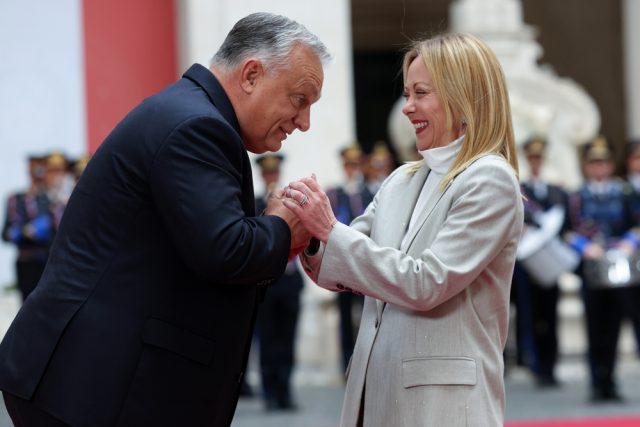
The electoral defeat of Viktor Orbán this Sunday, 12 April, is not merely the end of a political era in Hungary. It probably marks the closure of one of the two major models of conservatism—and of what might be called common-sense politics—that have coexisted in Europe over the past fifteen years.
Throughout this period, European conservatism has not been monolithic. It has been structured around two distinct ways of understanding power, sovereignty, and alignment within the international order. These two models shared a number of core intuitions — a critique of progressive overreach, a defence of the nation and the family, a concern with cultural continuity — yet diverged significantly in their strategic outlook, alliances, and transformative ambition.
The first model, and more developed in both scope and duration, has been embodied by Orbán. Crucially, this model has not been static. Orbán himself represents an evolution: from a rather classical liberal reformer in his early career to the architect of a political system that presents itself as an alternative to the dominant Western consensus, coining, defining and executing the illiberal democracy model that has become the blueprint for national populists everywhere. His approach is marked by a strong identitarian component, placing nationhood, culture, and demography at the centre of political action. Over the past decade, especially after Covid-19 restrictions died off, Budapest has been the beating heart of the European conservative movement, a place of pilgrimage for conservatives across Europe and beyond. The epicentre of a movement—a phenomenon, really— with deep roots formed by an ecosystem of powerful think tanks and institutions that both fuelled and protected the Orbanite project.
Alongside this complex ideological construct, Orbán has also displayed a distinctive form of geopolitical pragmatism. His openness to engaging with actors such as Russia—particularly on energy and the war in Ukraine—and China—especially on foreign investment—reflects not merely opportunism, but a broader reading of the world as increasingly multipolar. Within this framework, Hungary has sought to maximise its strategic autonomy vis-à-vis Brussels or a hostile—at times— White House. Orbán’s conservatism, therefore, was not only cultural or domestic; it was also geopolitical, aimed at repositioning both his country and, symbolically, Central Europe within a shifting global order. That was the rationale of the fascinating Hungarian strategy of connectivity, as developed by the chief political advisor to Prime Minister Orbán, Balázs Orbán.
Set distinctively apart from this stands the model represented by Giorgia Meloni. Also conservative, also critical of elements within the European consensus, yet fundamentally different in orientation. Meloni embodies a form of conservatism that is less rupture-driven and more reformist in nature —one that seeks not to redefine the system from the outside, but to influence it from within.
Her approach is, in this sense, more European than civilisational. Where Orbán cultivated a narrative of structural tension with Brussels, Meloni has pursued a strategy of integration and negotiation. And even more so, a leadership strategy. In many areas where the EU lacked vision, Rome provided one that was later followed by Brussels, with migration policy perhaps the best example. The EU’s approach to migration is increasingly aligning with Italian Prime Minister Giorgia Meloni’s “Mattei Plan for Africa,” focusing on “equal-to-equal” partnerships to stem migration at its source. In other words, where the Hungarian model elevated sovereignty even at the cost of confrontation, the Italian model balances it with institutional stability and credibility within the European framework.
This divergence is particularly evident in foreign policy. Meloni is firmly anchored in the Atlantic alliance, maintaining a consistent alignment with the United States regardless of who governs in Washington. Or, at the very least, an entente cordiale with the White House, despite which—or thanks to which— she is also able to call it out when she so deems appropriate, as she has recently done on Iran. Her international posture does not aim to diversify power centres, but rather to reinforce her position within existing alliances. In contrast to Orbán’s multipolar pragmatism, Meloni represents a disciplined Atlanticism, fully compatible with her domestic conservative agenda.
The consequence of Orbán’s defeat is therefore clear: of these two models, only one remains in power. European conservatism loses its more ambitious, more identitarian, and more strategically autonomous variant, and is left with a version that is more integrated, more gradualist, and more conditioned by the institutional realities of the European Union. This does not necessarily imply immediate weakness, but it does signal a profound transformation that might also spread across Europe. The conservative space loses some systemic tension and gains predictability. It loses a pole of political experimentation—with all its controversies—and consolidates around a form of governance more compatible with the existing European order.
The question now is not whether Meloni can replace Orbán. She cannot, because she operates within a different logic. The real question is whether the model that now stands alone is sufficient to sustain, develop, and project a meaningful conservative alternative in Europe.
What ended on 12 April was a way of doing politics —and with it, one of the two defining strands of contemporary European conservatism. Should conservatives now rally around Meloni? After all, she is the last woman standing.