


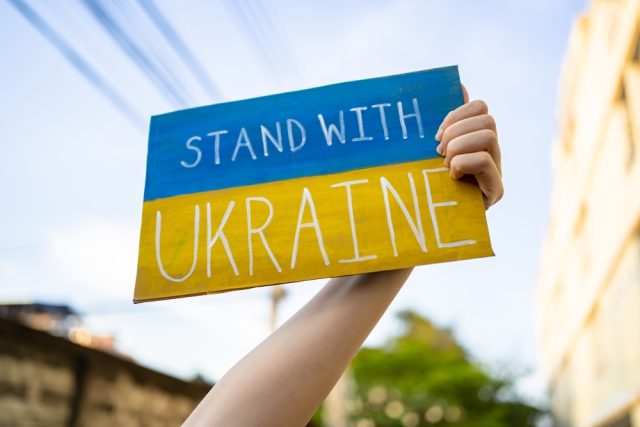
Ireland’s EU Presidency and Ukraine’s accession

Politics - June 21, 2026
According to a recent report in The Irish Times the Irish Government hopes to make “swift progress” on Ukraine’s EU membership bid when Ireland assumes the rotating EU Council Presidency in the second half of 2026.
Ministers aim to “prepare the ground” for the Union’s next enlargement, with a particular focus on advancing negotiations with Ukraine, Moldova and Albania while prioritising the completion of Montenegro’s accession treaty.
This latest signalling of strong ambition to accelerate Ukraine’s path to membership aligns squarely with longstanding positions of the ECR Group in the European Parliament.
Indeed, it has consistently adopted the view that enlargement, when conducted properly, remains a key instrument for Europe’s stability and prosperity and can serves as a strategic tool that anchors partners in the European project rather than leaving them vulnerable in grey zones.
The ECR has also welcomed the Commission’s recommendations on opening talks with Ukraine and Moldova, stressing that such moves strengthen security and must be merit-based, with full compliance to the Copenhagen criteria.
Yet welcoming Ukraine’s European aspirations does not require downplaying the domestic pressures this policy may create for Ireland.
The Government’s enthusiasm for fast-tracking accession comes at a moment when Irish public patience with the costs of supporting Ukraine has visibly frayed.
A clear majority of citizens recently backed efforts to wind down the generous supports extended under the Temporary Protection Directive. Polls have shown around 79 per cent endorsing the Government’s moves to tighten arrangements for Ukrainian beneficiaries, reflecting real strain on housing, services and public finances.
Ireland’s contribution has been substantial. Since Russia’s full-scale invasion, the State has committed hundreds of millions of euro in direct non-military aid and humanitarian assistance, stabilisation funds, energy infrastructure support and development programmes.
Cumulative bilateral support has run into the hundreds of millions, with fresh packages announced even in 2026.
There is a view however, among a not insubstantial portion of the Irish population that every euro directed abroad or spent on accommodation and services for Ukrainian arrivals is a euro not spent on fixing chronic failures at home.
The housing crisis provides the clearest illustration. Ireland welcomed large numbers under the Temporary Protection regime with promises of accommodation and supports. Yet the country already faced a severe shortfall before the influx.
Placing people in hotels, direct provision-style settings and private rentals stretched an already broken system. Public sentiment shifted as visible pressures mounted on schools, GPs and local communities. The recent poll numbers, with overwhelming backing for winding down special measures, reflect not indifference to Ukraine’s suffering but exhaustion with a policy that appeared open-ended while domestic needs went unmet.
Pushing Ukraine’s EU bid during the Irish Presidency also carries foreign policy implications for Ireland.
While supporting enlargement as a security tool against Russian aggression is consistent with ECR thinking, in that it denies Moscow influence, Ireland’s priorities risk setting it on a clearer collision course with Russia at a time when energy prices, hybrid threats and global tensions already test European resilience.
Ireland has a tradition of military neutrality in the classic armed sense during this conflict, however ambiguous that is seen by some. It has provided non-lethal aid and backed EU sanctions.
Russia however has shown willingness to target critical infrastructure and exert pressure through energy and other domains. For a country reliant on foreign investment, data centres and transatlantic connectivity, these vulnerabilities are real.
Irelands subsea cables and digital infrastructure, already under discussion in security reviews.
The Government’s draft policy platform speaks of being “ambitious” on enlargement and communicating its benefits to citizens both in candidate countries and within the Union.
That communication effort must be honest. Benefits exist, sure; a stronger, more secure eastern flank, economic opportunities over time, and a demonstration that aggression does not pay.
But will the costs be immediate and unevenly borne. ECR pragmatism insists on outcomes over process. Enlargement, as stated above must strengthen the Union, not import instability or overburden smaller members already failing at basics.
Montenegro also features prominently in Ireland’s plans as a test case, with work on its accession treaty. But Ukraine is a still large country at war, still needing massive reconstruction, anti-corruption reform.
Concerns from major members about rushing the process are well founded. The ECR’s view is that ‘merit must prevail’ but fast-tracking that bypasses standards would certainly weaken the Union, not reinforce it.
Public opinion in Ireland, as said above, has moved on. Early solidarity was genuine and widespread, but as Government moves to transition people out of special measures, explore voluntary returns where safe, and align with evolving EU approaches, the mood music in Ireland has changed.
Of course none of this negates Ukraine’s right to defend itself or its legitimate European aspirations, but policy must balance external ambition with internal capacity.
The coming Presidency does offer Ireland a platform. Yet its credibility depends on a kind of realism that is often sorely lacking in Ireland.
Will be vocal about the level of corruption that still exists in Ukraine?
Does Ireland have the political nerve to point out with unflinching honesty Transparency International’s 2025 Corruption Perceptions Index, which Ukraine scored just 36 out of 100, ranking 104th globally.
Or what about the serious problems that persist, which Ireland and other member states rightly criticise Russia for not tackling.
We know that oligarchic influence still distorts key sectors in Ukraine and judicial independence is incomplete, and corruption risks in defence procurement and reconstruction remain high.
Yes, anti-corruption bodies have achieved convictions, yet they face repeated political interference, even though attempts to weaken oversight institutions have drawn repeated warnings from the EU.
These issues cannot just be ignored. They directly affect Ukraine’s ability to meet the EU’s core rule-of-law requirements.
Courageous leadership if it is to mean anything means rejecting the idea that raising corruption concerns is somehow “unsupportive” of Ukraine.
The opposite is true. Honest dialogue strengthens the process. Ireland should insist on rigorous, merit-based conditionality alongside measurable reforms, transparent institutions, and verifiable progress.
Ireland must have the confidence to say this plainly. Only by confronting these realities can enlargement deliver genuine stability and prosperity instead of importing long-term fragility. Irish leaders should lead that necessary conversation, not avoid it. Whether it will do so is anyone’s guess. Ireland is nothing if not a country committed to certain stifling forms of consensus, and the consensus on Ukraine, for all its courage is often blind to the profoundly real and damaging practices that have marred the country for decades.

There is also a hard economic dimension that Irish enthusiasm tends to skirt. Ukraine is an agricultural superpower, with a farmed area larger than that of any current member state and a grain export capacity that already reshaped European markets when wartime disruption pushed cheap Ukrainian produce into neighbouring economies. Its accession would land directly on the Common Agricultural Policy, the single largest line in the EU budget and one on which Irish farmers remain heavily dependent. Folding a country of Ukraine’s scale into the CAP would, on current rules, redirect a substantial share of payments eastward and place real downward pressure on the supports Irish producers rely upon. Poland and others, hardly hostile to Kyiv, have already signalled their alarm. For a Government preparing to champion swift accession, an honest accounting would acknowledge that part of the bill may well be paid by the Irish farmer.

Like in any family, however, be that of people or nations, someone needs to be the adult in the room and face these challenges directly.