


 Subscribe


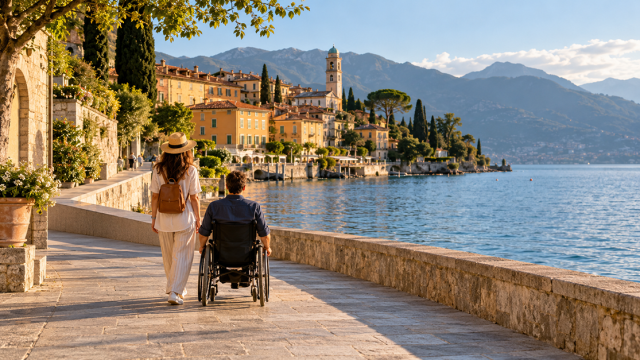
Accessible travel is becoming a test of competitiveness, as demographic change and rising investment reshape Italian hospitality.
A holiday can unravel before it begins: a booking website that cannot be navigated, an unclear description of a bathroom, a station without a usable connection. For travellers with accessibility needs, these details determine whether a destination is genuinely available. For Italy, removing such obstacles represents an economic opportunity alongside the responsibility to make travel more inclusive.
According to the 2026 Accessible Tourism Report, the sector accounts for approximately nine million arrivals and 38.6 million overnight stays in Italy. Its estimated direct added value reaches €5.3 billion, rising to €9.8 billion when the overall economic impact is included. These figures describe a substantial contribution to the economy, rather than simply the turnover of specialist travel services.
Produced by the Italian Institute for Tourism for All, IsITT, the report was presented at TTG Travel Experience in Rimini, with contributions from Fondazione CRT, SRM and Intesa Sanpaolo Innovation Center. Its findings suggest that accessibility increasingly belongs at the centre of business strategy, influencing investment, service design and the quality of destinations.
The potential audience extends well beyond any single category of traveller. The report cites Istat figures showing that around 2.9 million people in Italy experienced disabilities or severe limitations in usual activities in 2023, approximately 5% of the population. In 2025, 22.7% of people living in private households reported limitations of varying severity in everyday activities.
Ageing adds another dimension. Italy has 14.8 million residents aged over 65, representing 25.1% of its population, according to the report. Older age does not automatically imply disability, but it reinforces the value of comfortable transport, clear information and environments that accommodate different needs. Temporary injuries, sensory impairments and cognitive difficulties further broaden the range of experiences tourism providers must consider.
Businesses appear increasingly willing to respond. Among companies oriented towards accessibility, the share that invested during the previous three years rose from 79.6% to 84.5%. The proportion planning investment over the following three years increased from 67.5% to 74.2%. These percentages concern an already engaged group, so they should not be read as representative of every Italian tourism business.
Nevertheless, the direction is significant. Accessibility can influence how travellers choose accommodation, organise activities and decide whether to return. Because people often travel with relatives, friends or assistants, barriers affecting one individual can shape decisions for an entire party. Reliable provision therefore has commercial implications across hotels, restaurants, transport operators, cultural attractions and local shops.
The practical challenge is continuity. An accessible bedroom offers limited reassurance if the transfer vehicle cannot accommodate its guest or the nearby attraction remains unreachable. Destinations need coordinated planning across the visitor journey, supported by cooperation between public authorities, private operators and people with lived experience of disability. Their involvement should begin when services are designed.
Information deserves particular attention. A generic accessibility symbol cannot explain every traveller’s requirements. Detailed descriptions, accurate photographs and clear information about entrances, lifts, bathrooms and available assistance allow visitors to judge suitability themselves. Digital tools can make this easier, provided the tools are accessible and their information remains accurate.
That requires sustained maintenance as well as initial spending: a broken lift or outdated website can undo improvements and leave travellers facing uncertainty at the moment they need reassurance most during an unfamiliar journey.
Staff training is equally important. Thoughtful assistance means listening, communicating clearly and respecting individual preferences. Technology and physical adaptations work best when employees understand how to support guests without undermining their independence.
The report’s broader message is that inclusion and economic development can reinforce each other. For Italy, success should be measured through journeys people can actually complete and experiences they can enjoy with confidence. An accessible destination strengthens its appeal by improving the substance of hospitality: enabling more people to arrive, participate and feel welcome.
Alessandro Fiorentino