





 Subscribe


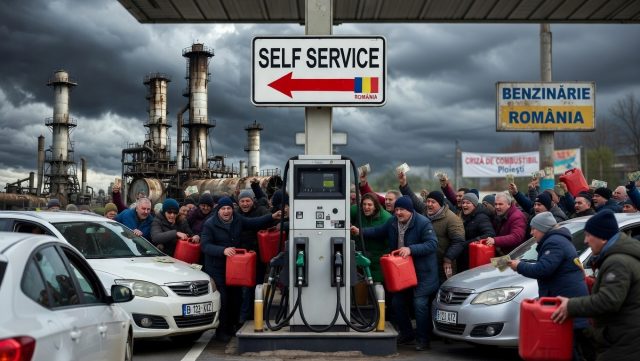
Fuel prices in Romania have been climbing relentlessly, with petrol already surpassing 9 lei per litre and analysts warning it could hit 12–13 lei before the year is out. Behind those numbers lies a perfect storm of broken refineries, geopolitical entanglements, a government scrambling for answers, and fuel companies that are, quietly, making a fortune. For Romanians, already the hardest-hit by inflation in the entire European Union, this is not an abstract economic debate. It is a daily calculation about whether to fill the tank or put food on the table.
Romania once had a proud refining industry. Today, that infrastructure is crumbling in real time. Petromidia, the country’s largest refinery, is currently undergoing scheduled technical maintenance, and its suspension has dragged the adjacent Vega refinery offline with it. Meanwhile, Petrotel Lukoil sits locked behind American sanctions against Russia.
That leaves Petrobrazi, the OMV Petrom facility, as the only refinery operating at significant capacity. It processes 4.5 million tons of fuel per year, but Romania uses approximately 8.4 million tons annually, around 6 million of which is diesel alone. Petrobrazi covers barely 35% of national demand, and even that figure has been temporarily reduced by about 10% due to partial maintenance on one of its units. The arithmetic is brutal: Romania is structurally dependent on imports to meet more than half its fuel needs.
There is an uncomfortable truth buried inside Romania’s refining crisis. With the exception of Petromidia, every Romanian refinery was built to process Ural crude, Russian oil. Even when Romania sources petroleum from Kazakhstan or Azerbaijan, it must be of the Ural-type blend to be compatible with its refineries. In practice, Romania is not free from Russian energy, regardless of what political statements suggest.
The imports that fill the gap are coming primarily from Turkey and India and are themselves processed from Russian crude. So, when a Romanian driver pays for fuel at a Bulgarian or Turkish import, they are, indirectly, funding a supply chain that runs through Moscow. Even the fuel arriving from Greece and Bulgaria is no sure thing: those countries face their own supply pressures and may not always be willing or able to export. Before the war in Ukraine, Saudi Arabia was a reliable source. That relationship has quietly faded.
Here is the irony that rarely makes headlines: as fuel prices rise, the Romanian state budget sees increased tax revenues from excise duties and VAT. Minister of Energy Bogdan Ivan stated openly that rising fuel prices had automatically boosted state receipts. The government, in other words, benefits fiscally from the very crisis it claims to be managing. Private fuel companies are similarly insulated, as they can directly pass international price hikes on to consumers rather than lose money on their own margins.
Romania leads the EU in inflation, at 8% at the start of 2026, where economists cite years of overspending. The external debt now has grown from 40% to over 61% of GDP since the pandemic. As fuel prices go up transport costs go up and then grocery prices go up, according to analysts food prices will be up by 10% in a year. And so you see the ripple effects first on the poorest and hardest-offended populations. According to one research, 56% of Romanians have already cut spending on eating and drinking, or cut portion sizes.
The EU has discussed ways to lower energy costs but Germany, Romania and Sweden have all ruled out Russian gas again or lifting sanctions on Moscow. This has created a narrow path: there are no immediate options to replace Russian gas, and no immediate option for alternative supply. The Romanian government is preparing for a fuel crisis that would prompt price limits, consumption controls and rationing mechanisms. Reduction of excise duties has been discussed, financial analysts say, but with a deficit currently running at 6.2% the state cannot afford to lose that revenue. Prime Minister Bolojan has declared “no populist measures are going to be implemented”, so people should not expect relief soon.
Romania holds roughly 90 days of fuel reserves, half on national territory, stored in private operators’ depots, and about 43% in other EU member states. The pumps are still running. For now. But the foundations beneath them have never looked more fragile.