





 Subscribe


In recent years, the international conservative movement has undergone a profound transformation. What once existed as a relatively loose network of political parties, intellectuals, and activists united by concerns over sovereignty, identity, and the perceived limits of liberal globalisation has gradually evolved into something more structured and interconnected. Today, it increasingly resembles an ecosystem in its own right. Conferences, media platforms, think tanks, and political alliances now connect conservatives across continents, facilitating a shared conversation that transcends national borders.
This past week alone offered a vivid illustration of that reality. CPAC Hungary and CPAC US (Dallas) took place almost simultaneously, while CPAC Great Britain was announced for the coming months. Other events—NatCon, MEGA, MIGA, and the many variations of these gatherings that continue to emerge—are further examples of the same phenomenon: a transnational network of conservative actors attempting to define a common intellectual and political agenda for the West.
Yet the more globalised this ecosystem becomes, the more visible its internal tensions appear. These tensions are not merely tactical or electoral; they are fundamentally strategic. At their core lies a deeper question about how conservative politics should position itself in a rapidly fragmenting world order.
Should conservatives define themselves primarily as defenders of national sovereignty against supranational institutions and technocratic governance? Or should they prioritise the defence of the Western alliance system—NATO, the transatlantic partnership, and the broader geopolitical alignment of democratic states and historical partners such as Israel?
Increasingly, the answer varies across the conservative spectrum. Some actors within the movement emphasise sovereignty almost exclusively, often framing international politics as a struggle against globalist institutions, liberal international norms, and bureaucratic governance structures that they perceive as detached from democratic accountability. Others, while equally critical of technocratic governance and cultural progressivism, remain firmly anchored in the West’s strategic architecture and believe that defending Western civilisation ultimately requires preserving the alliances that have sustained it since the end of the Second World War.
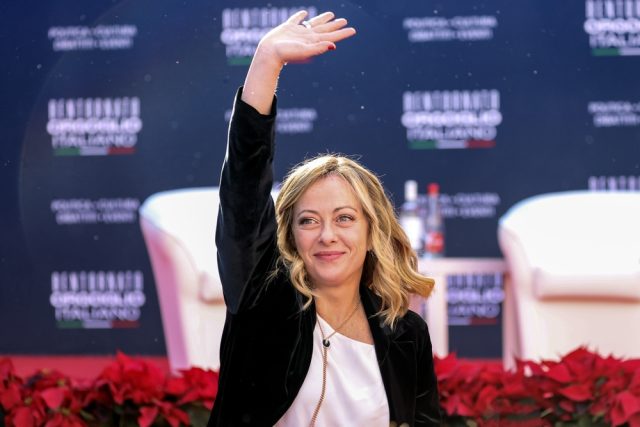
This divergence is gradually becoming one of the defining debates within contemporary conservatism. Few leaders illustrate this tension—and the attempt to navigate it—better than Italian Prime Minister Giorgia Meloni.
When Meloni first came to power, many observers expected her government to adopt a confrontational stance toward the European Union and to move closer to the more sovereigntist wing of the European right. Instead, her foreign policy has largely remained anchored in the Euro-Atlantic framework. Italy has continued to support Ukraine, while reaffirming its commitment to NATO and the broader Western security architecture.
This approach surprised many critics and even some of her supporters. Rather than abandoning sovereignty-based rhetoric, Meloni reframed it within a broader strategic logic: defending Italy’s national interests while remaining firmly embedded in the Western alliance system. The result has been a form of conservative realism.
On Ukraine, Meloni has been unequivocal in condemning Russian aggression and supporting Kiev, including through military assistance, while at the same time rejecting the idea of direct troop deployment. Yet she has also insisted that the long-term objective should be a just and sustainable peace rather than an indefinite escalation of the conflict.
On the Middle East, her position has followed a similar pattern. Meloni has maintained Italy’s solidarity with Israel while simultaneously calling for humanitarian restraint and advocating diplomatic pathways to de-escalation, including ceasefire proposals in Gaza. Her government has also urged prudence regarding the widening confrontation with Iran, emphasising the need to preserve regional stability and avoid a broader war.
Perhaps most interesting, however, is her relationship with the United States—particularly in the turbulent political context of Donald Trump’s return to the White House. Meloni is frequently portrayed as one of Trump’s closest allies in Europe. There is some truth to that characterisation. Their ideological affinities on cultural and social issues are evident, and Meloni has never hidden her appreciation for certain elements of Trump’s political message. Yet her diplomacy has proven considerably more nuanced than many anticipated.
While emphasising the central importance of the transatlantic alliance, Meloni has not hesitated to express concern about unilateral actions that could destabilise the international order. In recent debates surrounding U.S. military actions in the Middle East, for instance, she criticised interventions that might fall outside international legal frameworks while still reaffirming the importance of cooperation with Washington. Likewise, she has defended Italian and broader European Union interests in the face of American tariff-based economic pressure while maintaining a constructive relationship with the Trump Administration—something that few European leaders have managed to do successfully.
In other words, Meloni has attempted to maintain two positions simultaneously: loyalty to the Western alliance and strategic autonomy in its interpretation. This balancing act reflects a deeper political instinct. Meloni appears to understand that the future of the conservative movement will not ultimately be decided by ideological purity but by geopolitical credibility.
In Europe, especially, the political cost of abandoning the transatlantic framework would be enormous. NATO remains the cornerstone of European security, and Russia’s invasion of Ukraine has only reinforced that reality. Even leaders who emphasise sovereignty recognise that the defence of European civilisation ultimately depends on collective security structures.
At the same time, Meloni also recognises the cultural and political energy driving the new conservative networks emerging across the West. These networks challenge the dominance of progressive narratives in academia, the media, and international institutions. They have created a sense of shared intellectual and political purpose that did not exist two decades ago.
Yet this internationalisation also carries a risk: the transformation of conservatism into another form of ideological internationalism. The paradox is striking. Movements that define themselves through the language of national sovereignty increasingly operate through transnational alliances, media ecosystems, and political networks. In that sense, the new conservative international risks replicating some of the very dynamics that it once criticised in progressive globalism.
This is precisely where Meloni’s approach becomes particularly instructive. Rather than rejecting international cooperation among conservatives, she has attempted to anchor it within the broader strategic framework of the West. Her message—implicit but increasingly clear—is that cultural alliances cannot come at the expense of geopolitical stability.
European conservative parties may share intellectual sympathies with movements across the Atlantic, but their ultimate responsibility remains the security and prosperity of their own nations within the Western alliance. That, after all, is what patriotism is—or should be.
In practical terms, this requires acknowledging certain uncomfortable realities. Russia may not be a civilisational enemy in the abstract, but it remains a geopolitical adversary in the present. China represents a systemic challenge for Western democracies, even as its economic ties remain important for European industry. And the transatlantic relationship—despite its tensions—remains indispensable.
If the conservative movement hopes to become a durable governing force rather than a coalition of protest movements, it must reconcile sovereignty with alliances, identity with strategy, and national interest with international responsibility.
That is not an easy balance to achieve. But for now, Giorgia Meloni may be demonstrating that it is at least possible.