





 Subscribe


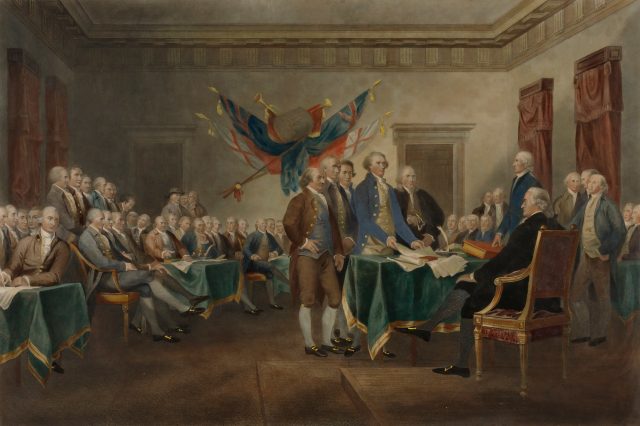
On 4 July 2026, 250 years will have passed since the American Revolution began with the Declaration of Independence. However, the Germanic roots of the American Revolution are not widely known. They go a long way back. In 98 AD, the Roman chronicler Tacitus described the self-rule of the Germanic tribes. It rested on two principles, government by consent and the right of rebellion. Decisions were made by popular assemblies. The king, or chief, of a German tribe had to persuade rather than command, except in war. For example, when the German missionary Ansgar (801–865) tried in 852 to convert the Swedes, he was told by the king that control of public affairs rested with the people. He therefore had to present his case to an assembly at Birka in Central Sweden. In the Nordic countries, kings were elected and occasionally deposed by popular assemblies, as the Icelandic chronicler Snorri Sturluson (1179–1241) wrote in his history of the Norwegian kings. One Nordic country, Iceland, even went without a king from 930 to 1262, governed only by law.
The Anglo-Saxon Witan and the Nordic Diet
The Anglo-Saxons who conquered England in the fifth century, after the Roman occupation, brought Germanic principles with them. The first king of unified England, Aethelstan (894–939), ruled with the help of a council of wise men, the witan, and so did his successors. In 1066, however, the Normans conquered England, abolished the witan, and established feudalism. Over the next two centuries, many attempts were made to cast off the ‘Norman yoke’, including, in 1215, the adoption of Magna Carta, the Great Charter, which greatly limited the king’s power and extended the protection of the law to everyone. In Denmark, the king was forced to sign a similar charter in 1282, and so were his successors. From 1319 onwards, Swedish kings also had to accept such charters. Meanwhile, in 1265, the nobleman Simon de Montfort summoned the first English Parliament. Essentially, this was a restoration of the witan rather than the foundation of a new institution, with the crucial difference that the members were elected directly. Gradually, the Parliament began to sit in two chambers: the House of Lords and the House of Commons. In Denmark and Sweden, the king had to share his power with a Diet of the Estates, including, in Sweden, the farmers.
The Contract Theory of Government
While in Sweden and Denmark, kings succeeded for a time in seizing absolute power, in England, the House of Commons defeated and, in 1649, beheaded King Charles I. In court, the presiding judge, John Bradshaw, told the king: ‘There is a contract and a bargain made between the King and his people, and your oath is taken: and certainly, Sir, the bond is reciprocal.’ When the son of King Charles, James II, attempted to seize absolute power, the House of Commons deposed him in 1688 for having tried ‘to subvert the constitution of the kingdom, by breaking the original contract between king and people’. A year later, the philosopher John Locke offered a defence of the ‘Glorious Revolution’ in Two Treatises of Government, using contract theory. In Parliament, two parties were formed: the Whigs, who supported the 1688 revolution, and the royalist Tories. From the other side of the Channel, the French philosopher Baron Montesquieu (1689–1755) admired the freedom enjoyed by the English. He thought it sufficient to read Tacitus’ work to see that the English had derived their admirable system of government by popular assembly from the German woods. Locke and Montesquieu, in turn, inspired the American revolutionaries of 1776, who explicitly said that they were restoring and extending ancient liberties rather than creating a new society. As Thomas Jefferson put it: ‘It has ever appeared to me, that the difference between the Whig and the Tory of England is, that the Whig deduces his rights from the Anglo-Saxon source, and the Tory from the Norman.’