





 Subscribe


The centre-left government in Iceland, led by Prime Minister Kristrun Frostadottir, a social democrat, has decided to hold a referendum on 29 August this year on whether Iceland should resume the EU membership application process, which began in 2010 and was halted in 2013. It should be noted that this is not a referendum on whether Iceland should join the EU: if voters say yes to resuming the application process, a final decision on membership will be made in another referendum. It is somewhat strange, and has not been done in other countries, to hold a referendum on whether to start or continue an application process. Normally, there is only a referendum at the end of the process. It is also somewhat peculiar that during the election campaign, the two pro-EU parties, Reform and the Social Democrats, downplayed the EU membership issue, even as they are now suddenly placing it on the agenda.
Arguments Against Membership Still Valid
According to the polls, about as many voters want to resume the application process as want to reject membership outright. I would not be surprised, however, if it were decided in the forthcoming referendum to resume the process. The reason is the seemingly plausible argument that we should keep an open mind on the issue and see what comes out of the ‘negotiations’ between Iceland and the EU on membership. Many voters do not realise that this argument is false. There are no ‘negotiations’. Membership in the EU entails unconditional acceptance of the EU’s laws and regulations. Any exemptions are always temporary adjustments (and liable to be struck down by the Court of Justice of the EU, an active agent of centralisation). The four main arguments against membership remain valid: that Iceland would surrender her hard-won sovereignty; that she would lose control over her fertile fishing grounds; that she would lose control over her ample green energy resources, hydroelectric and geothermal; and that, being one of the wealthiest countries in Europe, she would pay much more into the EU than she would get out of it.
The EU Has Fundamentally Changed
EU membership was seriously contemplated in the late 1980s and early 1990s, even by those who are now opposed to it. But three changes subsequently took place. First, Iceland, Norway, Liechtenstein, and, for all practical purposes, Switzerland joined the EEA, the European Economic Area, in 1994, which provided access to the European internal market without the political obligations of EU membership. Secondly, the EU changed fundamentally with the 1993 Maastricht Treaty, from an economic community to a federal state in embryo, from an open market to a closed state. Whereas economic integration benefitted all, political integration meant surrendering sovereignty to unelected, unaccountable bureaucrats in the European Commission. In the third place, the EU also fundamentally changed when the United Kingdom left in 2020. This was the only major power in Europe that had remained a democracy throughout the twentieth century. It is a sobering thought that in the spring of 1941, there were only six democracies in Europe: the three islands, Great Britain, Ireland, and Iceland, the two countries of the Northern periphery, Sweden and Finland, and the country in the mountains, Switzerland. The European continent does not have a strong democratic tradition.
The Double-Sided Head of Janus
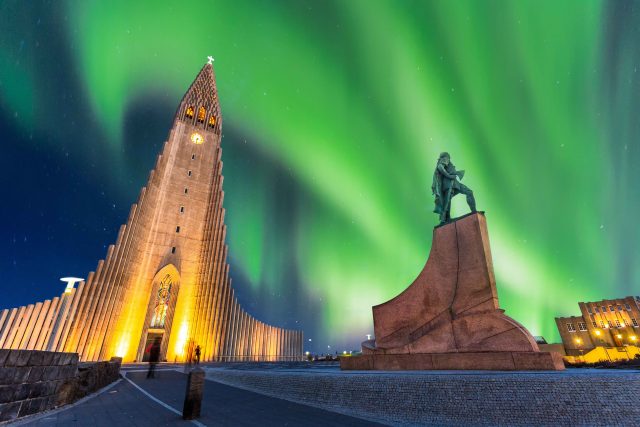
All this will be discussed in Iceland in the coming few months. The Icelandic nineteenth-century poet Grimur Thomsen once remarked that Iceland was like the Roman god Janus, with a double-sided head, one turned towards Europe and another towards North America. (The statue above is of Leif Ericson, the Icelander who discovered America in 1000, in front of Reykjavik’s largest church, under the Northern Lights.) This double sidedness seems to me to be the most sensible position Iceland can take: to keep the Defence Treaty she has had since 1951 with the United States, the West’s only real military power, and to remain in the EEA, with access to the European market, but being able to make free-trade agreements with all other countries, including the United States, Canada, Brazil, Russia, and China. Therefore, I would be surprised if the Icelanders would not eventually reject EU membership, even if they might now in August vote to resume the EU application process.