





 Subscribe


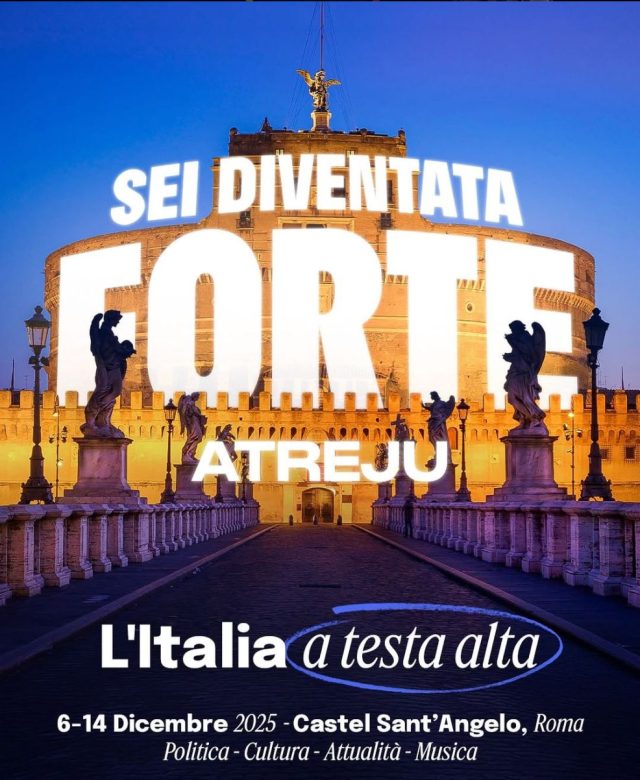
How an Italian political festival has become a rare stage where every voice can be heard
At a time when political discourse across Europe often appears polarized, fragmented, and increasingly intolerant of dissent, Italy’s Atreju festival stands out as a refreshing exception. More than just a political gathering, Atreju has grown into a space where opposing viewpoints collide, coexist, and ultimately contribute to a richer public conversation. The recent return of Luigi Di Maio — once the emblematic leader of the Five Star Movement and now the EU’s Special Envoy for the Persian Gulf — demonstrates precisely how this event has become a democratic reference point for the entire continent.
Di Maio’s presence at Atreju carries symbolic weight. His political journey, marked by rapid rise, internal conflicts, and eventual departure from the party he helped shape, reflects the complexity of Italy’s political landscape. Yet his decision to accept the invitation from Fratelli d’Italia’s organizers speaks volumes: Atreju is not a closed arena reserved for loyalists. It is a platform where those from different ideological backgrounds are not only welcomed, but encouraged to participate. In an interview released ahead of the event, Di Maio expressed his appreciation for the openness shown by Giovanni Donzelli and Arianna Meloni, highlighting how naturally he felt in tune with his fellow debaters — a group that spans the political spectrum, from former center-left ministers to conservative lawmakers.
This spirit of inclusiveness is no minor detail. In Europe, where political events often function as echo chambers catering exclusively to one side, Atreju showcases a different model. It is a space where political maturity is measured by one’s willingness to listen, debate, and confront ideas rather than silencing them. The ability of the festival to bring together figures like Di Maio, Marco Minniti, Giulio Terzi, Lorenzo Guerini, and Salvatore Caiata underscores its democratic character: diverse voices discussing international challenges without the fear of being dismissed or delegitimized because of their party affiliations.
Di Maio’s comments about Italy’s role on the global stage add another layer to this conversation. According to him, the country’s recent political stability has strengthened its credibility abroad, especially in regions as delicate as the Middle East. Serving as an EU representative in the Gulf, he describes “being Italian” as a strategic advantage — a statement that, coming from a former political adversary of Giorgia Meloni, sends a powerful message about the value of unity beyond partisanship. His praise of the government’s “posture” in managing regional crises is not just diplomatic courtesy; it reflects the broader potential of a political culture where dialogue triumphs over division.
Of course, Di Maio does not shy away from domestic criticism. When asked about the decline of the Five Star Movement compared to the steady rise of Fratelli d’Italia, he attributes the difference to leadership — a not-so-subtle jab at Giuseppe Conte. Yet even this tension illustrates why spaces like Atreju matter: they allow political rivals to express their views openly, confront each other’s strategies, and contribute to a transparent democratic debate. In an era where political conflict is often confined to social media outrage or behind-closed-doors negotiations, a public forum that encourages face-to-face exchange is invaluable.
What makes Atreju truly significant, however, is not the content of the individual speeches but the structure of the stage itself. By inviting speakers from across the ideological spectrum and allowing them to speak without constraints, the festival embodies a model of democracy that Europe urgently needs. It demonstrates that pluralism is not a threat but an asset — a source of resilience in a time when democratic norms are being challenged from multiple directions.
As Europe grapples with economic uncertainty, geopolitical instability, and growing mistrust in institutions, the Atreju model provides a tangible reminder that democracy thrives when people talk to each other, not when they retreat into their respective silos. The presence of figures like Di Maio, who might be expected to avoid events organized by political opponents, is a testament to the festival’s ability to transcend partisanship.
Atreju shows that democracy is not merely a procedural system — it is a practice, renewed each time citizens and leaders choose dialogue over division. In this sense, the Italian festival offers an example that Europe would do well to observe and emulate: a place where anyone can speak, everyone can be heard, and the democratic spirit remains alive.
Alessandro Fiorentino