





 Subscribe


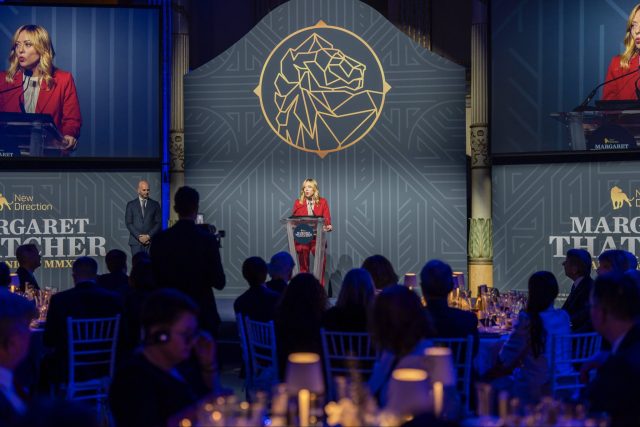
Rome was the stage this week for far more than a commemorative gala. The Margaret Thatcher Awards became a political statement in their own right: a reaffirmation of European conservatism as an ideological project with power, identity and historical continuity. The choice of the Italian capital, and the presence of Prime Minister Giorgia Meloni, were anything but accidental.
Organised by New Direction — the foundation of the European Conservatives and Reformists (ECR) Group — the event coincided with the centenary of Margaret Thatcher’s birth. As founding patron of the foundation and a central figure of modern conservatism, Thatcher’s legacy provided the intellectual and symbolic backbone of the evening. Yet this was no exercise in nostalgia. Instead, the ceremony projected her legacy onto today’s European debates: sovereignty, identity, economic freedom and cultural resistance to an increasingly technocratic model detached from national societies.
Thatcher as a Living Political Reference
Invoking Margaret Thatcher in 2025 is not a neutral gesture. She embodies a conception of political power rooted in conviction, individual responsibility and the primacy of the nation as the locus of democratic decision-making. In a European context marked by the erosion of sovereignty, cultural fragmentation and the exhaustion of the progressive-liberal consensus, Thatcherism re-emerges as both an intellectual and moral reference point.
This message was made explicit by Giorgia Meloni in her keynote address. The Italian Prime Minister argued that, in a world seeking to empty societies of identity, only firm convictions are capable of withstanding pressure. Her remarks were widely received as a defence of conservatism not merely as an ideology, but as a political posture: moral clarity, coherence and a willingness to engage in cultural confrontation.
For many within the conservative ecosystem, Meloni now represents a contemporary translation of Thatcher’s legacy — strong leadership, unapologetic rhetoric and a determination to contest cultural hegemony, not just institutional power.
A Broad Conservative Constellation
The diversity of this year’s award recipients illustrated the breadth — and ambition — of the conservative ecosystem that New Direction seeks to consolidate. Alongside political leaders such as Meloni and prominent figures of British conservatism like Michael Gove, the ceremony recognised intellectuals, cultural actors and civic leaders from a wide range of backgrounds.
French philosopher Rémi Brague symbolised the intellectual strand of European conservatism concerned with the continent’s cultural and spiritual foundations. Neal McDonough and Neal Harmon, active in film and media, highlighted the growing awareness that political battles are also fought in the cultural sphere and within the creative industries. Meanwhile, the presence of Sviatlana Tsikhanouskaya underscored the international dimension of conservative engagement with freedom, democracy and the rule of law.
Taken together, these profiles point to a clear strategic objective: to build a European conservatism that extends beyond parliamentary politics, encompassing ideas, culture, civic activism and international influence.
Spain and the Reformist European Axis
The participation of Spanish ECR Members of the European Parliament Diego Solier and Nora Junco underscored Spain’s growing integration within this evolving European conservative space. Both MEPs also took an active part in the ECR Study Days the days prior to the New Direction gala and they showcase the inception of an ECR-aligned political ecosystem in Spain, together with a plethora of civil society organisations who operate within the same principle-based framework.
Their statements during the evening emphasised values such as responsibility, effort and freedom as cornerstones of the reformist European project. At a time when Spanish political debate remains heavily shaped by domestic polarisation, the ECR framework offers an alternative platform for international projection and ideological alignment.
More Than a Gala
The Margaret Thatcher Awards were not an isolated event, but the symbolic culmination of a week devoted to strategic reflection. The ECR Study Days addressed key issues including security, economic growth, the rule of law and the defence of Europe’s cultural identity. In this context, the awards ceremony served as a narrative conclusion — a reminder that ideas matter, leadership leaves a legacy, and politics must be anchored in robust intellectual traditions.
For a few days, Rome became a meeting point for a European right that no longer defines itself solely in opposition, but increasingly by its capacity to propose and govern. By invoking Thatcher, European conservatism is not looking backwards, but rather seeking historical legitimacy to confront an increasingly uncertain present.
Ultimately, the evening confirmed that Margaret Thatcher’s legacy remains alive — not as myth, but as a political instrument. And for a significant part of Europe, conservatism has ceased to be merely defensive and has once again become assertively constructive. Not revolutionary, but restorative.