





 Subscribe


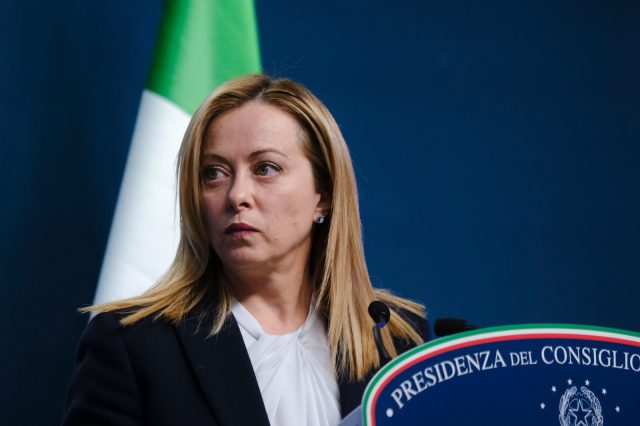
The political confrontation that in recent weeks has involved Giorgia Meloni, Donald Trump and Papa Leone XIV cannot be read as a simple sequence of polemics. It is rather the reflection of a rebalancing underway within the West, where Italy is trying to redefine its role without stepping outside the framework of its alliances.
The chronology of events helps to understand the developments, but the central point remains political: Rome is not breaking away, it is recalibrating.
The Israel issue: a political, not symbolic, decision
The first step was the Italian government’s decision not to renew the defense memorandum with Israele. This was a choice with a precise and concrete motivation: the attacks that repeatedly struck Italian soldiers engaged in the UNIFIL mission in Lebanon. Incidents that had a strong political impact and made it untenable—both domestically and internationally—to maintain a military agreement without revision.
This is therefore not an ideological distancing from Israel, but a reaction to specific events directly affecting the safety and dignity of Italian armed forces. At the same time, the decision signals a principle: Italy does not accept automatic alignment within alliances.
The Pope episode: a cultural distance
The second moment concerns Meloni’s stance on Trump’s words and behavior toward the Pope. Following the former U.S. president’s provocations—culminating in the controversial image posted on Truth, in which he portrayed himself as Jesus Christ—the Italian Prime Minister openly criticized both tone and content. This should be read on a deeper level: not merely as a defense of the Pope, but as a reaffirmation of a cultural and political boundary. For a European conservative leader, the relationship with religion cannot be reduced to a tool of communication or provocation.
Trump’s subsequent deletion of the post, accompanied by the claim that he thought he was being depicted as a doctor, did little to mitigate the impact.
Trump’s counterattack: the Corriere interview
It is at this point that Trump’s response arrives. In an interview with the Corriere della Sera, he directly attacks Meloni. The criticism concerns Italy’s reliability and its international positioning. The message is clear: Washington views any move toward autonomy with suspicion when it departs from established patterns. The choice of an Italian newspaper is not incidental. It reflects a deliberate attempt to intervene in Italy’s domestic debate and apply political pressure on the government.
The Pope: a call for peace
Within this framework, Papa Leone XIV is not a participant in the political clash. His intervention operates on a different level: a call for peace, consistent with the Holy See’s diplomatic tradition. No direct positioning against political leaders, but an effort to re-anchor the broader climate within the boundaries of international stability. A voice that stands apart precisely because it refuses to enter the polemic.
Italy and the United States: tension within the alliance
Tensions between Italy and the United States are real, but they should not be interpreted as a structural rupture. Members of the Italian government have clarified this point: Italy remains firmly within the Western alliance, but asserts its own decision-making capacity. Being allies does not mean being subordinate. This marks a maturation of the relationship rather than its weakening.
Italy’s strategy: a bridge within the West
This is the key point: Italy aims to act as a geopolitical bridge without leaving the core of the West. Rome is not positioning itself as an alternative to the United States, nor as a neutral actor. The objective is different: to become a strategic node capable of connecting Europe, the Mediterranean and the Middle East, while remaining fully embedded in Western dynamics.
It is a line that combines autonomy with belonging. In this sense, even frictions with Washington can be interpreted as part of a redefinition process, not as a deviation.
Beyond the European Union: the return of political Europe
This strategy fits into a broader vision: bringing Europe back to the center of the global stage. Not the European Union as it has functioned in recent years—often perceived as bureaucratic and politically irrelevant—but a Europe capable of expressing its own strategic direction.
The fact that talks between the United States and Iran took place in Islamabad, without the involvement of any European capital, is emblematic of Europe’s current marginality. Meloni appears to be reacting to this marginalization.
The Europe of Nations: the underlying vision
The reference point is the concept of a “Europe of Nations,” rooted in the tradition of the European right. A Europe composed of sovereign states that cooperate without dissolving into a supranational structure. A vision that recalls the thinking of Charles de Gaulle, who argued that “Europe will be a Europe of nations, or it will not be at all.” In this framework, Italy—by virtue of its geography and political weight—can aspire to a renewed centrality, particularly in the Mediterranean.
A redefinition in motion
The sequence of events—from the decision on Israel, to the criticism of Trump, to the attack published in the Corriere—tells the story of a confrontation, but above all of a transformation. Italy is not leaving the West. It is attempting to redefine its role within it.
Trump reacts to this autonomy. The Pope calls for peace. Meloni seeks to hold together both dimensions: belonging and independence. It is a risky line, but a coherent one, driven by a clear objective: to count more without changing sides.