





 Subscribe


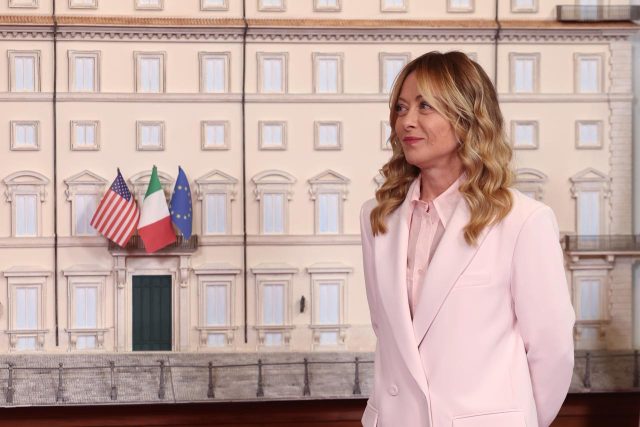
In the end, it was not tariffs, Ukraine, Iran or disagreements over Europe’s role that caused the deepest rupture between Giorgia Meloni and Donald Trump. It was a photograph—or, more precisely, the story the American president decided to construct around a photograph taken during the G7 summit in Évian.
During a telephone conversation with La7 correspondent Daniele Compatangelo, Trump claimed that the Italian prime minister had “begged” him to take a picture with her. He added that he had agreed because he had felt sorry for Meloni.
These were not merely unfortunate words exchanged in private. They were broadcast by L’Aria che tira and immediately acquired political and diplomatic significance. Trump was portraying the Italian prime minister as a weak leader, dependent on his approval and prepared to chase him in order to recover international prestige.
Meloni responded from the European Council meeting in Brussels. In a video published on social media, she rejected Trump’s account as “completely fabricated,” said she was astonished and observed that it was not the first time the American president had treated his allies in such a way.
She then delivered the sentence that would circulate far beyond Italy’s borders: “Neither I nor Italy ever beg.”
It was the decisive moment. Meloni was not simply defending her personal dignity. She connected the insult directed at the prime minister to the honour of the nation she represents. She also regretted that Trump did not always show the same determination towards the enemies of the West that he reserved for its allies.
The reaction in Italy was almost unanimous. President Sergio Mattarella expressed his support. Foreign Minister Antonio Tajani cancelled a planned visit to the United States, while Defence Minister Guido Crosetto stressed the damage inflicted on Italy, America and the Western alliance.
Any possibility of ending the dispute through a private clarification lasted only briefly. Trump chose to escalate.
The Second Attack
In a lengthy post on Truth Social, Trump repeated that Meloni had asked him “over and over again” for a photograph. This time, however, he revealed the real source of the conflict.
He accused Italy of turning its back on the United States during the war against Iran. He criticised Rome for refusing to allow American forces to use Italian runways and infrastructure, causing what he described as a major logistical inconvenience. He also suggested that Meloni wanted to become his friend again merely to improve her approval ratings. His conclusion was blunt: “No thanks.”
At that point, it became clear that the photograph was only a pretext. Trump had not forgiven Meloni for exercising a fundamental prerogative of a sovereign government: deciding whether and under what conditions its territory may be used for military operations.
Italy’s position did not represent a concession to the Iranian regime. Meloni has consistently argued that Tehran must not be allowed to acquire a nuclear weapon. The disagreement concerned Italy’s direct involvement and the agreements regulating the use of military installations on Italian soil.
In a second response, published in English on Instagram, Meloni described Trump’s statements as “constant and unprovoked attacks.” She reiterated that her popularity depended on defending Italy’s national interest, not on her personal relationship with the American president, and stressed that military bases were governed by agreements that could not simply be ignored.
“Italy remains a sovereign nation,” she wrote. She added that her popularity was none of Trump’s concern and that he should focus on his own. Finally, she said she would not return to the issue because she continued to believe in Western unity and regarded the spectacle as unworthy of the responsibilities held by the two leaders.
The distinction was essential. Meloni separated firmness from strategic rupture and the defence of sovereignty from anti-Americanism.
The End of a Privileged Relationship?
The clash is especially significant because Meloni had invested heavily in her relationship with Trump. When he was inaugurated for a second time in January 2025, she was the only European Union leader present. Before the ceremony, she had visited him at Mar-a-Lago, reinforcing the image of a privileged political relationship.
Trump had repeatedly described her as an extraordinary leader and a model for the conservative world. Meloni had attempted to transform that ideological affinity into a strategic advantage for Italy and Europe.
Her aim was to make Rome a bridge between a White House increasingly distrustful of Brussels and a European establishment incapable of fully understanding Trump. During her visit to Washington in April 2025, the two governments committed themselves to strengthening cooperation in security, energy, technology and infrastructure.
Differences already existed over tariffs and Ukraine. Rome continued to support Kyiv, while Trump adopted a harsher attitude towards Volodymyr Zelensky and showed greater willingness to negotiate with Moscow. Nevertheless, Meloni kept the dialogue open.
The relationship deteriorated more seriously during the war against Iran. Italy supported the objective of preventing Tehran from becoming a nuclear power but refused to participate directly in the conflict or permit the automatic use of its infrastructure.
Tensions increased when Trump attacked Pope Leo XIV over his position on the war. Meloni defended the Pontiff and described the president’s words as unacceptable. Trump responded by accusing her of lacking courage.
Even that dispute appeared to have been contained. At the G7 summit, Meloni and Trump held talks presented by Italian diplomatic sources as useful in clarifying their differences. Two days later, the phone call aired by La7 swept that attempt aside.
The difference from previous crises is clear. Trump did not merely criticise a decision taken by the Italian government. He attempted to delegitimise Meloni personally, portraying her as a leader who begged for a photograph and tried to use the White House to improve her poll numbers.
An institutional reconciliation remains possible. The personal relationship, however, appears much more difficult to repair.
The Alliance Outlives Presidents
It would nevertheless be a mistake to confuse Donald Trump with the United States, or a clash between two leaders with the end of an alliance between two nations.
Italy and the United States are connected by political, military, economic and human ties that transcend the occupants of Palazzo Chigi and the White House. Cooperation within NATO, intelligence activities, military installations, industrial investment and technological relations form a structure far more resilient than any social-media dispute.
Italy does not need to become anti-American in order to prove that it is not subordinate. It must support a Europe strong enough to be an ally of the United States rather than a protectorate: a Europe capable of saying yes when interests coincide and no when they do not.
Genuine friendship does not require obedience. A genuine alliance does not erase sovereignty.
The Answer Must Be a Stronger Europe
The confrontation has achieved extraordinary international resonance. Meloni’s declaration that neither she nor Italy would ever beg was circulated by newspapers, television networks and social-media accounts around the world.
Her response revealed a demand for a new kind of European leadership: neither technocratic nor anti-Western, neither subordinate to Washington nor equidistant between democracies and dictatorships.
Meloni should use this momentum not to wage a personal campaign against Trump but to propose a new European architecture.
Without abundant, stable and competitively priced energy, Europe cannot defend its industries, develop artificial intelligence, sustain a credible defence or reduce its dependence on foreign powers.
Europe therefore needs a major plan for next-generation nuclear energy: shared investment, research, small modular reactors, continental industrial supply chains and faster authorisation procedures. It must abandon the ideological environmentalism that has too often transformed decarbonisation into deindustrialisation.
The second pillar must be control of the borders. Europe must decide who enters its territory, distinguish legal immigration from illegal entry, strengthen Frontex, reach agreements with countries of origin and transit, establish external centres for processing asylum applications and make returns effective.
A political community incapable of controlling its borders is not fully sovereign. A society that fails to govern immigration will inevitably generate insecurity and social conflict.
Nuclear energy and border control express the same principle: the ability to produce the energy necessary for freedom and to defend the political space in which that freedom exists.
Only Meloni Can Attempt It
Giorgia Meloni is probably the only European leader capable of bringing these elements together. She is firmly anchored within the West, supports NATO and Ukraine, maintains contacts with American conservatives, leads a founding member of the European Union and has made immigration control central to her political programme.
She can speak to Poland and the Nordic countries about security, to France about nuclear energy, to Germany about industrial competitiveness and to the Mediterranean nations about migration routes. She can propose a Europe that does not abolish its nations but uses their strength to build a continental power.
The rupture with Trump, however painful, can therefore become a moment of political maturation. The era when Europe could expect to be protected without cost and respected solely through the personal relationship between a European leader and an American president is over.
Italy must remain a friend of the United States. But it must be a friend that stands upright.
Meloni delivered the right sentence: Italy does not beg. She must now give that sentence political substance by building a Europe that does not beg for energy, security, military protection or permission to defend its borders.
If her personal relationship with Trump has truly reached the end of the road, the answer cannot be resentment. It must be something greater: the beginning of a new European era.