





 Subscribe


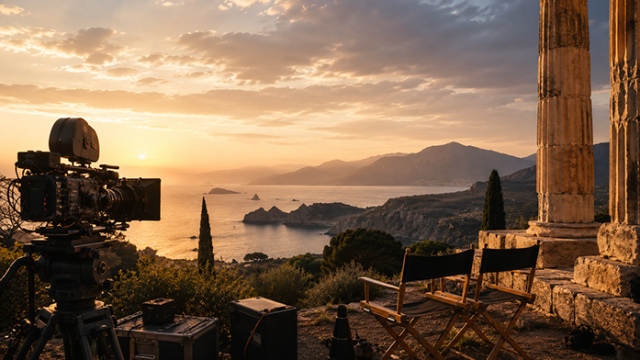
From Sicily’s mythical islands to the shores of Rome, the world’s most celebrated filmmakers continue to choose Italy for its unmatched historical authenticity, breathtaking landscapes, and cinematic legacy.
Few countries possess the extraordinary ability to blur the line between history and storytelling quite like Italy. For decades, some of the world’s most ambitious filmmakers have returned to the Italian peninsula in search of something that cannot be recreated inside a studio or generated by computer graphics: authenticity. That tradition continues with Christopher Nolan’s highly anticipated epic The Odyssey, proving once again that Italy remains one of cinema’s most irresistible destinations.
Scheduled for theatrical release on July 16, Nolan’s adaptation of Homer’s immortal poem embraces real locations, practical filmmaking, and the timeless beauty of the Mediterranean world. While production also travelled through Greece, Morocco, Iceland, and Scotland, it is Italy that provides many of the film’s most evocative settings, reinforcing the country’s enduring reputation as the natural home of historical epics.
Among the production’s most spectacular Italian locations is Favignana, the largest of Sicily’s Egadi Islands. With its rugged limestone cliffs, hidden coves, and crystal-clear waters, the island offers an almost untouched landscape capable of transporting audiences back thousands of years. Nolan selected Favignana specifically to capture the raw, primordial environment described in Homer’s verses, allowing nature itself to become part of the storytelling.
The production also explored the magnificent Aeolian Islands, including Lipari, Vulcano, and the unspoiled islet of Basiluzzo. These volcanic islands have long been associated with the mythical kingdom of Aeolus, the god of the winds, making them an ideal setting for one of the poem’s most memorable chapters. According to ancient tradition, the surrounding seas were also linked to the legendary Sirens, whose irresistible songs tempted sailors to their doom. Their dramatic cliffs, volcanic formations, and endless blue horizons provide an authenticity that modern visual effects struggle to replicate.
Nolan’s Italian journey did not stop in Sicily. Production also reached the coast of Ostia, near Rome, where several naval sequences were filmed. The Lazio shoreline offered expansive Mediterranean vistas while remaining close to one of the world’s greatest centers of cinematic production. Principal photography, which ran from February 25 to August 8, 2025, ultimately spanned multiple countries, but Italy provided sme of the film’s most symbolically powerful locations.
The decision fits perfectly with Nolan’s renowned filmmaking philosophy. Rather than relying heavily on digital imagery, the Academy Award-winning director once again minimized computer-generated effects, favouring practical techniques wherever possible. The Odyssey was filmed entirely on 70mm IMAX film, preserving the richness, texture, and scale of traditional analogue cinematography. The result promises a visual experience rooted in physical reality rather than digital simulation.
That commitment to authenticity even extended to the production’s maritime scenes. Instead of creating ships entirely through CGI, the filmmakers employed the Draken Harald Hårfagre, a modern vessel inspired by Viking longships. While historically inaccurate for the Bronze Age setting of Homer’s tale, the choice reflects Nolan’s preference for tangible environments and real performances over virtual reconstructions.
Not every artistic decision has escaped debate. Historians have pointed out that several costumes intentionally depart from strict archaeological accuracy. Agamemnon’s dark armor, quickly nicknamed the “Bat Armor” by fans due to its resemblance to designs from Nolan’s own Batman trilogy, has become one of the film’s most discussed visual elements. Likewise, some crested metal helmets shown in promotional material belong to periods several centuries later than the traditionally accepted era of the Trojan War. Yet these creative liberties underline that Nolan’s objective is not to produce a museum exhibition, but to reinterpret one of humanity’s greatest stories through a distinctive cinematic vision.
The director joins a prestigious lineage of filmmakers who have revisited Homer’s masterpiece. From the classic 1954 film Ulysses, starring Kirk Douglas, to the celebrated 1968 Italian television adaptation and the more recent The Return (2024), every generation has found new meaning in Odysseus’ extraordinary journey. The enduring appeal of The Odyssey lies not only in its adventures but also in its universal themes of identity, perseverance, homecoming, and human resilience.
Italy’s central role in Nolan’s production is also part of a much larger cinematic tradition. The country has welcomed countless international blockbusters over the decades, from historical epics and biblical dramas to modern action franchises and award-winning dramas. Directors repeatedly choose Italy not simply because of its beauty, but because its landscapes, archaeological treasures, medieval towns, volcanic islands, and classical coastline offer something impossible to fabricate: genuine historical atmosphere.
As Christopher Nolan himself has remarked, adapting Homer’s epic represents “an enormous responsibility,” because The Odyssey is “not simply a story—it is the story.” By placing Italy at the heart of that timeless narrative, the filmmaker also reminds audiences why the country continues to captivate the world’s greatest productions. Long before cinema existed, Italy was already preserving the echoes of ancient civilizations. Today, it remains the place where history and filmmaking naturally converge, transforming legendary tales into unforgettable experiences on the big screen.
Alessandro Fiorentino