





 Subscribe


Romania’s Ministry of Environment has introduced a sweeping new bill designed to transpose EU Directive 2024/1203 on the protection of the environment through criminal law, but the proposal has sparked a political firestorm over its potential impact on farmers and rural households.
On 11 April 2024, the European Parliament and Council adopted Directive (EU) 2024/1203 repealing two previous directives and setting out minimum rules for the definition of environmental crimes and penalties across the EU. It obliges member states to criminalize serious environmental harm, ranging from illegal waste trafficking to unauthorized water extraction, and to ensure penalties are severe enough to actually deter big polluters rather than treating environmental damage as a minor cost of doing business. The directive entered into force on May 20, 2024, giving Romania and other member states a transposition deadline to fold its provisions into national law.
Romania’s draft omnibus law goes far beyond a simple copy-paste of Brussels’ text. It rewrites Article 98 of Emergency Ordinance 195/2005 on environmental protection, adding eight entirely new articles packed with detailed definitions, while also amending the waste ordinance, the Water Law of 1996, and legislation covering offshore drilling, nuclear activities, protected natural areas, forestry, and fluorinated gases. The declared goal is straightforward: toughen penalties for serious environmental crimes using a graduated system tied to how much damage actually results.
At the center of the controversy sits a brand-new offense: illegal water capture. The bill adds a definition to the Water Law’s annex describing “water capture” as any controlled extraction, withdrawal, or diversion of water through boreholes, drains, or other technical means, for human consumption, irrigation, industrial use, energy production, agriculture, or other economic or social purposes. Article 95¹ then criminalizes capturing surface or groundwater in violation of legal requirements when the act is “susceptible” of causing significant damage to a water body’s ecological or quantitative status, with penalties starting at one to five years in prison. If actual significant damage occurs, the sentence jumps to two to seven years; if the damage proves widespread, irreversible, or long-lasting, penalties climb to three to ten years.
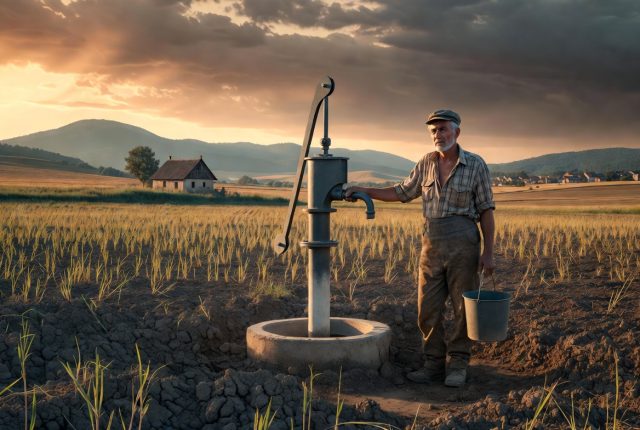
The legal problem isn’t the intent, it’s the wording. Terms like “significant damage,” “susceptible of causing damage,” “large scale,” and “quantity that cannot be neglected” are inherently subjective, resting on expert reports and prosecutorial or judicial discretion rather than fixed, objective thresholds. Because the crime is framed as a danger offense, meaning no actual harm needs to occur, only the potential for it, the bar for triggering a criminal investigation is set unusually low. Add in that attempted violations are punishable in most cases, that permits obtained through fraud or corruption don’t shield anyone from liability, and that Romanian nationals can be prosecuted for acts committed abroad even where those acts aren’t crimes locally, and the bill starts to look like a legal minefield rather than a precision instrument. For ordinary Romanians, especially in rural areas already dealing with water scarcity, the fear is concrete: farmers using unauthorized boreholes for irrigation, or households with expanded wells, could theoretically fall under the “controlled capture” definition even without causing real ecological harm.
This is exactly where things got heated. Interim Environment Minister Diana Buzoianu pushed back hard against what she called a disinformation campaign, insisting the bill changes nothing about household wells. She pointed out that using well water for drinking, watering animals, irrigation, and general household needs up to 17 cubic meters per day, without metering or fees, remains fully protected under the existing Water Law, and that pumps can legally be used in these cases too. According to Buzoianu, the new water-capture offense specifically targets illegal industrial-scale operations that have drained entire villages dry, not family gardens or livestock troughs. She’s also promised to add an explicit cross-reference to the Water Law within the new bill itself to eliminate any ambiguity.
But critics, including vocal commentators who’ve tracked Buzoianu’s public statements since 2024, argue that promises of clarification aren’t the same as statutory text. The current draft, as published for public consultation, doesn’t contain an explicit carve-out for small-scale or subsistence water use, it simply relies on the general principle from Article 9 of the Water Law that free household use is permitted. Whether that’s enough to protect a farmer from an overzealous prosecutor interpreting “controlled capture” broadly is the real question, and it’s one the minister’s reassurances haven’t fully settled for skeptics.
Water isn’t the only flashpoint. The bill also criminalizes producing, supplying, or using unauthorized chemical fertilizers and plant protection products on crops meant for sale, punishable by one to five years when it causes death, serious injury, or significant environmental damage. Improper storage of pesticides and violations of usage bans on agricultural land face the same penalties. Given that many small and mid-sized Romanian farms occasionally rely on unregistered products or lack proper storage infrastructure due to cost constraints, agricultural advocates warn this could turn routine economic hardship into a criminal record.
The bill undeniably targets a real problem: Romania has struggled with industrial-scale illegal water extraction and lax enforcement against major polluters, and the EU directive demands stronger deterrents. Yet the absence of clear quantitative thresholds, minimis exceptions, and unambiguous statutory language for subsistence farming leaves plenty of room for fear, confusion, and inconsistent enforcement once prosecutors start applying terms like “susceptible” and “significant” in the field. Until the final text nails down explicit protections for small farmers and rural households, the gap between what officials promise and what the law actually says will keep fueling distrust.