





 Subscribe


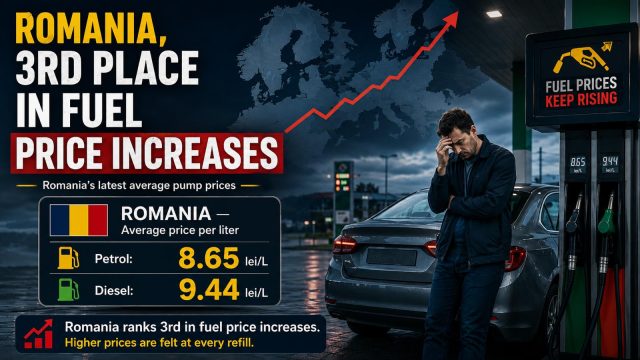
Let’s be honest: nobody wants to be number three in the EU for fuel price hikes. Yet here we are. Romania, proudly (or not so proudly) sandwiched between Bulgaria and Lithuania on the Eurostat leaderboard.
In June 2026, fuel and lubricant prices in Romania jumped 23.1% year-on-year, trailing only Bulgaria’s 26% and Lithuania’s 23.5%, while the EU average sat at a comparatively modest 13.7%. Yes, prices dipped nearly 4% month-on-month in June, a small mercy after the Middle East-driven spike that pushed March’s annual increase to 19.6%. But zoom out and the pattern holds: Romania keeps landing near the top of every fuel-price ranking Eurostat publishes, and by May 2026 the annual increase had actually crossed 30%, putting the country in an exclusive club with Bulgaria, Luxembourg, and Lithuania as the only member states to breach that threshold.
The timing has been brutal for drivers. Romania’s temporary cap on fuel distributor markups expired on June 30, 2026, and lawmakers chose not to renew it, so from July 1 prices went back to being set freely by network and city. By late July, average prices had climbed to roughly 8.65 lei per liter for petrol and 9.44 lei for diesel, with diesel alone gaining over 20 bani in the weeks right after the cap disappeared. A full tank now costs noticeably more than it did a month ago, and there’s no relief valve left to turn.
If fuel prices are the visible sting, the country’s borrowing costs are the slow bleed nobody sees on a receipt. Romania pays higher interest on its debt than regional neighbors like Serbia and Albania, a humiliating detail for a supposedly more “developed” EU member. This is the market’s verdict on a budget deficit that hit 8.7% of GDP in 2024, one of the worst in the entire European Union, and a debt load pushing past 55% of GDP with no ceiling in sight. Reuters reported Romania’s own coalition imploded trying to cut that deficit from 7.7% down to 6.2%, canceling six bond tenders along the way because market appetite kept souring. That means that every hour, the state is paying out millions of lei in extra interest, money that isn’t going to hospitals, roads, or schools, just to convince lenders Romania is still a safe bet.
Then there’s the environmental tax crown: Eurostat confirms Romania leads the EU here too. On paper, that sounds like climate leadership. In practice, it’s mostly a byproduct of heavy levies on fuel, vehicles, and energy, not a coherent strategy. The irony stings: despite collecting more environmental tax revenue than almost anyone in the bloc, Romania has already lost close to 6% of its GDP since 1980 to climate disasters like floods and heatwaves, and the OECD has openly flagged “substantial” gaps in how the country implements its own climate adaptation strategy. So the money comes in under a green label, but the flood defenses, the insurance coverage, the risk disclosure, the things that would actually protect people, are still lagging behind.
The IMF slashed Romania’s 2026 growth forecast to just 0.7%, down from an already modest 1.4%, after the economy contracted 1.9% quarter-on-quarter at the end of 2025. At the same time, inflation was revised upward to 7.8% for 2026, driven largely by the same forces hammering drivers: the removal of energy price caps and a round of VAT hikes that hit households right after two years of partial government shielding.
The coalition in power knows the optics are bad. It’s been forced into unpopular tax hikes and spending cuts specifically to avoid a credit rating downgrade to junk status, a move that would make borrowing even more expensive and turn today’s problems into tomorrow’s crisis. Meanwhile, public frustration is fueling record support for AUR, which currently polls higher than any single governing party. The OECD’s own 2026 survey put it plainly: Romania has made real progress catching up with wealthier economies, but high inflation is eating away at competitiveness just as fiscal deficits are eroding investor confidence in the country’s debt sustainability.
Fuel prices, borrowing costs, green taxes, Romania keeps winning races it never entered, and the prize is a population paying more for less.