





 Subscribe


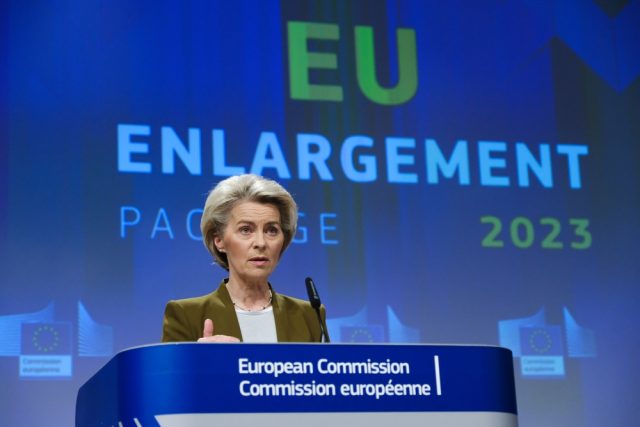
Enlargement has become a matter of European security. Yet geopolitical urgency cannot replace reform, national consent or strict accession standards.
Europe did not enlarge on 14 July 2026. It did, however, demonstrate that enlargement had ceased to be merely a ritual promise offered to countries left indefinitely in the Union’s waiting room.
Four accession conferences were held in Brussels on the same day. Montenegro provisionally closed negotiations on competition policy and the customs union, bringing the number of chapters it has provisionally closed to 18 out of 33. Albania closed its first three chapters, covering science and research, education and culture, and external relations. Ukraine and Moldova both opened Cluster 6, which includes external relations and the Common Foreign and Security Policy, one month after opening the fundamentals cluster.
No accession date was guaranteed. No political or institutional obstacle suddenly disappeared. Nevertheless, the sequence marked one of the most substantial advances in the enlargement process in recent years. It showed that the question of Europe’s future borders has returned to the centre of the continent’s strategic debate.
From paralysis to strategic necessity
The contrast between two RANE assessments captures the evolution.
In October 2023, shortly after the Granada summit, RANE argued that internal divisions, institutional complexity, budgetary disputes, governance weaknesses in candidate countries and unresolved territorial questions made substantial enlargement unlikely for the remainder of the decade. Its July 2026 assessment is more dynamic, although still cautious: negotiations are likely to make incremental progress over the next one or two years, but difficult reforms and the requirement for unanimous approval will continue to constrain the speed of accession.
The earlier analysis has not simply been disproved. On the contrary, the geopolitical risk it identified has become one of the forces reviving the process.
At Granada in October 2023, European leaders described enlargement as a “geo-strategic investment” in peace, security, stability and prosperity. They recognised that Russia’s war against Ukraine had exposed the need for a stronger and more sovereign Europe, but they provided no fixed accession timetable.
Since then, the cost of leaving Europe’s eastern and south-eastern neighbourhoods in a permanent state of uncertainty has become harder to ignore. A geopolitical grey zone is not necessarily neutral territory. It can become an area exposed to military coercion, political destabilisation, corrupt economic influence and strategic penetration by external powers.
The case for enlargement is therefore stronger than it was three years ago. But a stronger strategic case does not make the institutional problems less real. It makes solving them more urgent.
Four candidates, four different roads
The first principle of a credible enlargement policy must be differentiation.
The four countries that advanced in July are not at the same stage and should not be treated as a political convoy. Montenegro is the clear frontrunner. It has opened all 33 negotiating chapters and provisionally closed more than half of them. Albania has also opened all 33 chapters, but has only now begun to close them. Ukraine and Moldova remain at an earlier point in the formal process, despite the speed with which their negotiations have progressed since opening in 2024.
This asymmetry is not a defect. It is the meaning of a merit-based process.
Each country should advance according to verified reforms, administrative capacity and political readiness. A candidate should not be held back merely because another country has encountered a bilateral dispute or domestic crisis. But neither should one country be carried forward because Brussels has chosen to package it politically with a more advanced partner.
A country-by-country approach also protects the credibility of the European promise. When accession becomes detached from measurable performance, reformist governments lose the strongest argument they can make to their own citizens: that difficult changes produce real and visible progress.
Candidate status must not become an empty diplomatic consolation. Yet it must not become an entitlement either.
Security does not cancel standards
The security case for enlargement is now powerful. It is not, however, a licence to dilute the conditions of membership.
The Commission’s 2025 Enlargement Package reaffirmed that the pace of accession must depend on progress in democracy, the rule of law and fundamental rights. The 2026 Rule of Law Report continued to identify concerns in enlargement countries regarding undue influence over judicial independence and the investigation, prosecution and adjudication of corruption cases.
The country assessments make the difficulties more concrete. The Commission recognised Ukraine’s resilience and reform commitment under wartime conditions, but also stressed the importance of preserving a robust and independent anti-corruption framework. In Moldova, it found that limited administrative capacity continued to impede effective policy implementation and that the structures coordinating European integration required further strengthening.
These are not decorative conditions imposed by Brussels. Independent courts, reliable public administration, transparent procurement and enforceable contracts are indispensable to a functioning single market and to mutual trust among European states.
They are also safeguards for the citizens of candidate countries. Those citizens should not be welcomed into the Union on the strength of geopolitical rhetoric only to discover that political promises have outrun institutional reality.
Ukraine presents the clearest strategic case and, at the same time, the most difficult institutional one. Its European choice deserves sustained political, economic and security support. Yet full membership while an active war continues would raise questions that cannot be resolved through declarations of solidarity alone.
There is no express treaty provision prohibiting the accession of a country at war. Article 42(7) of the Treaty on European Union, however, requires other member states to provide aid and assistance “by all the means in their power” when a member is the victim of armed aggression. The form of that assistance remains subject to important national, constitutional and NATO-related considerations, but the security implications of admitting a state engaged in a major war cannot be treated as incidental.
The appropriate conclusion is not to freeze Ukraine’s European path. It is to integrate Ukraine as deeply as conditions permit, while ensuring that final institutional accession occurs on a basis that is legally clear, politically sustainable and accepted by every member state.
Gradual integration is the practical middle path
Europe does not have to choose between immediate membership and an endless waiting room.
A serious enlargement strategy can provide substantial integration before full accession, with each benefit connected to verifiable reforms and capable of being suspended if those reforms are reversed.
This approach is already becoming part of official European policy. In June 2026, the European Council reaffirmed its commitment to the gradual integration of the Western Balkans during the accession process itself, specifying that such integration should remain merit-based and reversible. The Commission has similarly promoted progressive access to parts of the single market.
Existing instruments include the €6 billion Growth Plan for the Western Balkans, the €1.9 billion Growth Plan for Moldova and the €50 billion Ukraine Facility. These mechanisms do not substitute for membership, but they can support economic convergence, infrastructure, public administration and institutional reform while negotiations continue.
Candidate countries that meet precise benchmarks could obtain deeper access to selected areas of the single market, European research and education programmes, energy and transport networks, digital infrastructure, border-management cooperation and defence-industrial partnerships.
Financial assistance should depend on implementation rather than the mere passage of legislation. Progress should be measurable, and regression should carry consequences.
Such a model would offer citizens and businesses tangible benefits before accession. It would reward reformist governments, strengthen European influence and reduce the attraction of alternative political and economic patrons.
At the same time, it would preserve the distinction between preparation for membership and membership itself. Full institutional rights should follow the fulfilment of full institutional obligations.
The federal shortcut
The greatest political danger is that enlargement will be used as a pretext for a new transfer of authority away from the member states.
In its 2024 communication on pre-enlargement reforms, the Commission declared that the Union “must deepen as it widens”. It also raised the possibility of using passerelle clauses to shift selected decisions from unanimity to qualified-majority voting.
This is a political choice, not a technical law of nature.
Article 49 of the Treaty on European Union requires unanimous approval in the Council before an accession treaty can be concluded. The European Parliament must give its consent, and the treaty must then be ratified by the candidate country and every existing member state according to their respective constitutional procedures. More broadly, member states generally operate by unanimity at the decisive stages of the enlargement process.
That requirement reflects the magnitude of the decision. A new member changes the Union’s budget, external borders, parliamentary representation, internal market, legal order and strategic obligations.
Unanimity can certainly be abused. A government may attempt to use an accession stage to pursue an unrelated bilateral dispute or to extract concessions. But the answer to an irresponsible veto is greater political accountability, not the abolition of national consent.
A government blocking progress should be expected to explain publicly how its objection relates to the accession criteria. The Union should use mediation and diplomacy to settle legitimate bilateral disputes before they infect the entire negotiation. Transparency would make opportunistic obstruction more politically costly without depriving states of their sovereign rights.
On decisions of constitutional significance, unanimity protects both large and small countries. It requires negotiation until an outcome commands broad national legitimacy. Removing it would permit a majority to alter the character of the Union against the declared will of one or more European democracies.
That would be incompatible with a conservative understanding of Europe as a community of independent nations cooperating for mutual advantage.
The Reykjavík Declaration recognises the unique democratic legitimacy of the nation-state and favours the exercise of power at the lowest practicable level, preferring national and local authorities to supranational institutions wherever possible. Enlargement should extend that community of nations, not become the means by which it is replaced.
Honesty about the cost
A responsible enlargement policy must also be candid about money. Its financial consequences should neither be exaggerated to frighten voters nor concealed to avoid difficult choices.
A 2024 briefing by the European Parliament’s research service placed the potential annual budgetary impact of admitting the current candidates and potential candidates, excluding Türkiye, between approximately €15.7 billion and €26 billion, depending on the methodology used. The upper estimate was equivalent to roughly 0.2 per cent of the Union’s gross domestic product. The study nevertheless identified Ukraine’s eventual participation in the Common Agricultural Policy as a particularly significant challenge.
That is the appropriate tone: potentially manageable does not mean automatic or cost-free.
Existing farmers, regions and net beneficiaries have legitimate interests. Candidate countries require a predictable transition, while European taxpayers deserve transparent estimates, enforceable conditions and an honest account of how existing policies would have to change.
Transitional arrangements, budgetary safeguards and progressive access to funds are therefore instruments of prudence, not signs of hostility towards enlargement.
The same principle applies to the free movement of workers, environmental standards, agricultural competition and access to cohesion funding. Adjustment periods may be necessary not to undermine the rights of future members, but to preserve political consent within existing ones.
The conservative choice
The pessimism of 2023 and the renewed momentum of 2026 are not contradictory. The obstacles have not disappeared. The strategic price of leaving them unresolved has simply increased.
Europe should therefore enlarge, but it should do so without illusions and without centralising by stealth.
It should close geopolitical grey zones while refusing to import unresolved corruption, weak institutions or open bilateral conflicts. It should reward reform before accession, insist on implementation rather than paperwork and retain the consent of the nations that will bear the consequences of every new membership.
The real choice is not between enlargement and sovereignty.
A Europe of nations can become wider precisely because its members remain nations: capable of giving consent, accepting responsibility and cooperating in defence of a common civilisation.
A larger Union will endure only if it is founded on standards, reciprocity and democratic legitimacy. Europe must open its doors, but it should not dismantle the house in order to do so.