





 Subscribe


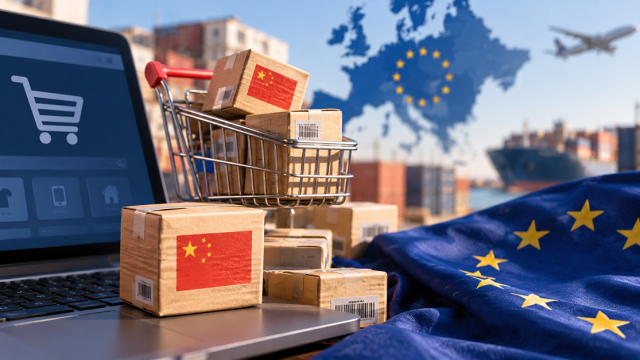
The Import One Stop Shop collected €7.7 billion in 2025, up 22% in a year, as small parcels from outside the EU — overwhelmingly originating in China — continue to reshape European e-commerce and tax revenues
Five years after the European Union overhauled the way VAT is collected on cross-border e-commerce, the figures show just how significant the reform has become. In 2025, businesses declared €38.8 billion in VAT through the EU’s three One Stop Shop regimes, an increase of 17% from €33.1 billion in 2024.
The system was introduced in July 2021, replacing the need for businesses engaged in certain cross-border sales to register for VAT separately in every member state where their customers were located. Instead, companies could use a single digital portal to declare and pay VAT due across the EU.
The latest figures published by the European Commission suggest that the mechanism has become an increasingly important component of Europe’s tax infrastructure. But one part of the system is growing particularly rapidly: the Import One Stop Shop, or IOSS.
The boom in small parcels
IOSS covers imports of goods worth no more than €150 from countries outside the European Union. VAT declared through the scheme reached €7.7 billion in 2025, up 22% from €6.3 billion the previous year.
Behind that growth lies the extraordinary expansion of low-value e-commerce shipments entering Europe.
The phenomenon is especially pronounced in Italy. According to figures from the Italian Customs and Monopolies Agency, 98.5% of the small parcels arriving in Italy from non-EU countries in 2025 originated in China. That concentration is even higher than the EU average, which stands at around 91%.
The figures illustrate how the rapid expansion of direct-to-consumer commerce from Asia has become relevant not only for retailers and customs authorities but also for European tax revenues. Millions of individually inexpensive purchases collectively represent a substantial and rapidly growing VAT base.
Three schemes, one system
The One Stop Shop framework is divided into three main regimes, each addressing a different category of cross-border transaction.
The Union scheme is by far the largest. It primarily covers EU-established businesses selling eligible goods and services to consumers in other member states. VAT declared through the scheme reached €27.9 billion in 2025, compared with €24 billion in 2024.
The Non-Union scheme applies to B2C services supplied by businesses established outside the EU without an establishment in the Union. It generated €3.2 billion in declared VAT last year, up from €2.8 billion in 2024.
Finally, IOSS deals specifically with low-value imported goods and accounted for the remaining €7.7 billion.
All three mechanisms evolved from the Mini One Stop Shop, or MOSS, which had been operating since 2015 and was initially designed to simplify VAT compliance for certain digital and telecommunications services. The 2021 reform dramatically expanded that principle to the broader e-commerce economy.
More than €125 billion since 2021
The five-year trajectory demonstrates how rapidly the system has grown.
During the second half of 2021 — the first six months in which the new rules applied — VAT declared through OSS and IOSS amounted to €7.75 billion. The total then jumped to €19.5 billion in 2022, €26.3 billion in 2023 and €33.1 billion in 2024 before reaching €38.8 billion last year.
Cumulatively, more than €125 billion in VAT was declared through the schemes between their launch and the end of 2025.
Participation among businesses is expanding as well. By December 31, 2025, approximately 193,000 operators were registered under the One Stop Shop framework, 12% more than a year earlier.
The Union scheme accounted for 173,630 registered businesses, a 13% annual increase. IOSS had 13,733 registered operators, up 7%, alongside 1,394 registered intermediaries, an increase of 3%. These intermediaries play a particularly important role because they can fulfil VAT obligations on behalf of non-EU suppliers without an establishment inside the Union.
Five years after its introduction, the One Stop Shop has therefore moved well beyond being merely an administrative simplification. Its growth increasingly mirrors a structural transformation in European retail: more cross-border digital purchases, more direct imports and an unprecedented flow of low-value parcels into the EU.
And as that flow continues to expand, the humble “mini parcel” is becoming an increasingly significant source of European VAT revenue.
Alessandro Fiorentino