





 Subscribe


In the European defence debate, roads are generally imagined as carrying traffic in one direction: troops, armoured vehicles, fuel and ammunition towards the front. On Europe’s north-eastern frontier, however, the same road may have to support a simultaneous movement in the opposite direction: civilians leaving a threatened area.
This is the problem Poland and Lithuania have begun to address by working on a cross-border evacuation plan that, in the event of a major crisis or military aggression, would allow some residents of Lithuania, Latvia and Estonia to reach Polish territory. No definitive operational scheme is yet in place. Warsaw and Vilnius are assessing procedures, infrastructure capacity and logistical requirements ahead of an agreement between the two governments. Yet the very fact that such planning has begun shows how rapidly the meaning of military preparedness is changing in Europe.
The initiative emerged as Lithuania conducts Vyčio Skliautas 2026, its largest annual exercise testing the national mobilisation system. The scenario includes a gradual deterioration in the security environment, cyberattacks and disinformation campaigns, disruptions to energy and communications, pressure on essential services and interference with transport corridors. The authorities are also testing the registration of evacuees, the use of alternative routes and the separation of civilian and military traffic.
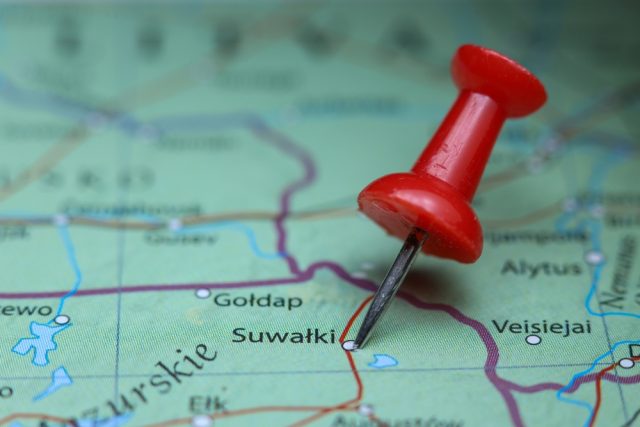
The decisive piece of geography is the Suwałki Corridor, the narrow strip of territory between Poland and Lithuania that separates the Russian exclave of Kaliningrad from Belarus. It is the only land connection between the Baltic States and the rest of the Atlantic Alliance. In the event of conflict, reinforcements bound for Lithuania, Latvia and Estonia would have to pass through it. Yet the same space could also see thousands of families, cars, buses, ambulances and emergency vehicles moving southwards.
A road congested with civilian vehicles cannot be freely used by a military convoy. A damaged bridge, a fuel depot running dry or a disabled communications system can delay an evacuation just as effectively as it can slow the arrival of allied forces. Even a wave of false information, deliberately spread to provoke a premature and disorderly flight, could have military consequences without a shot being fired.
For this reason, Lithuania has stipulated that evacuation routes must be coordinated with the armed forces, police and territorial military commandants. The national plan approved in July assumes that around 75 per cent of the population could evacuate by their own means, leaving local authorities responsible for those without private transport and for the most vulnerable groups. It is a realistic assumption, but also a formidable coordination problem. The spontaneous movement of hundreds of thousands of people cannot simply be left to individual improvisation.
Preparing an evacuation does not mean accepting that war is inevitable, nor resigning oneself to abandoning national territory. It means preventing panic from becoming a weapon in the hands of an adversary. A society that understands the procedures, has access to reliable information and knows where to go is less vulnerable to intimidation. Families can protect themselves without paralysing the military response, while the state retains the ability to set priorities and keep essential services running.
This is now part of deterrence. The new NATO resilience baseline requirements, published on 15 September, call on Allies to integrate civilian and military planning more closely. The competing needs of national forces, allied reinforcements, businesses and the civilian population must be reconciled before a crisis makes every decision more difficult. Combat units alone are not enough if railways, ports, electricity networks and public administrations cannot support their deployment.
The European Union has an important role, provided that role is correctly defined. The Commission has set the objective of creating an EU-wide military mobility area by 2027, with more harmonised rules and a network of land, sea and air routes that can be used rapidly. Its Preparedness Union Strategy also recognises the need for dual-use investment, civil-military cooperation and better public preparedness.
Brussels can finance bridges capable of carrying heavy military equipment, remove regulatory obstacles at national borders, improve railway connections and promote interoperability between emergency systems. It cannot replace knowledge of the territory, the responsibility of national and local authorities or the contribution of civil society organisations. The model emerging between Poland and Lithuania is not that of an abstract, centralised command. It is one of two sovereign states preparing a practical response to a shared risk.
The lesson concerns the whole of Europe, not merely the Baltic States. The continent’s defence depends on a network beginning at western and southern ports, crossing railways, motorways and logistical hubs, and reaching the eastern frontier. A weakness anywhere along that chain can undermine the response capacity of the entire Alliance.
The Suwałki Corridor is often depicted on military maps as a chokepoint to be defended. It should now also be seen as a test of the state’s ability to protect its citizens while fighting to keep its territory free. The road through Suwałki must allow allied forces to enter without preventing the most exposed civilians from leaving. If Europe wants its deterrence to be credible, it must demonstrate that it can manage both directions.