





 Subscribe


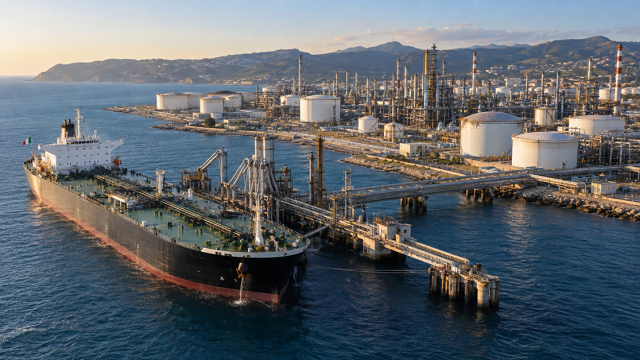
Ten conventional plants give Italy industrial strength, but imported crude, specialised equipment and uneven fuel demand complicate the promise of energy autonomy.
An oil tanker arriving at an Italian port carries a reminder that refining power and energy independence are different things. Italy can turn crude into petrol, diesel, aviation fuel and industrial materials on a substantial scale. Yet the raw material feeding those operations overwhelmingly comes from elsewhere. Keeping refineries open protects a strategic capability; it does not remove the vulnerability that begins before the oil reaches shore.
That distinction sits at the centre of the debate over whether Italy can produce more fuel when international supplies become uncertain. Industry Minister Adolfo Urso has presented higher production as a plausible option, arguing that Italy preserved refining infrastructure while other European countries continued closing plants. The argument has substance, but the size of the opportunity depends on engineering, logistics and the particular products in short supply.
Italy’s conventional refining network comprises ten sites: Priolo, Augusta and Milazzo in Sicily; Sarroch in Sardinia; Sannazzaro de’ Burgondi in Lombardy; Trecate in Piedmont; Busalla in Liguria; Ravenna in Emilia-Romagna; Falconara in the Marche; and Taranto in Puglia. This is a geography shaped by industrial demand and maritime access, with northern plants serving major consumption centres and island installations connected to Mediterranean shipping routes.
The system is smaller than it was a generation ago. Around 1990–1991, Italy had approximately twenty operating refineries and annual capacity near 100 million tonnes. By 2025, capacity had fallen to 83.3 million tonnes, a reduction of roughly 17%. The plant count therefore declined much faster than aggregate capacity, showing why counting refinery gates alone provides an incomplete picture of industrial strength.
Another distinction matters when measuring activity. [UNEM’s 2026 annual report](https://www.unem.it/wp-content/uploads/2026/06/UNEM_Relazione-annuale-2026.pdf) records 63.7 million tonnes of refinery throughput for 2025: material processed, rather than an equivalent quantity of finished products available for sale. Refining consumes energy and involves processing losses. Calling throughput “fuel production” obscures those differences and makes comparisons with national consumption less reliable.
The reported utilisation rate of about 77% can nevertheless look like an invitation to increase output. Why not simply activate the remaining 23%? Because a refinery is a connected series of processes rather than a single machine with an adjustable speed. Distillation, conversion and treatment equipment must work together, and the limiting stage can change with the crude being processed.
Scheduled maintenance, unexpected outages, energy requirements and product specifications also affect achievable output. An installation may have room to distil additional crude without having equivalent capacity to produce more compliant diesel or aviation fuel. National averages conceal these constraints. They cannot establish how much extra fuel could reach customers, from which plant, or within what timeframe.
Scale varies considerably across the network. The reported capacity estimates place Priolo at approximately 19.4 million tonnes annually, Sarroch at 15 million, Milazzo at 10.6 million and Sannazzaro at 10 million. Trecate follows at around 9 million, Augusta at 8.1 million, Taranto at 5.2 million, Falconara at 3.9 million and Busalla at 1.85 million.
Those figures describe potential processing scale, not guaranteed annual deliveries. Definitions also deserve attention: nominal capacity, capacity balanced against downstream equipment, and actual throughput are different measures. [ISAB](https://www.isab.com/it), for example, currently describes its Priolo complex as having capacity of 320,000 barrels per day. Comparing such figures with tonnes requires assumptions about crude density and the operating basis being used.
Sarroch illustrates the importance of both size and flexibility. [Its operator reports](https://www.saras.it/it/cosa-facciamo/raffinazione) processing capacity of 15 million tonnes annually, equivalent to approximately 300,000 barrels daily. Large coastal complexes can connect Italy to multiple supply routes, but their contribution during a disruption still depends on available feedstocks, functioning transport links and the ability to make the products buyers need.
Eni remains central to the network through Sannazzaro and Taranto, alongside its 50% interest in Milazzo. [Its published figures](https://www.eni.com/content/dam/enicom/documents/eng/reports/2024/Fact-Book-2024-eng.pdf) put Taranto’s primary balanced capacity at 104,000 barrels daily. Ownership, however, should not be confused with national availability: fuel moves through commercial networks, and the existence of domestic processing equipment does not automatically reserve every barrel for domestic customers.
The trade figures expose this complexity. Italy imports more than 16 million tonnes of refined products while exporting over 25.7 million. On those figures, it is a net exporter overall. Yet an aggregate surplus can coexist with dependence on particular fuels, seasonal imports or regional supply gaps. An exported tonne of petrol cannot automatically replace an imported tonne of jet fuel.
Domestic petroleum consumption of roughly 62 million tonnes therefore cannot be set against refinery throughput as though the two formed a complete balance sheet. A meaningful comparison also needs consistent product definitions, imports, exports, stock movements and processing losses. Without those elements, apparently reassuring national totals may conceal shortages in specific parts of the market.
Diesel, aviation fuel and liquefied petroleum gas account for about 64% of the imports described in the reported data, with roughly one third of imported refined products originating in the Middle East and Asia. Italy can also import diesel while remaining a net exporter of it. Timing, location, quality and commercial arrangements help explain flows that otherwise appear contradictory.
The deeper constraint lies upstream. The figures cited put national crude requirements around 55 million tonnes annually and domestic extraction near 4 million. These should be treated as indicative figures rather than merged automatically with the separate 2025 refinery series. Their central message is unmistakable: Italian wells provide only a small fraction of the oil the country needs.
Energy economist Davide Tabarelli argues that investment could lift domestic production to at least 8 million tonnes. Even that outcome would leave a large import requirement. Additional extraction could diversify supply and reduce exposure at the margin, but it would require viable projects, investment and time. It should be understood as a potential contribution, not a forecast of independence.
Basilicata is the principal focus of the production discussion, notably Val d’Agri and Tempa Rossa. Sicily also has established petroleum fields, including Ragusa and Gela, while smaller northern operations contribute much less. Gas deposits must be distinguished from oilfields: Gagliano Castelferrato, mentioned alongside Sicilian extraction sites, is a gas producer and cannot be counted as an equivalent source of refinery crude.
Meanwhile, the refining map is changing through conversion rather than closure alone. Porto Marghera and Gela have become biorefineries, and Livorno has halted traditional processing for its conversion. [Eni describes](https://www.eni.com/en-IT/actions/global-activities/Italy/livorno.html) a planned Livorno unit capable of producing 500,000 tonnes annually from biogenic feedstocks, predominantly vegetable waste and residues. Such investment preserves industrial activity while changing what enters and leaves the site.
Biorefining nevertheless does not replace conventional crude capacity tonne for tonne. Its feedstocks, equipment and product mix differ, and its contribution must be assessed accordingly. For policymakers, the practical task is to coordinate the transition with continuing fuel needs: retaining essential capabilities, improving reliability and avoiding gaps between the retirement of existing facilities and the availability of alternatives.
Italy’s strongest strategy is therefore broader than asking refineries to run harder. It combines dependable plants, diversified crude purchases, adequate storage, efficient transport and lower oil demand. The country possesses a substantial industrial buffer against disruption. Turning that buffer into greater security requires attention to the entire supply chain, from the origin of the crude to the fuel actually delivered. The relevant question is how much usable supply can be secured when trade is disrupted and how quickly households, airlines and businesses can obtain it where they need it.
Alessandro Fiorentino