





 Subscribe


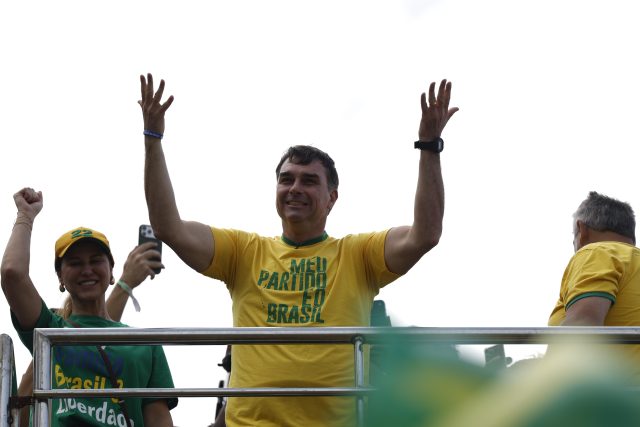
When I first visited Brazil in the autumn of 1993, I felt that the three witches brewing trouble in Shakespeare’s Macbeth were at work in this large country, and that their names were Violence, Poverty, and Corruption. This still seems to be the case. The remedies for violence and poverty, however, are well known: upholding law and order and introducing economic freedom. During Jair Bolsonaro’s tenure as President from 2019 to 2023, much was achieved in those two fields, not least through the efforts of his Minister of the Economy, Paulo Guedes, a student of Milton Friedman at the University of Chicago. At the Liberty Forum in Porto Alegre in April 2026, which I attended, Guedes described the ambitious programme of liberalisation, privatisation, and tax simplification he implemented. At the Forum, Jair’s son, Flávio Bolsonaro (in the photo above), and three other candidates in the presidential election on 4 October 2026 spoke. Flávio said the two most urgent problems in Brazil at present were judicial activism and personal security.
Judicial Activism at its Worst
Indeed, Brazil has seen judicial activism at its worst in recent years. Lula da Silva, the leader of the Workers’ Party and a committed socialist, served as Brazil’s president from 2003 to 2011. He was convicted of corruption in July 2017 and spent more than a year in prison. Two other courts upheld his original conviction, but in 2021 a majority of the Supreme Federal Court, largely composed of his appointees, annulled it on formal grounds: the proceedings had not been held in the proper venue, and the first judge to convict him had been biased. Conveniently for Lula, the statute of limitations barred a retrial. Consequently, Lula, backed by a motley alliance of the very poor, the left-wing elite in universities and the media, and environmental extremists, could stand in the 2022 presidential election, where he narrowly defeated Bolsonaro.
Going after the Bolsonaros
During the 2022 campaign, the Supreme Court judge presiding over the electoral tribunal, Alexandre de Moraes, tried to suppress criticism of Lula as ‘fake news’. Moraes subsequently convicted Jair Bolsonaro of plotting a military coup after riots broke out in the capital, Brasília, a week after Lula took power, despite a lack of hard evidence linking Bolsonaro to the riots. He also cited loose talk among Bolsonaro’s staff after the election about rejecting its outcome. Moraes sentenced the 70-year-old ex-president to 27 years in prison. He also convicted Bolsonaro’s son, Eduardo, who sought refuge in the United States, of obstructing justice by intimidating Brazil’s judiciary. He sentenced him to four and a half years in prison and barred him from seeking elected office, exclaiming that ‘it is not the role of a Brazilian federal lawmaker to lobby abroad against his own country’. Now, however, Moraes is widely discredited after the Brazilian media exposed his connection to a notorious fraudster, Daniel Vorcaro, whose failed Master Bank has cost the Brazilian bank insurance system enormous sums.
Economic Freedom, Less Corruption
Lula has never concealed that he is a man of the hard, anti-Western left. He is friendly with the Iranian mullahs, and when asked to intervene on behalf of an Iranian woman, Sakineh Mohammadi Ashtiani, who had been sentenced to death by stoning for adultery, he refused: ‘I need to respect the law of a country.’ After the international financial crisis of 2007–2009, he said it had been caused by ‘white people with blue eyes’. But of course people are no better or worse for the colour of their skin or eyes. One of the wonders of modern Brazil has indeed been that she is largely colour-blind. Almost everybody is of mixed race. She is a great country of great people who may eventually drive out the three witches: Violence, Poverty, and Corruption. Flávio Bolsonaro may not be perfect, but he is much more likely than Lula to increase economic freedom, which will not only reduce poverty but also make corruption less profitable: the fewer resources politicians control, the less likely they are to be led into temptation.