


 Subscribe


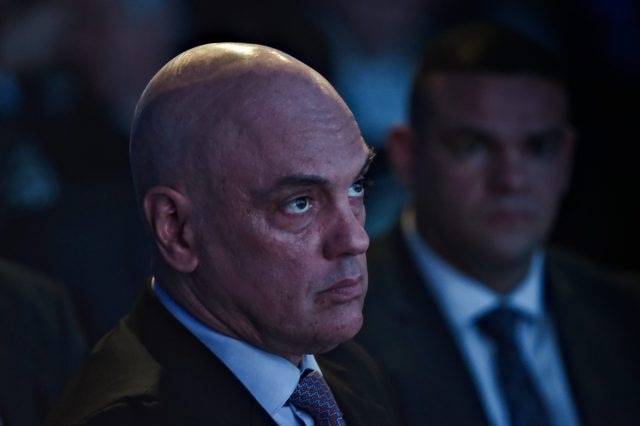
Seven minutes after Lula, Brazil’s incumbent President, was declared the winner of the second round of the presidential election, held on 25 October 2026, one of his supporters on the Supreme Court, Alexandre de Moraes (photo above), issued an order prohibiting the defeated candidate, Flávio Bolsonaro, from leaving Brazil and requiring him to surrender his passport within 24 hours.
Annulling Lula’s Conviction and Suspending X
Moraes has targeted the Bolsonaro family for several years. In 2021, with support from some of his colleagues, Moraes annulled Lula’s prison conviction for corruption on technical grounds (the judges found he had not been prosecuted in the proper venue). As a result, Lula could run in 2022 and defeat Flávio’s father, incumbent President Jair Bolsonaro. During the election campaign, Moraes suspended the media platform X in Brazil, partly because some accounts criticised his annulment of Lula’s conviction. Eventually, Moraes and X reached a compromise that blocked some accounts.
Convicting Bolsonaro Senior
Moraes later convicted Jair Bolsonaro of attempting to overturn the election results and organising riots on 8 January 2023. However, Bolsonaro was then travelling in the United States, and no convincing evidence had been produced to establish a direct link between him and the riots (though there had been some informal discussion in Bolsonaro’s inner circle immediately after the election about what to do in the event of election fraud). Moraes sentenced the seventy-year-old Bolsonaro to 27 years in prison. Justice Luiz Fux wrote a compelling dissent.
Convicting Bolsonaro Junior
Bolsonaro’s son, Eduardo, fled to the United States, while Moraes and his colleagues convicted Eduardo of encouraging the United States to impose tariffs on Brazil and sanctions on Moraes. Although Moraes was one of the alleged targets of Eduardo’s actions (and should therefore have been disqualified), he sentenced Eduardo to four years and two months in prison. It was therefore not surprising that the third family member, Flávio, fled to the United States when Moraes ordered him to surrender his passport. His fate had probably already been decided: ‘Give me the man, and I will give you the case against him.’ In a heated debate before the election, Lula suggested that Flávio should be in prison.
A Surge in Support for Lula
In the first round of the presidential election, Flávio received 47 per cent of the vote and Lula 45 per cent, whereas in the second round Flávio received 48 per cent and Lula 52 per cent. Although one judge, Cristiano Zanin, Lula’s ally and former personal lawyer, controversially permitted, on his own, polls to remain open for two additional hours in some places, no plausible evidence has been presented that the election itself was fraudulent. Lula saw a surge in support between the two rounds. Poorer segments of Brazilian society identify with Lula, a former metalworker: for example, my housekeeper and the doormen at my Rio de Janeiro condominium all voted for him. Left-wing elites in the media and universities also supported him.
Lula: A Left-Wing Extremist
It is Lula, not Flávio, who is the extremist: a friend of the Iranian mullahs and of the former dictators Castro and Maduro, Lula has fully participated in Putin and Xi’s efforts to form an anti-Western alliance, although he has so far been constrained by his lack of a majority in the Brazilian Congress. Indeed, in the first round of the elections, the Right won many seats and now controls Congress. Lula, rather than Flávio, is also the populist: during the campaign, he promised bread and circuses. But in future, he may not be able to rely on support from Moraes, who is implicated in the greatest scandal in recent Brazilian history: the failure of Daniel Vorcaro’s Master Bank. He is not the only one: Flávio Bolsonaro once accepted a grant from Vorcaro for a documentary on his father. But Moraes’ wife, a lawyer, contracted with Vorcaro for no less than $25 million in legal advice. Moraes himself seems to have been in close contact with Vorcaro, who once asked him whether he should flee the country. The response has not been revealed, but Vorcaro did try to flee and was apprehended at an airport in São Paulo. Moraes is widely discredited, and Brazilian history shows that sometimes the hunter becomes the prey.