


 Subscribe


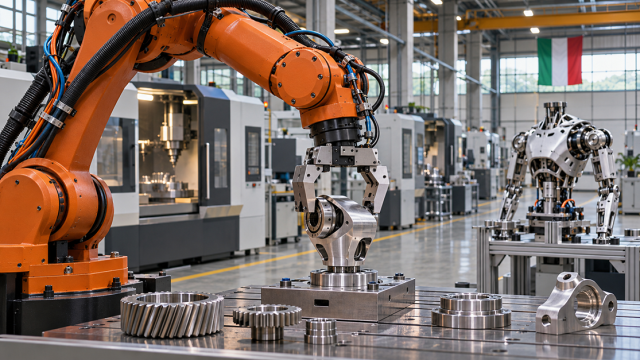
High-tech machinery exports reached €30 billion in 2025. New investment could unlock a further €18.3 billion in sales abroad as Chinese competition intensifies.
Italy is the world’s third-largest exporter of advanced capital goods and ranks fourth in industrial robotics exports, including mechanical components. That position gives Italian manufacturers a foothold in two markets that are changing quickly. China is gaining ground in sophisticated machinery and already dominates humanoid robot deliveries. For Italian companies, the question is how much more they can sell with the factories they have today, and where it makes sense to build additional capacity.
The Ingenium report, prepared by Confindustria’s research centre in collaboration with Federmacchine, puts Italian exports of capital goods with high levels of automation, creativity and technology at €30 billion in 2025. It identifies €4.9 billion in additional export potential using existing production capacity. A further €18.3 billion would require investment to expand that capacity. The distinction matters for manufacturers deciding whether to pursue new orders with their current facilities or commit capital to larger operations.
The report’s international comparison puts Italy’s 2024 exports in the category at about $33 billion, or 8.3% of the global total. China led with 19.2%, followed by Germany at 17.9%. Italy’s share slipped from 8.6% in 2019 to 8.3% in 2024. Germany and Japan recorded larger declines, of 1.1 and 2.6 percentage points respectively, while China gained ground. Italy’s ranking therefore tells only part of the story. It remains a major supplier, but an increasing share of world demand is being met by Chinese exporters.
The shift is particularly visible in robotics. Italy exported $408 million worth of industrial robots in 2024, accounting for 5.4% of global exports. That trade gives Italian manufacturers a base from which to explore a newer market. Worldwide deliveries of humanoid robots reached an estimated 13,000 to 20,000 units in 2025. Deliveries reached the same range in the first half of 2026 alone, with Chinese manufacturers accounting for 97% of the market.
The report identifies 2026 to 2028 as a window for Italian companies to enter the humanoid supply chain, particularly as suppliers of mechanical components. Selling parts to robot makers would allow Italian firms to draw on their manufacturing expertise while the market is still taking shape. The sharp rise in deliveries gives suppliers a reason to explore that opportunity now. The concentration of production in China also makes access to a relatively narrow pool of customers an important commercial consideration.
For a component supplier, the commercial test will be whether early interest translates into repeat orders. Those orders matter when deciding whether to add production capacity, especially in a young market where delivery figures are growing rapidly from a small base and future demand is still difficult for suppliers to judge reliably.
Lucia Aleotti, Confindustria’s vice president responsible for its research centre, said Italian machinery manufacturers were starting from a strong position, but faced more persistent uncertainty, less stable trade rules and Chinese competition in advanced manufacturing. She called for skilled workers, predictable investment incentives and financing that helps businesses enter riskier markets. She also urged better coordination of existing support measures so that companies could act on the demand identified in the report.
Bruno Bettelli, president of Federmacchine, pointed to the role Italian machinery plays in what other manufacturers can design and produce. A machinery supplier’s contribution can be easy to miss because it sits upstream of the finished product. In robotics, that same position could give Italian firms a way to participate in the growth of humanoids through the components that go into each machine.
The two export estimates suggest different priorities. Companies with room to take on more work can focus on reaching customers and winning orders with the facilities they already operate. Capturing the larger opportunity means deciding where expected demand justifies expanding production, then securing the financing and skills to deliver. In a market where China is already gaining share, the timing of those decisions will shape how much of the potential identified by Ingenium becomes actual export revenue.
Alessandro Fiorentino