





 Subscribe


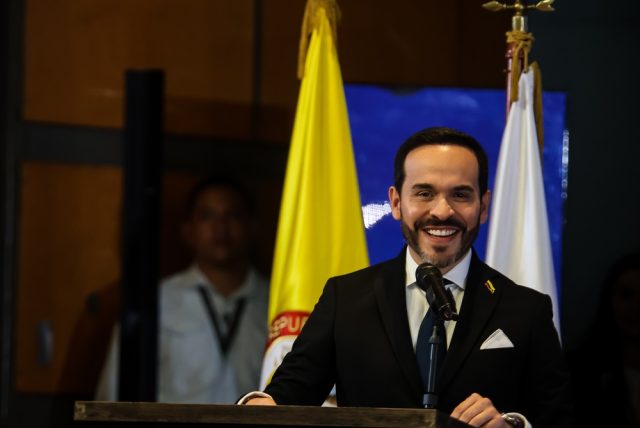
On 7 August, Abelardo de la Espriella was sworn in as president at a sports arena in Cali, not the usual Plaza de Bolívar. This was Colombia’s first presidential inauguration outside the capital. De la Espriella, who won the June runoff by less than 250,000 votes, chose to take the oath before the armed forces instead of a Congress where he lacks a majority.
The new administration’s direction was clear within hours. Colombia will restore relations with Israel and open an embassy in Jerusalem. Ties with Cuba and Nicaragua have been cut. Colombia has joined Washington’s counter-narcotics alliance. Fourteen embassies and fifteen consulates will close, and Bogotá now recognizes Moroccan sovereignty over Western Sahara. There has even been talk of leaving the United Nations and the OAS, though most analysts see this as unrealistic.
The pattern is clear: Colombia is realigning toward Washington and a group of Latin American governments, including Milei, Kast, Noboa, Peña, and Mulino, who sat in the front row in Cali with King Felipe VI of Spain. Europe was mostly absent, with only a few MEPs attending. This absence is hard to explain. The inauguration of a new government in a country as important as Colombia is not something the European Union should ignore. Colombia is a key player in South America, affecting European trade, security, and efforts to stop drug trafficking to Europe. If Europe wants to remain influential, it cannot just watch from the sidelines. This moment matters especially for European conservatives, since the new Colombian government already shares their priorities on security, family, and the Atlantic alliance.
Security First
De la Espriella’s plan starts with regaining control over the country: labeling armed groups as narco-terrorist organizations, rebuilding the security forces, and moving away from a negotiation-first approach that brought neither peace nor authority. This issue is not only a local debate. The cocaine funding these groups increasingly ends up in European cities like Antwerp, Rotterdam, Algeciras, and Valencia. For over a decade, European conservatives have argued that organized crime is concerning sovereignty, not just social policy. Colombia is where this problem starts.
Culture and the Family
On moral issues that European conservatives often discuss more openly among themselves than with others, De la Espriella is clear. He is consistently pro-life, rejects the 2022 Constitutional Court decision that decriminalized abortion up to the twenty-fourth week, opposes euthanasia, and supports marriage as a union between a man and a woman. He was the only candidate to sign the Pledge to Life and the Family. He sees these issues as cultural, not just legislative, arguing that real social change comes from strengthening culture and values, not from passing new laws. This approach will be familiar in places like Warsaw, Rome, and Madrid.
A caveat is necessary. Abortion remains legal in Colombia to twenty-four weeks; the jurisprudence is settled, and a president facing a fragmented Congress has limited means of changing it—something he has openly acknowledged. Those wishing for a rapid counter-revolution in family law will be disappointed. What they will find is a head of state making the anthropological case for the family at a moment when that case is losing ground across much of Latin America.
Atlanticism and its Risks
The coordination with Washington is unusually complete. A US presidential delegation led by the Acting Attorney General attended the inauguration. The State Department announced a billion-dollar security package to be pursued with Congress, welcomed Colombia into the Shield of the Americas (with Medellín as its operational hub), and set out a Bilateral Prosperity Dialogue. De la Espriella, a naturalised US citizen who practised law in Miami for more than a decade, had already sent his Vice-President-elect and ministers-designate to Washington during the transition.
For conservatives who have spent the past years arguing that Europe’s security cannot be decoupled from America’s, this is a natural partnership. It also carries a warning. Iván Cepeda’s charge that the arrangement risks turning Colombia into a protectorate is partisan, yet it identifies a real asymmetry: where one party supplies the money, the technology and the strategic framework, the relationship is hostage to that party’s electoral calendar. Washington’s attention to Latin America arrives in surges and departs without notice. Europe cannot replace the United States in Colombia’s security calculus and should not try. What it can offer is a second axis—trade less subject to executive whim, the largest investment stock of any bloc, and a visa regime worth defending. Washington is dependency; Europe, handled properly, is leverage.
Israel: a Risky Move
Of the early announcements, the restoration of relations with Israel and the opening of an embassy in Jerusalem will cost the most and be understood the least. Petro had broken relations over Gaza and made the rupture a signature of his foreign policy, calling his successor’s intention a source of shame. The international climate around the Israeli government has hardened well beyond the usual quarters.
The calculation rests on three propositions. Israel was a significant supplier to the Colombian armed forces, and a president whose programme depends on military capacity could not sustain the breach. The cost in the Arab world is judged bearable. And, as De la Espriella said on taking office, his foreign policy will privilege alliances with countries that share his principles.
Conservatives should be candid about the consequences. This is the decision most likely to complicate any deeper European relationship, because European positions on Israel now cut across the left-right divide rather than along it. Support for Israel’s security remains strong among many European conservatives; it is far more contested in the Parliament as a whole, in the Council, and in the chancelleries whose goodwill Colombia will need on visas and trade. The mature course is to compartmentalise the tension and to decline the invitation—which will come—to turn every European conversation into a referendum on Jerusalem.
The diplomatic habit has not yet been acquired. Before the ceremony itself, eleven European and neighbouring states—including Croatia, Malta, Cyprus, Serbia and, most awkwardly, Ukraine—were left off the invitation list until 4 August. The explanation was administrative and plausible: a backlog of unaccredited ambassadors inherited from the outgoing government. Yet Ukraine was omitted while Russia was invited.
The Parliamentary Track
Sympathy alone will not deliver results. Trade files, visa policy and the deforestation regulation are decided by coalitions that run through the EPP and often through Renew and the Socialists. A government that speaks only to its closest ideological friends in Brussels will discover it has excellent contacts and no votes.
The most neglected channel remains the Euro-Latin American Parliamentary Assembly. EuroLat met in Mexico City in May, marking twenty years of the partnership’s parliamentary pillar: 150 members, half from the European Parliament and half from the Latin American assemblies. It binds nobody, which is precisely why it is valuable—it is the cheapest sustained access to European legislators a Latin American parliament possesses, and it produces the rapporteurs who subsequently shape how Brussels frames a region. Colombia sits in it through the Andean Parliament. The left has staffed that room seriously for two decades; the right has largely treated it as a junket.
If the new administration wants ballast in the face of the volatility of its own executive diplomacy—and after a fortnight of announcements, ballast is what it most conspicuously lacks—the parliamentary track is where it will find it. Ministers are dismissed; legislators are re-elected.
What lies ahead for Colombia-EU relations
The practical agenda is clear: a Colombian ambassador to the Union of real political weight rather than a reward appointment; an early visit to Brussels and Strasbourg making the case to fight organised crime, and to support EU efforts on Venezuela; and active defence of the Schengen waiver and trade preferences before they become bargaining chips elsewhere. Madrid matters especially in this regard. Felipe VI’s presence in Cali was the week’s most significant European signal, and Spain remains the indispensable interpreter of Latin America inside the EU. Here, Spain has had a bad track record in the region since 2004, with two non-consecutive Socialist Administrations that have supported corruption-led, narco-funded authoritarian Bolivarian socialism in Latin America, and a People’s Party rule (2011-2018) that practised acquiescence and embraced irrelevance. That can now change in the 2027 general elections, which project a governing majority of PP and Vox. Under the new government, Spain has a historic opportunity (perhaps its last) to be the EU’s broker in the region.
The obligation runs both ways. Brussels will be tempted to lecture—about abortion or gender ideology more broadly, about Israel, about the rule of law—and should resist. A Colombia that dismantles its narco-economy is worth more to European interior ministries than one that signs agreeable communiqués. De la Espriella has four years and a divided Congress, and he will be judged by what survives him. The convictions he brings are recognisable to common-sense Europeans and are cheered by European conservatives. The question is whether those conservatives will do the unglamorous institutional work of turning a shared disposition into a durable relationship.