





 Subscribe


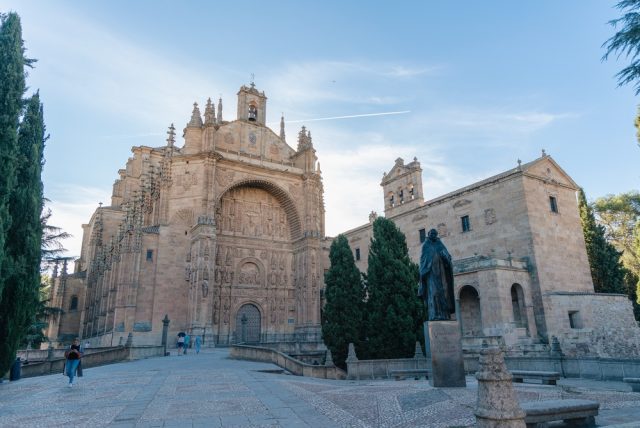
On Hispanic Day, recovering Spain’s intellectual heritage means rediscovering a principle the West urgently needs: power must answer to justice.
Every 12 October, Spain and the wider Hispanic world confront a familiar argument about their past. For some, Hispanic Day is an occasion for gratitude: a celebration of a civilisation that connected continents, founded cities and universities, and created an enduring community of language, faith and culture. For others, it is an invitation to revisit the injustices of conquest. Too often, the debate becomes a choice between uncritical celebration and indiscriminate condemnation. Both approaches leave something essential unexplored: the intellectual tradition through which Hispanic civilisation examined its own power.
This year offers a particularly fitting opportunity to recover that tradition. In 2026, we mark five hundred years since Francisco de Vitoria took up his chair at the University of Salamanca, the milestone around which the School of Salamanca’s anniversary is being celebrated. At a moment when the West appears increasingly uncertain about its identity and its principles, this inheritance deserves more than an academic commemoration. It deserves a place in our public arguments about freedom, sovereignty and the legitimate exercise of authority.
The conventional genealogy of Western political thought moves from Jerusalem, Athens and Rome towards London and Philadelphia. It is a powerful narrative, but an incomplete one. Before London and Philadelphia, there was Salamanca. Recognising this does not require diminishing the achievements of the English constitutional tradition or the American founding. It requires acknowledging that the West developed through several connected traditions, and that the Hispanic contribution cannot be reduced to exploration, conquest or the administration of empire. Spain also helped formulate the questions by which political power would be judged.
The thinkers associated with Salamanca belonged to the broader renewal of scholastic thought that confronted the emerging modern world. Their concerns were remarkably concrete: commerce across continents, monetary change, taxation, warfare and the encounter with peoples beyond Christendom. Theology was not a retreat from these problems. It supplied the framework through which they examined them. Their starting point was that human action, including the action of rulers, remained subject to an objective moral order. Neither political success nor material strength could establish, by itself, that an action was just.
Their central question was devastatingly simple: by what right? By what right does one person govern another? By what right does a prince levy taxes, wage war or claim dominion over a distant people? Such questions were uncomfortable precisely because they denied rulers the convenience of treating possession of power as sufficient justification for its use. They demanded an account of political authority: where it came from, what purposes it served, and what obligations limited it. That demand remains fundamental to any civilisation which wishes to distinguish government from domination.
Within this tradition, political community was more than a collection of isolated individuals, and government was more than an instrument of the ruler’s will. Thinkers such as Francisco Suárez situated political authority within the community and understood its conferral upon a ruler through human arrangements. Their arguments were grounded in natural law and a Christian understanding of social life. We should not turn them retrospectively into contemporary liberal democrats. Yet neither should we overlook their contribution to the proposition that political authority requires justification and that no ruler possesses an unlimited natural entitlement to command.
Juan de Mariana gave this concern a particularly forceful expression. His reflections on kingship considered the virtues required of a ruler and the dangers of tyranny. The distinction between governing a political community and treating it as personal property was crucial. A king could not simply regard the possessions of his subjects as an extension of his treasury. Nor could public office erase the demands of justice. The relevance is obvious whenever governments treat institutions as partisan possessions, public resources as instruments of personal advantage, or electoral victory as permission to remove every obstacle to their ambitions.
There is also a lesson here about freedom. For these thinkers, liberty could not be understood adequately as the mere absence of restraint. It belonged within an account of human flourishing, responsibility and the common good. A person’s freedom mattered because human beings were capable of rational and moral action. Freedom therefore carried obligations, just as authority did. This is an inheritance conservatives should take seriously. A free society depends upon citizens capable of exercising judgment and accepting duties, alongside institutions capable of preventing the abuse of power.
The international implications were equally significant. Vitoria’s examination of Spain’s presence in the Americas challenged the assumption that religious difference deprived Indigenous peoples of rightful possession or political standing. His arguments also contained claims that remain contested, and they should be read in their historical complexity. Nevertheless, his recognition that non-Christian peoples could possess legitimate dominion introduced a formidable constraint upon imperial ambition. Difference did not make another people’s property ownerless. Superior force did not settle the question of rightful authority.
The Debate of Valladolid, held in 1550 and 1551, brought the legitimacy of conquest into a confrontation between Bartolomé de las Casas and Juan Ginés de Sepúlveda. It should not be turned into a comforting morality play. Spain’s imperial record contained injustices, and the existence of debate did not automatically prevent them. Nor did the proceedings produce an unequivocal settlement that resolved the moral problems of empire. Their significance lies in the fact that the justification of imperial conduct could itself become a matter of examination within the institutions and intellectual life of the imperial power.
That distinction matters for Hispanic Day. A mature patriotism can recognise both achievement and wrongdoing because it possesses standards by which to distinguish them. It need not pretend that every action undertaken by one’s country was honourable. Equally, it need not accept that wrongdoing invalidates an entire civilisational inheritance. The Hispanic tradition gave rise to arguments capable of judging the conduct of Hispanic rulers themselves. Recovering those arguments is an act of fidelity to that inheritance. It asks us to preserve its capacity for moral judgment, including when judgment becomes inconvenient.
The inconvenience is particularly apparent in geopolitics. Every great power faces the temptation to confuse its ability to secure an outcome with its right to do so. Military superiority, financial influence and technological advantage can make that confusion seem practical, even inevitable. But a civilisation abandons something essential when it accepts that justice merely records the preferences of the strongest. Salamanca’s question interrupts this logic. A government may be able to intervene, intimidate or compel. It must still explain the grounds of its action and the limits it recognises.
This principle should matter especially to conservatives who wish to defend the West. We cannot plausibly defend constitutional government at home while treating arbitrary power abroad as admirable whenever it serves a friendly state. Nor can we insist that our opponents respect sovereignty while regarding the sovereignty of weaker countries as disposable. Consistency does not require pretending that every regime is morally equivalent. It requires accepting that our own judgments must rest upon principles which bind us as well as others. Otherwise, the language of civilisation becomes a rhetorical accompaniment to power.
The same obligation applies within national borders. An election confers authority to govern under an existing constitutional order. It does not transfer ownership of the state to the winning party. Legislatures, courts and public institutions have purposes which exceed the immediate interests of those who occupy office. Conservatives understand the importance of inherited institutions because these embody experience, distribute responsibility and restrain ambition. They should therefore be particularly alert when leaders present institutional limits as illegitimate obstacles simply because those limits prevent them from obtaining everything they want.
Behind these restraints lies a deeper question: why should power recognise any limit it can successfully evade? The Christian natural-law tradition supplied an answer rooted in the nature and dignity of the human person. Rulers and subjects alike stood within a moral order they had not created. Political office could not exempt its holder from it. Today, people disagree about that foundation, but the underlying problem remains. Universal rights become precarious when their authority depends entirely upon the changing preferences of governments, majorities or international institutions.
Hispanic Day should therefore invite an exercise in intellectual recovery. The universities, jurists and theologians of the Hispanic world belong within the West’s understanding of itself, alongside its other great traditions. Their work offers resources for examining taxation, political consent, warfare and the obligations of government. Five centuries after Vitoria arrived in Salamanca, the inheritance remains demanding. It asks rulers to justify their decisions, citizens to exercise freedom responsibly, and nations to judge themselves by standards higher than success. To honour Hispanidad on 12 October is to accept that demand: power must answer to justice.