





 Subscribe


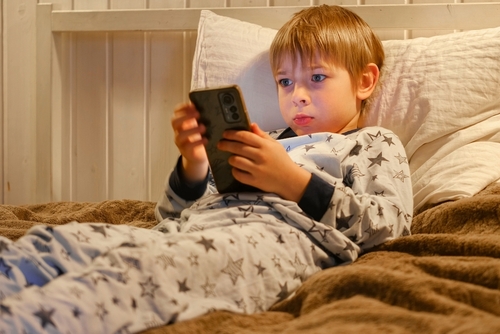
Europe is trying to restore order to the relationship between minors, social media and artificial intelligence. The challenge is not to demonise technology, but to defend what no algorithm should ever be able to replace: education, the freedom to grow up, and the possibility of living without being constantly captured by a screen.
There is a scene that has become ordinary in our homes: a child walks into the kitchen, picks up the phone “just for a moment” to check a message and, twenty minutes later, is still there. One video leads to another, a notification opens a social network, an algorithm suggests content increasingly similar to what has just been watched. Meanwhile, dinner is getting cold.
This is no longer merely a matter of household discipline. It has become a political, cultural and even anthropological question: who is educating our children?
The question is no longer theoretical. On 17 September, the European Commission presented the EU KIDS ACT, a proposal intended to change the way minors access social media, video-sharing platforms, video games and artificial-intelligence-based chatbots. The Commission’s official document, EU Approach on the Safety of Children Online (COM(2026) 680 final), starts from a difficult fact: according to the 2026 Eurobarometer, teenagers spend an average of 4.5 hours online on school days and 6.1 hours at weekends.
The political conclusion Brussels is beginning to draw is significant: we cannot simply ask adults to protect young people from digital products designed to capture their attention.
If the product is the child, the customer is no longer simply the adult
For years, we have approached the problem as though it were exclusively educational: “Check how much time they spend on the phone”, “Set parental controls”, “Tell them to switch it off”.
All true. But incomplete.
The European document recognises that many digital business models are designed to maximise the amount of time spent in front of a screen and may exploit the vulnerabilities of minors. Infinite scrolling, constant notifications, reward systems and personalised recommendations are part of the design of these products.
From a conservative perspective, this point deserves particular attention.
Conservatism is not nostalgia for a world without technology. It is the belief that not everything that is technically possible is automatically good for human beings, especially when it involves people who are still developing.
A child is not an adult consumer in a smaller format. A fourteen-year-old does not necessarily possess the cognitive and emotional tools to recognise sophisticated forms of manipulation. And an algorithm is not an educator.
The Commission puts it in remarkably clear terms: “parents should raise children, not algorithms.”
The heart of the EU KIDS ACT is a gradual approach to access. Under the age of 13, there would be no access to social media. Between 13 and 15, certain services could be used through a “mini-account” subject to adult supervision, with limited functionalities and a one-hour daily limit. From 15, minors could open their own account independently, while continuing to have the right to a safe digital environment. For children aged zero to three, the Commission recommends avoiding screen exposure and prioritising face-to-face interaction.
This is therefore not simply a matter of “banning social media”.
It is a different philosophy: digital freedom should grow together with a person’s maturity.
We already accept this principle elsewhere. We do not allow a child to drive a car because freedom, in order to be genuinely exercised, presupposes ability and responsibility. We do not give them an unlimited credit card because they do not yet possess the tools to manage it.
Why, then, should we consider it normal for a twelve-year-old to enter a global digital environment where strangers, advertising, sexual content, influencers, scammers and algorithms compete to capture their attention?
Perhaps the most interesting aspect of the EU KIDS ACT does not even concern age. It concerns who must demonstrate that a service is safe.
Today, adults often need almost the expertise of a computer engineer: privacy settings, controls, accounts, filters, permissions and notifications. The European proposal reverses the perspective: platforms will have to demonstrate that they have designed services that are safe for minors.
The Commission refers to “safety by design”: no infinite scrolling, no deceptive notifications, greater control over recommendation systems, minors’ profiles private by default, unwanted contacts blocked, and simple tools for reporting harmful content.
If a company produces a toy intended for children, we demand that it be safe before it reaches their hands. Should we accept that an application used every day by millions of teenagers can be designed without the same degree of care?
Here an important economic principle also emerges: those who profit from a service must assume an appropriate share of responsibility for the risks that service creates.
Yet we must also avoid the opposite mistake: turning technology into the new scapegoat.
The digital world offers knowledge, creativity and opportunities for connection. The OECD’s PISA 2025 report calls for a balanced interpretation: moderate and purposeful use of devices can support learning, while prolonged recreational use at school is associated with poorer outcomes.
In Italy, the problem appears particularly concrete. Thirty-seven per cent of students report that their classmates are distracted by digital devices in most or all science lessons, compared with an OECD average of 28 per cent. Italian students who report this kind of distraction score, on average, 13 points lower in science than their peers.
This does not mean that “the phone is harmful”. It means something more reasonable: a tool can be useful and, at the same time, become harmful when it is used at the wrong time, in the wrong way or without limits.
It is the old virtue of moderation, applied to the new world.
Education must offer something beyond the screen
There is another chapter that deserves attention: education.
The Commission proposes training for teachers and school leaders, digital and artificial-intelligence literacy, online safety education and measures to strengthen young people’s resilience. But it also proposes something much less technological: more sport, art, libraries, youth clubs and community spaces.
This is one of the most valuable parts of the document.
A teenager does not only need to learn how to use the Internet better. They need to have a life rich enough not to need the Internet to fill every empty space.
A football match, a theatre rehearsal, a walk with friends, a book read on the sofa, a conversation with a grandparent: these apparently simple experiences build identity, belonging, patience and the ability to be with others.
An algorithm can suggest a thousand friends. But it cannot teach friendship.
The fact that Brussels is moving in this direction is not accidental.
The United Kingdom has announced measures to prevent social-media platforms from offering their services to under-16s and is introducing further protections for teenagers and minors. Australia has also moved towards a threshold of 16, while several European countries are considering national initiatives.
The international direction is therefore clear: the era of leaving platforms entirely to self-regulation is changing.
But precisely for this reason, we must remain vigilant on the other side.
Protecting children must not become an excuse for the widespread surveillance of adults. Age verification must be effective, but also respectful of privacy. The EU KIDS ACT provides for tools intended to verify age without storing identity documents or biometric data.
Protecting children does not mean building a society in which everyone must constantly prove who they are.
Freedom remains a value even when we regulate digital freedom.
The EU KIDS ACT will still have to be discussed and approved by the European Parliament and the Council. The text may therefore change.
But the issue has now been placed on the table and cannot be dismissed as a simple dispute over apps.
What we are deciding is what idea of childhood we want to defend.
A childhood marked by constantly interrupted attention, permanent comparison with others, the search for approval and the relentless consumption of content?
Or a childhood in which a child still has the right to be bored, to play, to make mistakes, to read slowly, to speak while looking someone in the eyes and to grow up without being constantly measured by a number of “likes”?
The conservative answer should be clear.
We must not be afraid of technology. We must have enough confidence in human beings to demand that technology remain at their service.
An algorithm may know our preferences, predict our behaviour and even imitate a conversation. But it cannot be our father, our mother, our teacher or our friend.
Because educating does not mean maximising the amount of time spent in front of a screen.
Education means preparing a person for freedom.
And for a child, freedom also begins with the possibility of switching off the screen.