





 Subscribe


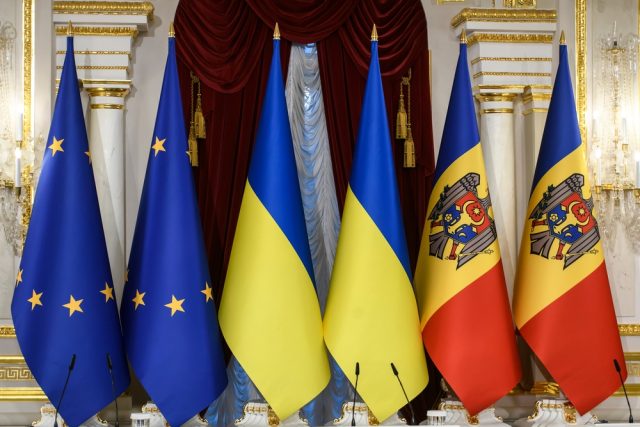
The agreement in principle reached in Brussels on 12 June 2026 to unblock accession negotiations for Ukraine and Moldova marks a geopolitical turning point that European conservatives cannot and must not ignore. Welcoming the opening of the first negotiating cluster on “Fundamentals” means recognizing that Europe’s border is not merely a geographic line, but a civilisational perimeter. In the face of Moscow’s imperialism and hybrid pressures, supporting the sovereignty and self-determination of Kyiv and Chișinău is a strategic imperative.
However, the real battle for the eurorealist right is now being fought within the EU institutions themselves. The Brussels establishment, true to its age-old reflex of exploiting every crisis to centralise power, is already weaponising enlargement as a Trojan horse to dismantle the Treaties. The federalist narrative is uniform: a Union of over thirty members would be completely ungovernable without abolishing the national veto.
This article analyses the risk of an institutional trap that, in the name of external solidarity, aims to permanently dilute the sovereignty of existing nations. For the ECR, the answer cannot be a centralised superstate, but a confederation of free nations, where unanimous consensus and strict merit remain the sole pillars of political legitimacy.
The EU’s decision to unblock accession talks with Ukraine and Moldova is a geopolitical necessity. But it must not become a federalist ambush against the sovereignty of Europe’s existing nations.
On 12 June 2026, the European Union crossed an important threshold. The twenty-seven member states reached an agreement to open the first cluster of accession negotiations with Ukraine and Moldova—the foundational phase known simply as “Fundamentals.” With the formal step scheduled for mid-June in Luxembourg, this breakthrough represents a major shift in the continent’s alignment. Crucially, the diplomatic deadlock was broken only after Hungary lifted its veto, following concrete guarantees on minority-rights protections and an amended action plan hammered out between Budapest and Kyiv.
For Ukraine, still fiercely resisting Russia’s imperial war of attrition, and for Moldova, constantly exposed to Moscow’s hybrid pressures, this is far more than a technical milestone. It is a powerful strategic signal that Europe’s frontier is civilisational, not just geographic. Nations that choose sovereignty, constitutional government, and Western alignment cannot be left to rot in the geopolitical grey zones coveted by the Kremlin.
Yet, conservatives must remain clear-eyed. European solidarity with Kyiv and Chișinău does not require a suspension of critical judgment. Enlargement must be serious, demanding, and strictly merit-based. Most importantly, it must not be exploited by institutional centralisers in Brussels as a convenient pretext to strip member states of their vetoes, dilute national sovereignty, and smuggle in a federalised European superstate through the back door.
Merit, Not Sentiment: Entering Through the Front Door
The European right has never hesitated to state an obvious truth: Ukraine’s struggle is a European struggle. Kyiv is not defending an abstract bureaucratic slogan; it is defending the fundamental right of a nation to exist, to secure its borders, and to reject subordination to a foreign empire. Similarly, Moldova’s path represents a courageous choice by a small nation seeking structural reform and institutional anchoring in a region historically plagued by Moscow-backed frozen conflicts.
However, moral clarity must not be confused with institutional haste. European Union membership is not a lifetime achievement award for courage; it is a legal, economic, and constitutional architecture of immense weight.
In this context, the decision to begin strictly with the “Fundamentals” cluster is a victory for common sense over emotionalism. The Copenhagen criteria—established to ensure that any applicant possesses stable institutions guaranteeing democracy, the rule of law, and a functioning market economy—remain the absolute baseline.
The Conservative Principle: A Union that admits new members without ironclad rule-of-law guarantees imports permanent instability into its own institutional bloodstream. Treating economic readiness or minority protections as negotiable compromises betrays the very values the Union claims to safeguard.
The road ahead remains long, spanning six thematic clusters and 33 complex chapters. By ensuring that the opening of this first cluster does not mean an artificial “fast-track,” member states have protected the integrity of the process. Ukraine and Moldova will advance because they reform, not because Brussels elites need a symbolic headline for the evening news.
The Federalist Trap: The Assault on the National Veto
The more dangerous political battle is now being fought within the Union itself. The Brussels establishment suffers from a chronic reflex: every historic crisis is treated as an argument for more centralized power. Now, enlargement is being weaponised as the ultimate tool for institutional revolution.
The federalist narrative is predictably uniform: a Union of thirty-plus members supposedly cannot function under the rule of unanimity; therefore, nations must surrender their vetoes—particularly in foreign policy and security—and accept the dictate of Qualified Majority Voting (QMV). In plain terms, national governments could find themselves outvoted on existential matters touching diplomacy, sanctions, border control, and strategic energy alignments.
The comments made by European Council President António Costa point clearly in this direction, suggesting that unanimity should be bypassed when opening negotiation chapters, reserving it only for final closures.
This is not a technical adjustment; it is a profound shift in leverage. Removing the requirement for consensus at the opening stage effectively disarms member states, preventing them from protecting vital domestic interests before the bureaucratic train gathers unstoppable momentum.
As the European Conservatives and Reformists (ECR) group has consistently warned, using enlargement as a false pretext to build an artificial superstate will only destabilize Europe. Unanimity is not an obstacle to efficiency; it is the constitutional guarantee that ensures nations negotiate as equals.
No conservative should accept the premise that defending Ukraine’s independence abroad requires sacrificing democratic sovereignty at home. It would be a tragic irony to protect one nation’s self-determination while permanently eroding it across the rest of the continent.
Consensus Works: The Failure of a “Two-Tier” Europe
The compromise achieved with Budapest is highly inconvenient for the federalist camp. For years, critics have decried the national veto as an engine of absolute paralysis. Yet, this episode proves the exact opposite: the veto did not destroy the process; it forced genuine, high-level diplomacy.
The breakthrough occurred because Hungary’s legitimate demands regarding the rights of national minorities were treated seriously, resulting in a concrete, binding roadmap. If Europe truly values pluralism, the rights of historical minorities cannot be dismissed as a nationalistic nuisance. The unanimity rule ensured these communities were not simply outvoted and forgotten.
For the same reason, conservatives must welcome the Council’s deep skepticism toward alternative, experimental structures—such as the “associated membership” concepts floating around Berlin and Paris. Proposals aimed at creating a multi-speed Europe, where candidate states enjoy partial institutional access without full voting rights, risk establishing a permanent hierarchy.
Europe does not need a solar system where Paris and Berlin sit at the centre while lesser nations orbit at varying degrees of dependency. Ukraine, Moldova, and the nations of the Western Balkans deserve honesty: full membership when they are fully ready, and no second-class imperial status in the meantime.
A Confederation of Nations
The agreement of 12 June 2026 is an act of geopolitical realism. It signals to Moscow that Eastern Europe is not a permanent post-Soviet playground, and it provides reformers in Kyiv and Chișinău with a clear, stable political horizon.
But the price of a wider Europe cannot be a centralized Europe.
A stronger Union will not be achieved by pretending that national sovereignty is obsolete. Sovereignty is precisely what Ukrainians are fighting for on the battlefield, what Moldovans are protecting against hybrid subversion, and what citizens across all current member states expect their governments to defend. The future belongs to a wider confederation of sovereign nations, equal in dignity and bound by treaties—not a bureaucratic empire with an insatiable appetite for centralized power.