





 Subscribe


Over the last decade, the European debate on migration has gone through phases of heated ideological confrontation, often oscillating between rhetoric of perpetual emergency and technocratic reassurance. However, at the beginning of 2026, a profound change can be perceived that transcends old political categories. This is not an instinctive reaction or a retreat dictated by fear, but rather a demand for realism that comes from the very heart of European societies. The management of migration flows and the protection of external borders are no longer perceived as mere items on a bureaucratic agenda, but as constituent elements of the democratic legitimacy of states and the very stability of the European project.
A change of phase in the European debate: the signal from European public opinion
An unequivocal signal in this regard comes from continental public opinion. According to a large survey conducted on a sample of over 11,700 citizens in 23 Member States, 71% of Europeans agree that the European Union should grant national governments significantly greater control over their own borders in order to manage immigration more effectively. What makes this data politically relevant is its geographical and political transversality: the consensus for greater sovereignty over borders is not the exclusive preserve of a single region, but is high in countries in the east, north, west and south of the continent. This convergence suggests that the demand for control is not an act of defiance towards integration, but rather a reaction to the perception of centralised management that has lost touch with operational needs on the ground.
The numbers: overall decline, concentrated pressure
Data on migration flows in 2025 provide an objective framework for this perception, revealing a complex reality of partial progress and persistent pressure. Although irregular entries into the EU fell by around 25% in the first eleven months of the year, to around 166,900, the pressure has not disappeared, but has become more concentrated. The Central Mediterranean route continues to be the most heavily used corridor, accounting for 40% of total entries, with Libya as the origin of over 90% of departures on this axis. While some routes, such as the Western Balkans, have seen significant declines, others, such as the Western Mediterranean route, have seen increases of 15%. These figures confirm that migration is a dynamic phenomenon that requires a rapid and calibrated response, a function that national authorities seem better equipped to perform than supranational coordination, which is often slowed down by cross-vetoes and procedural complexities.
When control works: the role of political choices
An often overlooked element in the public debate is that the overall reduction in irregular crossings is not the result of a spontaneous dynamic, but the result of specific political choices. Where the EU and Member States have invested in stricter controls, cooperation with transit countries and operational agreements on limiting departures, flows have shown a significant decline. This suggests that migration management is not an uncontrollable phenomenon, but a variable that is sensitive to political will and the capacity for intervention. Conversely, where responses remain fragmented or delayed, pressure tends to shift rather than diminish, exacerbating tensions between Member States.
Schengen under stress: the crisis of mutual trust
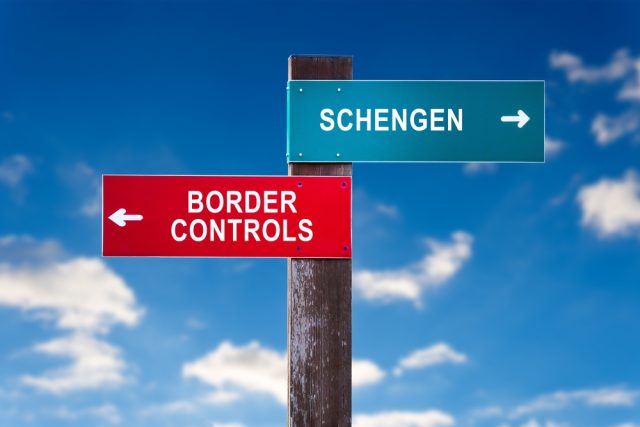
This asymmetry between centralised decisions and local consequences is putting the Schengen system under unprecedented political stress. Although free movement remains an indispensable pillar for most Europeans, its survival paradoxically depends on the ability to restore confidence in the security of external borders. The fact that twelve governments have notified the temporary reintroduction of internal border controls since the beginning of 2025 — eight of which explicitly cite migration as the cause — should not be interpreted as a desire to dismantle the area of free movement, but as a self-defence mechanism in the face of secondary flows that the current rules are unable to contain. When internal border control becomes standard practice, it is a sign that the contract of trust based on shared responsibility has entered into crisis.
The European response and its structural limitations
In this context, the response of the European institutions, culminating in the new Pact on Migration and Asylum and the agreements on the “solidarity pool”, represents a necessary but still incomplete attempt to address the problem. Recent reforms on return procedures and lists of “safe countries of origin” point in the right direction towards greater firmness, but they do not resolve the fundamental issue of operational competence. For a European conservative, the issue is clear: political responsibility must follow effective competence. If national governments are accountable to their voters for public safety, social cohesion and the sustainability of local services, they must retain the right to decide who enters and resides on their territory. Effective European cooperation should not translate into blind delegation to centralised bodies, but into subsidiary support for Member States managing the front line of external borders.
Sovereignty and Treaties: a possible rebalancing
It is also worth remembering, without indulging in polemical exaggeration, that the current structure of the European Treaties does not impose any legal obligation on Member States to delegate all their powers in the area of border control and migration management. Migration policy is, by its very nature, an area of shared competence, in which the role of the Union should be to support and coordinate the actions of Member States, not to replace them. The tendency to interpret every request for greater national control as a violation of the “European spirit” therefore has no solid legal basis, but rather reflects an extensive political interpretation that has ended up fuelling ambiguity and institutional tensions. In this sense, the demand for clearer national ownership of operational decisions does not represent a break with the European order, but rather a possible rebalancing of it.
Control and humanity: a false dichotomy
Finally, there is a human dimension that requires the restoration of order. Despite the decrease in arrivals, the cost in terms of human lives in the Mediterranean remains dramatic, with over 1,700 victims recorded in 2025 alone. It is a moral error to contrast control with compassion: disorder at the borders only fuels the criminal business model of human traffickers, encouraging dangerous journeys based on the illusion of an asylum system that has, in too many cases, become an improper channel for economic migration. A firm, predictable and legally based control system is the only real precondition for a humane migration policy capable of protecting those who are genuinely entitled to asylum and discouraging those who attempt to circumvent the rules.
The crux of democratic legitimacy
It is precisely in this area that a decisive part of the credibility of the European institutions is at stake today. When a large majority of citizens perceive a growing distance between decisions taken at supranational level and the concrete effects on local communities, the risk is not only political but also democratic. The demand for greater national border control does not express nostalgia for the past, but rather the need to re-establish a clear link between decision-making, responsibility and consensus. Ignoring this signal would further fuel the divide between citizens and institutions, with consequences that go far beyond the issue of migration alone.
Reforming without breaking
Ultimately, Europe is not faced with a binary choice between isolation and openness, but with the need to realign its governance with reality. Reforming without breaking means accepting that national sovereignty is not an obstacle to cooperation, but the foundation on which it must rest in order to be credible. Only by restoring the ability of states to act and protect their citizens will it be possible to preserve Schengen and, with it, citizens’ trust in a Europe that is finally up to the challenges of the 21st century.