


 Subscribe


There is an image, almost literary in its dramatic intensity, that conveys the profound unease of our time. In her recent 2026 State of the Union Address, European Commission President Ursula von der Leyen evoked a scenario that, until just a few years ago, we would have relegated to Orwellian dystopia: “the great capture of our children.” Young people spending between four and six hours a day in front of screens, sucked into feeds scientifically designed to eliminate attention spans, colonise minds, and deprive them of childhood itself.
Faced with this downward spiral, which threatens not only the economy but the very essence of Western civilisation, the Brussels address offers a twofold approach: on the one hand, embracing the potential of Artificial Intelligence as applied to the real economy; on the other, imposing a robust regulatory clampdown on social platforms and strengthening the protection of minors. This is a turning point that deserves in-depth analysis, stripped of technocratic rhetoric. Indeed, when viewed through the lens of conservative realism, the digital challenge of our century reveals a fundamental truth: technology is not a neutral god to which we must sacrifice our future, but a tool that must remain firmly anchored in the values of the individual, the family, and cultural sovereignty.
In the official 2026 State of the Union document, Artificial Intelligence is not presented as an abstract programming exercise, but rather as the backbone of the continent’s future security and productivity. The European Commission has wisely understood that the real contest is not about creating large frontier models — an area in which the Chinese Dragon and Silicon Valley giants enjoy an almost insurmountable competitive advantage — but about the ability to apply AI to the existing industrial fabric.
The European plan, which will see strategic initiatives launched in November, focuses on five high-value-added sectors in which Europe possesses exceptionally high-quality historical data:
- Healthcare and diagnostics (such as early breast cancer screening);
- Transport and autonomous mobility;
- Precision agri-food production;
- Advanced manufacturing;
- Defence and aerospace.
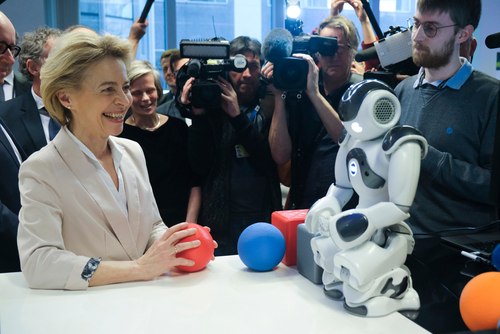
The stated objective is to improve energy efficiency and reduce costs, but subject to an inviolable condition: preserving human initiative and agency (human agency). One particularly telling passage rejects the idea of a robot doctor: the algorithm must empower the clinician, not replace human compassion and judgement.
However, the European approach to social policy risks slipping into its usual dirigiste tendencies. While the Quality Jobs Act and the announced European Care Deal seek to address the asymmetries generated by automation, Brussels’ bureaucratic obsession risks stifling the labour market rather than making it more dynamic. A true conservative knows that worker protection does not arise from new centralised decrees, but from strengthening intermediary institutions, family businesses, and continuing education rooted in local communities.
The most courageous and politically significant part of the address undoubtedly concerns the announcement of the EU KIDS ACT. The Commission is proposing a layered system of protection and a genuine legal revolution: reversing the burden of proof. Families will no longer have to prove that an application is harmful; instead, Big Tech companies will have to demonstrate that their algorithms are entirely safe for minors.
The plan envisages an absolute ban on access to social media for children under 13 and a prohibition on personal accounts until the age of 15, at which point only “mini-accounts”, fully supervised by parents, will be permitted. Between the ages of 15 and 18, a safe design requirement will come into force, eliminating predatory features that foster addiction or expose girls to the ordeal of sexually explicit deepfakes. Next autumn, the framework will also be complemented by the Digital Fairness Act, extending protection to the entire population against the hypnotic design of digital interfaces.
This legislative shift, although originating from an institution traditionally regarded as progressive and globalist, such as the European Commission, addresses a need that is profoundly conservative in nature. When the text of the address emphasises that “children need time to be bored… because that is when they use their imagination, talk, agree, disagree, and form an opinion”, it is articulating an extraordinary defence of the natural order of human development.
Philosophical conservatism, from Edmund Burke to Roger Scruton, has always viewed with suspicion anything that severs real communal ties in favour of artificial abstractions. In the hands of a pre-adolescent, the smartphone acts as a social solvent: it undermines family authority, replaces the civic catechism of the community with the moral dictates of TikTok influencers, and atrophies the capacity for judgement. Protecting minors from Big Tech is not an act of state censorship, but an act of legitimate self-defence on behalf of family sovereignty. The family is the first and fundamental natural society; if the state allows foreign, transnational corporations to bypass parental authority in order to monetise their children’s mental health, then the state is failing in its primary duty.
To understand the scale of this battle, it is worth stepping away from the halls of Brussels for a moment. Imagine a square in a small Bavarian town or somewhere in central Italy. Until fifteen years ago, Saturday afternoons were marked by the sound of footballs striking church walls, scraped knees, and lively arguments among teenagers learning the art of social diplomacy through physical contact, eye contact, and tone of voice.
Today, in that same square, an almost spectral silence often reigns. Five or six young people sit on the same bench, side by side, yet their eyes are glued to a glowing screen. They do not look at one another. They do not talk. They communicate through instant notifications sent from just a few centimetres away. A local parish priest, deeply traditional in outlook, recently told me: “I used to hear confessions of youthful rebellion and minor transgressions. Today, young people bring me a sense of emptiness, a kind of digital performance anxiety that robs them of sleep. They have a thousand virtual friends and not a single real shoulder to cry on.” This is not evolution; it is an anthropological mutilation. In this sense, the EU KIDS ACT merely codifies a resistance that civil and spiritual society has been calling for over a long period.
While Europe debates regulatory questions of the highest order, the international landscape is moving at breakneck speed. In the United States, the debate on AI is moving beyond the logic of Silicon Valley alone towards a vision of national and economic security that aligns more closely with the concerns of the industrial and identity-oriented right. The competition with China will not be won by signing treaties, but by repopulating factories and integrating automation systems in order to bring manufacturing production back to the West.
This is precisely where innovation management and conservative thought converge. We should not fear Artificial Intelligence applied to turbines, electricity grids, or precision medicine. Such efficiency is welcome because it preserves our economic competitiveness and guarantees strategic independence. The real distinction to be made — and one that conservative leaders must emphasise forcefully — is between AI that serves the human intellect and AI (or platform capitalism) that enslaves the human soul.
Von der Leyen’s 2026 address, despite all the historical limitations of European centralism, has the merit of drawing a line in the sand. It is now up to European conservatives to remain vigilant, ensuring that these regulations do not become a pretext for restricting citizens’ freedom of expression, but remain focused on defending human dignity, the sanctity of childhood, and the centrality of the family. For Western civilisation will not be saved by sacrificing itself on the altar of unrestrained technological progressivism, but by keeping alive the flame of what makes us authentically human.