





 Subscribe


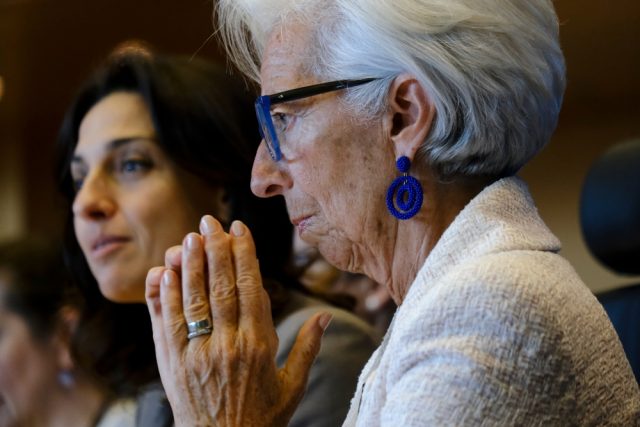
On February 18, 2026, a leak orchestrated through the Financial Times tore away the veil of apparent technocracy that surrounds the Eurotower: Christine Lagarde is reportedly considering early resignation. The ECB’s official response — “no decision has been taken” — is the classic smoke signal which, in political intelligence jargon, confirms that a maneuver is underway.
This is not a trivial rotation of banking positions. We are in the midst of a preventive institutional engineering operation that lays bare the systemic fragility of the European Union and transforms monetary policy into a shield against popular sovereignty.
The Politicization of Monetary Defense
The thesis reported by the media is chilling in its linearity: Lagarde should leave before the natural expiry of her term in October 2027 to allow Emmanuel Macron to secure the appointment of her successor before Marine Le Pen’s Rassemblement National can claim that power.
From the perspective of European security, this is not “stability”; it is procedural subversion. If the ECB, the only truly federal and autonomous institution in the EU, is used as a tactical weapon to neutralize the outcome of future democratic consultations, the damage to the credibility of the European order is greater than any spread crisis.
- The dangerous precedent: An automatism is created whereby the calendar of independent institutions is synchronized with the survival needs of national elites.
- The architectural flaw: The independence of the ECB, born as a dogma to protect the value of the currency, is now invoked to protect a specific political order, transforming it from referee to partisan player.
Geopolitics of the Euro: Between Eurobonds and the “Currency War”
The analysis cannot stop at the French border. The ECB is attempting to take a leading role in the global geopolitical challenge: from the launch of Eurobonds to the management of international liquidity to compete with the dollar and the Trump administration’s stablecoins.
In this scenario, the presidency of the ECB is no longer just an economic position, but a Strategic Command. Berlin’s haste in declaring a German candidacy — with names such as Joachim Nagel or Isabel Schnabel — “perfectly conceivable” reveals Germany’s desire to regain control of the monetary helm to balance French activism. For Italy, the prospect of a German or Dutch “super hawk” (such as Klaas Knot) represents a direct threat to debt sustainability and, by extension, to national social stability.
Post-Lagarde profiles and strategic doctrine
If the succession becomes a battleground between worldviews, here are the profiles that could change the face of the Eurotower:
- Joachim Nagel (Germany) – The return to “Fortress Marco”: His candidacy represents Berlin’s desire to restore monetary orthodoxy. However, his recent openness to Eurobonds suggests a new pragmatism: the awareness that German stability today depends on the resilience of the European defense industry. Nagel at the ECB would mean a more rigorous institution but one that is potentially more integrated into the financing of common security.
- Fabio Panetta (Italy) – The Digital Euro as a geopolitical asset: Former governor of the Bank of Italy, Panetta is the theorist of technological monetary sovereignty. For him, the ECB must protect the EU’s strategic autonomy against the excessive power of American Big Tech and Chinese payment systems. A profile that breaks with pure technicality, seeing currency as an instrument of power projection.
- Pablo Hernández de Cos (Spain) – The mediator of balance: Former governor of the Bank of Spain, he represents institutional continuity. He is the most suitable candidate if the EU decides to “freeze” the political confrontation, focusing on a figure with a high technical profile capable of dialoguing with the markets without lending himself to electoral engineering operations.
- Klaas Knot (Netherlands) – The vanguard of the “Frugal”: His appointment would send an unequivocal signal to the markets and the capitals of the South: the time for flexibility is over. In geopolitical terms, Knot represents a Europe that is closing in on fiscal discipline, but at the risk of leaving itself unprotected on the flank of the investments necessary for industrial and military transition.
The Strategic Risk: Democracy as a “Threat to Security”
The most disturbing aspect is the underlying narrative: the idea that a democratic vote (the French one in 2027) is such a threat to European financial security that it justifies a “blitz” at the top of the Eurotower.
This view has three harmful effects:
- Erosion of Legitimacy: If citizens perceive that key decisions are being made in advance, thereby nullifying their vote, the European social contract will be irrevocably broken.
- Market Retaliation: The artificial stability created by an early political appointment is a house of cards. The markets punish the lack of transparency and the perception that the central bank has become a branch of the Élysée Palace.
- External Vulnerability: A Europe that manipulates its internal rules for partisan purposes is a weak Europe, exposed to pressure from Washington and Beijing, which will not hesitate to exploit these institutional fractures.
True European security does not come from engineering calendars, but from the ironclad nature of the rules. If Lagarde’s term expires in 2027, it must end in 2027. Any deviation motivated by fear of the ballot box turns the ECB into a permanent election committee.
The gamble of an early succession is not only a democratic blunder, but a security vulnerability. The ECB’s strength lies in its operational independence, which allows it to act as a technical rather than a political lender of last resort. If this independence is sacrificed on the altar of short-term political stability, the transmission of monetary policy is compromised. In a context of ‘fragmented geo-economics’, where access to markets and payment infrastructures has become a weapon of coercion, the ECB cannot afford to appear as a partisan actor. An appointment perceived as a ‘blocking’ move would expose the Eurozone to speculative attacks and a loss of international confidence just as it is trying to promote the euro as a global alternative to the dollar.European conservatism must demand a return to the original mission: a central bank that is the guardian of the currency, not the guardian of governments. The stability of the Union is not achieved by shielding institutions against democracy, but by making institutions so solid and neutral that they can survive any political change. Without this consistency, there is no defense, no security, no future for the continental order.
“The real issue at stake is not who will sit at the top of the Eurotower, but whether Europe will be able to manage the transition to a multipolar global order without losing its internal legitimacy. The ECB is already planning its defense against cyber and geopolitical risks through targeted stress tests for 2026, recognizing that financial stability is now inseparable from national security. However, resilience is not built solely with algorithms or currency reserves, but with the solidity of institutions.
A European architecture that ‘plays ahead’ against its own citizens to preserve the status quo is not a secure architecture; it is a fragile architecture. The future of European defense — whether we are talking about Eurobonds for military spending or Digital Euro for payment autonomy — requires a consensus that no political maneuvering can replace.
European conservatism must demand a return to its original mission: a central bank that is the guardian of the currency, not the guardian of governments. The stability of the Union is not achieved by shielding institutions against democracy, but by making institutions so solid and neutral that they can survive any political change. Without this consistency, there is no defense, no security, no future for the continental order.
The lesson is clear: European security comes from respect for rules and transparency, not from power engineering. Only by remaining apolitical can the ECB continue to be the pillar of European sovereignty in a world that makes no concessions to those who are divided internally.