





 Subscribe


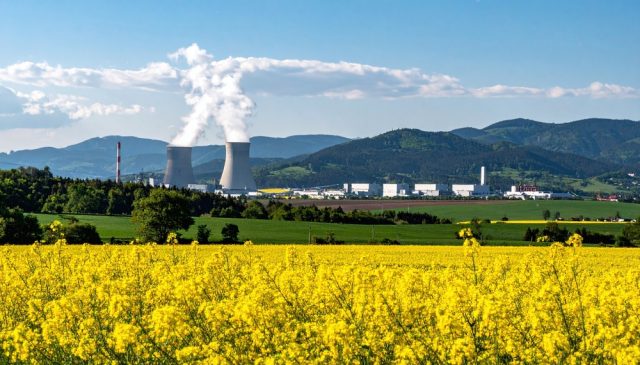
For decades, Europe’s energy policy has been shaped less by strategic realism than by ideological reflex. Nowhere has this been more evident than in its long and often irrational aversion to nuclear power. Yet history has a way of exposing comfortable illusions. As instability in the Middle East with Iran’s blockade of the Strait of Hormuz —and U.S. blockade of Iran’s blockade, as painfully explained by U.S. Secretary of War, Pete Hegseth recently— once again sends fossil fuel markets into turmoil, Europe may finally be forced to confront a painful truth: its anti-nuclear stance was not prudent environmentalism, but strategic self-harm. Suicide, actually.
A serious disruption to Gulf oil and gas flows is immediately reverberating across global energy markets. Europe, still heavily dependent on imported hydrocarbons despite years of green rhetoric, is already face soaring prices, industrial strain, and renewed vulnerability to external shocks, as it also happened under Covid-19. In such a scenario, many Europeans are beginning to realise that the narratives long deployed against nuclear power—of apocalyptic danger, unsolvable waste, and inevitable catastrophe—were less grounded in reality than in a collective political hallucination. The anti-nuclear consensus may come to be seen for what it increasingly appears: not wisdom, but a bad dream; indeed, a nightmare from which Europe must urgently awaken.
The timing for such a reassessment could hardly be more appropriate. Across the continent, the political tide is already turning. Most symbolically, Belgium—once one of Europe’s most committed nuclear phase-out states—has dramatically reversed course. In a landmark decision announced this week, the Belgian government moved to acquire the country’s nuclear assets from Engie and suspend decommissioning plans, explicitly citing energy security, affordability, and reduced fossil-fuel dependence as motivations. Belgium’s volte-face is not merely technical; it is emblematic of a broader European reconsideration.
Elsewhere, the nuclear revival is already underway. France remains committed to expanding its reactor fleet. Poland is pressing ahead with its first commercial nuclear programme. Czech Republic and Romania are expanding capacity. Even historically sceptical states such as the Netherlands and Sweden have reopened the debate.
Perhaps most consequentially, Hungary has continued to double down on nuclear energy through the construction of Paks II, the expansion of its flagship nuclear plant with Russia’s state nuclear company Rosatom. Construction officially entered its major phase in early 2026 with first concrete poured for Unit 5. Whatever one thinks of the geopolitical complications surrounding Russian involvement, the strategic logic behind Budapest’s decision is difficult to deny: in a volatile world, states that can generate stable baseload electricity domestically possess a structural advantage over those dependent on imported hydrocarbons.
Indeed, Paks II illustrates both the promise and the paradox of Europe’s nuclear moment. Hungary correctly understands that energy sovereignty requires dispatchable domestic generation. Yet because much of Western Europe spent years dismantling its own nuclear industry, Budapest has had little choice but to turn to external suppliers—including geopolitical rivals—to secure that capability. Europe’s anti-nuclear dogma has therefore not reduced dependency; it has merely shifted and in some cases worsened it.
The strategic case for nuclear power is becoming overwhelming. Unlike wind and solar, nuclear provides continuous baseload generation irrespective of weather conditions. Unlike gas, it does not expose states to the geopolitical leverage of exporters. Unlike coal, it does not undermine decarbonisation targets. And unlike the caricatures propagated by activists for decades, modern Generation III+ reactors bear little resemblance to the outdated technologies associated with the accidents of the twentieth century.
What Europe is slowly rediscovering is something previous generations understood instinctively: civilisational power rests upon secure, abundant, controllable energy. The U.S. knows it, China knows it, Russia knows it, and Europe must learn that this is an unescapable reality.
For too long, European elites attempted to substitute industrial realism with moral posturing—imagining that intermittent renewables, imported LNG, and wishful thinking could together sustain advanced economies. The Ukraine war shattered part of that illusion. A major Iranian fossil fuel disruption could shatter the rest.
As Tehran’s actions—and broader instability in the Gulf—once again expose the fragility of global hydrocarbon supply chains, Europe must finally conclude that energy policy cannot be outsourced to ideology.
Europe’s anti-nuclear era was built on fear. Its nuclear revival will be built on necessity. And history suggests necessity is the stronger force. After all, it is also referred to as survival instinct.