





 Subscribe


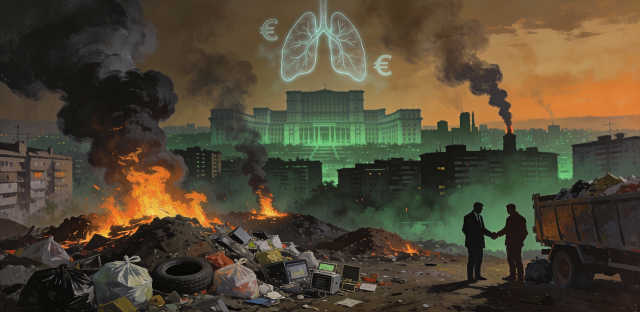
Romania’s air pollution crisis today is a tangled mix of urban smog and the toxic smell of the waste that is illegally burned around Bucharest, with very high human and financial cost consequences and that exposes some pretty troubling connections between local power dynamics and the proliferation of the so-called “waste mafia.”
Fine particulate matter from traffic, industry and domestic heating has already put Romania in some of the EU’s worst performers, with PM2.5 figures that are nearly three times the WHO’s recommendations and considerably above the EU urban mean. Illegal garbage burning outside of Bucharest and close vicinity to Ilfov and Giurgiu counties compounds this baseline with a cocktail of dioxins, heavy metals and microplastics, with trash piles and electronic waste publicly set on fire to be scrap or disposed of. Those pollutants compound risks of asthma, cardiovascular disease and cancer, especially in disadvantaged communities located proximate to the dumps, but not able to access quality health care.
These impacts are even greater for urban residents, particularly in Bucharest and large industrial areas where pollution episodes can reach up to five times recommended safety thresholds. A European Public Health Alliance–commissioned study estimated that air pollution costs each resident of Bucharest over 3,000 euros per year in lost health, productivity and welfare, the highest per‑capita damage among EU capitals. In many cities in Romania, total health‑related social costs attributable to air pollution have been estimated at around 8–10% of local income, underlining the unspoken ways that pollution erodes wellbeing and future economic opportunities. Apart from medical costs and lost working days, Romania faces increasing legal and financial risks at the EU level.
In December 2025 the European Commission referred Romania to the Court of Justice of the European Union for systematically failing to ensure a functional air‑quality monitoring network, including too few sampling points and poor‑quality data for PM10, PM2.5, sulphur dioxide, nitrogen oxides, heavy metals, etc. Romania could receive lump‑sum fines and daily penalty payments until it reaches compliance if the Court confirms these breaches of ambient air‑quality directives, indirectly increasing the economic cost of pollution.
Fields and riverbanks have also been documented covering mixed construction debris, plastics and tyres in localities including Bolintin‑Vale and Sintești which residents burn to recover steel valued at just several €, whilst fumes travel up to 25 kilometers into Bucharest’s air basin. Public health and economic research estimate that air pollution costs Bucharest residents already thousands of euros per person annually in a health cost and lost productivity each year in damage to health, according to public‑health research, while the strain from illegal waste burning has local costs estimated to be many times higher than would have been feasible through our usual measure of environmental cost.
Reporters and prosecutors are described as the perpetrators of an entrenched waste‑management “mafia” that benefits by importing rubbish from Western Europe, operating illicit dumps and bypassing proper pollution treatment fees. These networks depend on corrupt officials who bypass violations, issue attractive permits and close investigations, assisted by a long‑standing combination of poorly funded regulators and inconsistent local governance in Bucharest’s six sectors. Whistle‑blowers report how efforts to impose more rigid tax on waste as fuel were refused in response to lobbying from powerful industrial interests, thus showing the political power this business is able to exert.
The European Commission has subsequently informed the EU Court of Justice Romania has failed to operate an effective air‑quality monitoring system, contending that its lack of data and lack of enforcement seriously undermines the EU’s rules on pollution. In the region of Bucharest–Ilfov, the Environmental Guard already announced that it has served nearly 2.5 million lei in fines in 2025 alone, including drones to find illegal fires in places such as Vidra and Sintești. Nevertheless, multiple visits indicate that burning and dumping continue, as the penalty is still lower than a company’s profit from the waste trade.
EEA country profiles indicate that while several European Union countries have accelerated urban PM2.5 toward or below ten micrograms per cubic meter, Romania’s emissions still rank among the bloc’s highest, with several regions such as Bucharest experiencing spikes in ambient pollution orders of magnitude above EU limit values. Regional analyses rank Romania as one of Europe’s most polluted countries, and the smoke from illegal dumping ensures that a city’s people inhale a blend of standard traffic smog and unregulated industrial-grade emissions from burned plastics, tyres and electronics on illegal dump sites everywhere in Romania. Compared with other European Union countries that monitor waste and implement rigorous waste and incineration rules, Romania’s poor record with no official data, tolerated illegal garbage and captured its regulators leave people on the hook for disproportionate health threats.
A number of European countries have concrete examples of how we can combat waste-related pollution and organised crime. Italy’s “Land of Fires” where mafia‑led dumping and burning of toxic materials was once notorious is starting to decrease following the creation of specialized anti‑mafia units, tougher environmental crime laws and transparent tracking of contaminated sites, along with support for legal waste‑treatment alternatives, the report added. Poland established a special unit in its environmental inspectorate to zero in on a “trash mafia” that illegally burned and dumped waste by the thousands, using police, prosecutors and customs to dismantle networks and quickly close illegal sites.
Replicating these approaches for Romania would mean criminalising entirely all illegal burning and burying of waste, investing in environmental prosecutors and intelligence‑led teams, and protecting whistleblowers in public institutions and private firms. Just as crucial is to choke economic oxygen on the garbage mafia by doing so through transparent public tenders, realistic landfill and incineration rates, and EU‑based investments in “new age” recycling and waste‑to‑energy plants, so local authorities and politicians will not profit off of dumping trash into the dark corners of society.