





 Subscribe


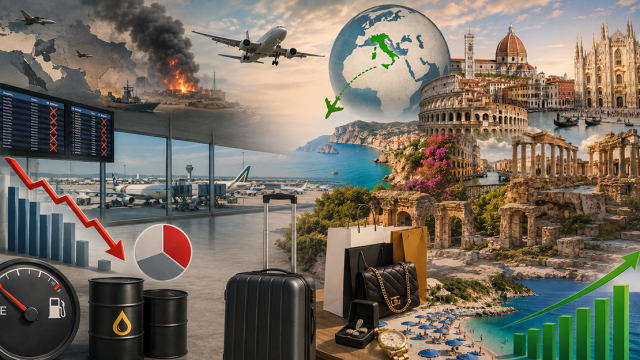
Conflict disrupts air travel, deters high-spending visitors from the Gulf, and reshapes Italy’s tourism landscape, even as overall international demand remains historically strong.
The ongoing conflict involving the United States and Iran is reshaping global travel patterns, with Italy emerging as one of the countries feeling the economic consequences. While the Italian tourism industry continues to perform strongly overall, the sharp decline in visitors from the Persian Gulf has exposed the vulnerability of one of the country’s most lucrative tourism segments.
According to the latest report by the Bank of Italy, tourist arrivals from the Gulf region have fallen dramatically since the outbreak of hostilities. Using anonymized mobile phone data, analysts found that the number of visitors from Gulf countries declined by approximately 35% in March, plunged by around 60% in April, and remained 20% below last year’s levels in May. The figures represent one of the steepest regional declines recorded this year.
The downturn is largely attributed to growing concerns over aviation safety and travel reliability. Major international hubs such as Dubai, Abu Dhabi, and Doha—normally among the busiest transit airports connecting Europe with Asia and the Middle East—have been perceived as less secure because of regional tensions. At the same time, disruptions in aviation fuel supplies and widespread operational uncertainty have discouraged travelers from booking long-haul flights.
The International Air Transport Association (IATA) estimates that during the first week of March alone, approximately 85% of flights departing from or arriving at Gulf airports were cancelled. Although flight operations gradually resumed, by the end of the month fewer than half of the originally scheduled services remained operational. Compared with pre-war flight schedules, nearly one in four flights planned for May was ultimately cancelled, while airlines also reduced capacity for the peak summer season.
The current situation marks a sharp reversal from the positive momentum experienced throughout 2025 and early 2026. Last year, Italy enjoyed robust tourism growth driven by the Jubilee celebrations in Rome, which attracted millions of international visitors. The first quarter of 2026 also exceeded expectations thanks to the economic boost generated by the Milan-Cortina Winter Olympics, temporarily offsetting the early effects of geopolitical instability.
Foreign visitor spending in Italy increased by 4.6% in 2025, reflecting both higher arrivals and stronger demand for cultural tourism. German tourists remained the largest international market, generating €8.8 billion in spending and approximately 13 million overnight stays. American visitors ranked second, contributing €6.6 billion despite a smaller number of arrivals, thanks to their longer average stays. During the first three months of 2026, Italy’s tourism balance continued to improve, with foreign visitor spending accelerating by 5.4%.
The decline in Gulf tourism is particularly significant because visitors from the region traditionally belong to the highest-spending segment of the international market. They frequently choose five-star hotels, dine in premium restaurants, shop extensively for luxury fashion and jewelry, and purchase personalized travel experiences in Italy’s most renowned art cities. Their economic contribution extends well beyond accommodation, supporting luxury retail, hospitality, and high-end services.
Before the current crisis, Italy’s National Tourism Agency (ENIT) had forecast approximately 964,000 arrivals from the Middle East during 2025, representing annual growth of more than 21%. More than 310,000 visitors were expected to come from the United Arab Emirates alone. ENIT also estimated that around 83% of Gulf travelers would choose Italy’s historic cities, with luxury shopping and cultural tourism ranking among their primary motivations.
Despite these disappointing figures, the broader outlook for Italy’s tourism industry remains remarkably positive. According to estimates by CNA Turismo e Commercio, the country is expected to welcome more than 224 million tourist overnight stays between July and September, establishing a new all-time summer record. Direct tourism spending during the period could approach €27 billion, while the total economic impact is projected to range between €43 billion and €48 billion.
The recovery appears even more impressive when compared with previous years. During the summer of 2019, before the COVID-19 pandemic, Italy recorded approximately 215 million overnight stays. This year’s projection exceeds that figure by more than nine million nights. Following the collapse of summer tourism to fewer than 140 million overnight stays in 2020, the sector has recovered more than 80 million overnight stays within six years, returning to historic highs.
Strong international demand continues to fuel this expansion, particularly from the United States, Germany, France, and the United Kingdom. Italy’s enduring appeal as a cultural destination, the growing popularity of food and wine tourism, and the extension of the travel season into September have all strengthened the industry’s resilience. The Amalfi Coast, Salento, Sardinia, Sicily, the Romagna Riviera, Lake Garda, and the Dolomites remain among the country’s most sought-after destinations, while Rome, Florence, Venice, Naples, and Milan continue to dominate city tourism. At the same time, smaller destinations known for their local traditions, craftsmanship, and authentic experiences are attracting increasing international attention, helping diversify Italy’s tourism success even amid geopolitical uncertainty.
Alessandro Fiorentino