





 Subscribe


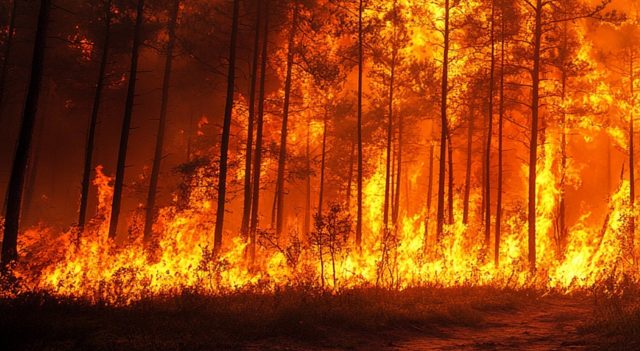
The summer of 2026 has also brought severe strain to Southern Europe in the form of forest fires. In late July, there were widespread reports of fires in France and Spain; Italy and Greece have also been affected.
Naturally, reporting on these fires is accompanied by reminders of climate change. To the layperson, it seems difficult to question that connection. Long, dry, hot summers inevitably make the European continent more vulnerable to fires. Prolonged heat, drought, and—in the worst-case scenario—wind can cause small fires to rapidly escalate into major ones.
An online search reveals that the Earth’s average temperature has risen by approximately 1.3 to 1.4 degrees Celsius since pre-industrial times—that is, since the 19th century. One also learns that this rapid rise in temperature is attributed to increased carbon dioxide emissions.
There is likely no reason to question this. It is therefore natural to link the forest fires that occur during hot, dry summers to climate change—and, by extension, to the carbon dioxide emissions driving those changes.
However, we have all likely heard of the Danish researcher and writer Bjørn Lomborg. In books such as “The Skeptical Environmentalist” (originally published in Danish in 1998) and “False Alarm” (2020), he attempts to provide a more nuanced perspective on what he views as the unjustified alarmism prevailing worldwide regarding climate change and its consequences.
Lomborg argues that the environmental movement exaggerates the threat climate change supposedly poses to humanity. He further contends that alarmism leads us to make poor and costly decisions regarding environmental policy. There are better ways to address the annual forest fires in Southern Europe than by forcing European populations to cut carbon emissions.
But the most shocking thing about Lomborg is his assertion that forest fires are a diminishing problem globally. In a recent Facebook post from July 30, Lomborg writes that Europe is experiencing less burning than normal in 2026 and that all continents are seeing less fire activity this year than the long-term average.
He criticizes an earlier Facebook post by the Danish Minister for the Environment, the socialist Maria Eumert Gjerding, in which she links the current fires in France and Spain directly to the climate crisis. The minister writes: “This summer’s forest fires make it clear: the fight against climate change is more important than ever.” Later in the post, the minister discusses the government’s actions regarding the “climate transition,” specifically mentioning the shift in agriculture and the energy system.
However, Lomborg considers these measures pointless and ineffective. He argues that the minister is engaging in scaremongering unsupported by data. Of course, we should address carbon emissions in the long run, but this must be done in a reasonable and effective manner. We must also be willing to acknowledge that, over the past twenty years, the area affected by forest fires annually has decreased from three percent of the Earth’s surface to just two percent.
But how, then, is it possible—one might wonder—for people in Southern Europe to perceive forest fires as a growing problem? And how is it possible for fire safety authorities to routinely describe forest fires as an escalating issue? To an outsider, these contradictory accounts appear utterly baffling.
One criticism leveled at Lomborg’s line of reasoning is that the overall reduction in the area affected by forest fires is due to today’s superior technical capabilities for firefighting. It is also a matter of forest and wild vegetation having been converted into agricultural land. Furthermore, it has been argued that Lomborg downplays the specific problems facing certain densely populated regions, such as Southern Europe. Some have even claimed that Lomborg’s arguments are unethical, as they aim to diminish our concern regarding the grave issue of climate change.
Yet the fact remains: overall, the total global area affected by forest fires has indeed decreased. From that perspective, there may well be some merit to Lomborg’s idea that there is no direct link whatsoever between our consumption and lifestyle habits (which impact the climate) and the supposedly increasing incidence of fires.