





 Subscribe


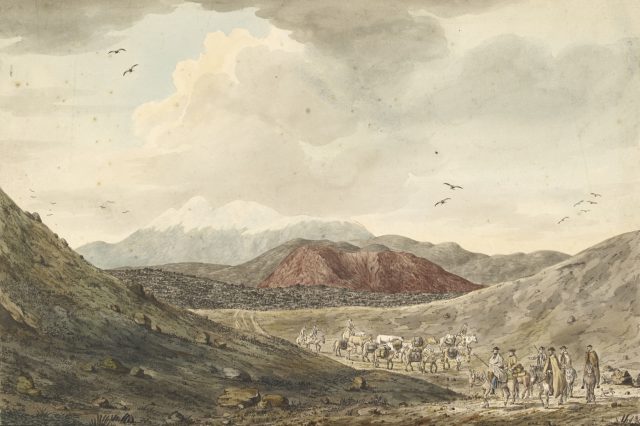
Few people have taken an interest in Iceland, a barren outpost and long a Danish dependency. Yet Iceland has had a few good friends abroad. They include the Danish polymath Ole Worm (1588–1654), who saved many of the ancient Icelandic manuscripts from destruction; the Danish king Frederick VI (1843–1912), who sincerely wanted to recognise Iceland as a sovereign country; and Lord Daniel Hannan (b. 1971), who eloquently defended Iceland during the 2008 Icelandic bank collapse. I can, however, think of only two foreigners whose actions have been crucial to Iceland in moments of need: the British botanist Sir Joseph Banks (1743–1820) and the Swiss lawyer Dr Carl Baudenbacher (b. 1947).
Banks Saved Iceland from Famine
In 1772, Sir Joseph Banks financed an expedition to Iceland, where he and his entourage climbed the legendary volcano Hekla and studied not only the island’s animals and plants but also its glaciers and geysers. Banks visited Iceland’s Deputy Governor, Ólafur Stephensen, and met his ten-year-old son, Magnús. In Iceland, Banks was accompanied by the draughtsman John Cleveley Jr., who depicted the travellers descending Hekla (see above).
In 1807, Banks was President of the Royal Society and an adviser to the British government. That year, during the Napoleonic Wars, hostilities broke out between the United Kingdom and Denmark. The Royal Navy patrolled the North Atlantic to enforce the British blockade of the continent. Ships arriving from Iceland in the autumn were captured, and their crews and passengers detained. Among the passengers was Iceland’s Chief Judge, Magnús Stephensen. He eventually reached Copenhagen, where he realised that Iceland might face famine if transport to and from the island were halted for years. He recalled the English visitor he had met as a lad 35 years earlier, Sir Joseph Banks, and wrote to him, describing their meeting and the present plight of his compatriots.
In the years that followed, Banks secured permission for ships to sail to and from Iceland. His personal friend, King George III, even issued an Order in Council in 1810 stating that the Icelanders, although subjects of the Danish king, should be considered friends. This was probably a unique document in military history. Thus, thanks to Banks, Iceland avoided the famine that Norway suffered because of the blockade, described in the famous poem Terje Vigen by Henrik Ibsen.
Baudenbacher Released Iceland from a Debt Prison
Dr Carl Baudenbacher was President of the EFTA Court in 2012, when a dispute between Iceland, on the one hand, and the United Kingdom and the Netherlands, on the other, was brought before the Court. In October 2008, Iceland’s three main banks collapsed. One of them, Landsbanki, had collected deposits in Great Britain and the Netherlands through its London branch, so the Icelandic Depositors’ Guarantee Fund was responsible for those deposits. However, that institution had negligible funds. The British and Dutch governments immediately reimbursed the depositors and presented the Icelandic government with a bill of four billion euros, plus interest. This was a staggering sum by Icelandic standards, half of the annual Gross Domestic Product, and even higher when interest was included.
The Icelandic government rejected the bill, arguing that liability lay solely with the Landsbanki estate and the Icelandic Depositors’ Fund; that the Icelandic state could not be held responsible for private transactions; and that it had adopted the required regulatory framework. The British government tried to force Iceland to accept liability by imposing an anti-terrorism law and by blocking a loan from the International Monetary Fund. It looked as if Iceland would be locked in a debt prison, similar to Haiti in 1825 and Germany in 1919. However, under Baudenbacher’s leadership, the EFTA Court found in Iceland’s favour on sound legal grounds. Eventually, the Landsbanki estate fully reimbursed British and Dutch depositors, but the interest payments would have been enormous: Haiti only paid up in 1947 and Germany in 2010.
In Iceland, Baudenbacher became a national hero, as Banks had been before him. On 10 August 2026, Baudenbacher will come to Iceland to advise the Icelanders on whether to remain in the EEA or to join the EU.