





 Subscribe


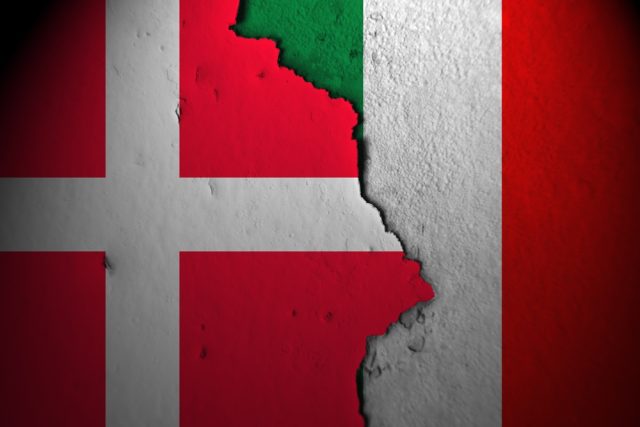
The most recent joint statement by Giorgia Meloni and Mette Frederiksen, the only two women currently leading governments in the European Union, has created waves across the European media landscape. It is not often that a conservative and a social democrat – both of whom have been in power for years in their own countries – jointly convey such a clear and powerful message on a topic toward which the left typically displays its usual ideological hostility. When a prominent figure of the right speaks about protecting Europe’s Christian heritage and how important it is that our values and way of life be respected by everyone who comes here, there is nothing unusual about that. But when a social democratic politician states the same ideas, from the very same angle as a conservative, we are, in fact, in a different paradigm – one that goes beyond ideology.
The president of the Italian Council of Ministers and the head of the Danish government are two leaders who, by progressive “standards”, should express aversion toward one another. Yet on more than one occasion, Giorgia Meloni and Mette Frederiksen have sat at the same table and spoken the same language. The Italian and Danish Prime Ministers are living proof that there are still politicians who prioritize the security of their own citizens, the fight against illegal immigration, and the crucial battle to defend European identity over ideological disagreements.
The collaboration between the two prime ministers did not begin now, with these statements published on August 10, 2026, but several years ago. In April 2023, Meloni welcomed Frederiksen to Palazzo Chigi to discuss, among other things, unrestricted immigration and effective measures to protect the European Union’s internal borders. A year later, in May 2024, just one day after the ratification of the infamous Pact on Migration and Asylum, Denmark and Italy, joined by other member states, signed a letter to the European Commission, calling for “complementary efforts” to stop waves of refugees from reaching Europe’s borders.
In October 2024, during a meeting held prior to the European Council summit, organized by Italy, Denmark, and the Netherlands, discussions focused on the “innovative solutions” offered by return hubs – which at the time seemed like a utopian idea to implement, but have now become an imperative policy. Once again, Giorgia Meloni and Mette Frederiksen held similar positions. “A great number of Europeans are tired of us helping people from outside who commit crimes. It can’t go on like this,” the Danish hard liner prime minister said at the time.
Another open letter, published last year in May, backed by the governments of Italy and Denmark and signed by seven other countries, called for a debate on the interpretation of the European Convention on Human Rights, in order to make it easier to deport foreign nationals who have committed severe crimes. This March, Meloni and Frederiksen sent a new joint letter to Brussels, warning that Europe cannot risk the reoccurrence of the horrific events of 2015–2016 and calling for the examination of emergency mechanisms in the event of a similar influx of migrants.
Two weeks ago, in the midst of the Ceuta crisis, Italy and Denmark once again took the lead in drafting a letter, signed by 22 EU heads of state and government, calling for a “coordinated European response” to the ongoing invasion of the Spanish enclave.
The joint statement issued on August 10 is only the latest in this line of significant developments. This time, the two prime ministers explicitly reaffirmed that illegal immigration is completely unacceptable. Furthermore, they stated that they are proud of our Christian cultural heritage, which must be protected at all costs. And those who come to European soil must accept and fully respect our values.
This is the unified vision that will ensure Europe’s survival. This cooperation also has a special symbolic dimension. Meloni is the new “Iron Lady” of the European right, while Frederiksen is a leading representative of Scandinavian social democracy. Their political differences have not disappeared. But the existential issues of migration and identity take precedence over ideological disputes. In an era when public discourse is flooded with the rejection of roots and the distortion of true values, their statement on the Christian heritage is like a breath of fresh air.
The Meloni-Frederiksen partnership should stand as a model, not as an anomaly. A model of a Europe that is fighting to remain Europe. Our continent of sovereign nations, with borders that must be defended and an identity that must be asserted. “We are united in our desire to look after Europe,” Giorgia Meloni and Mette Frederiksen stated on August 10. To protect Europe – that is, to protect ourselves.