





 Subscribe


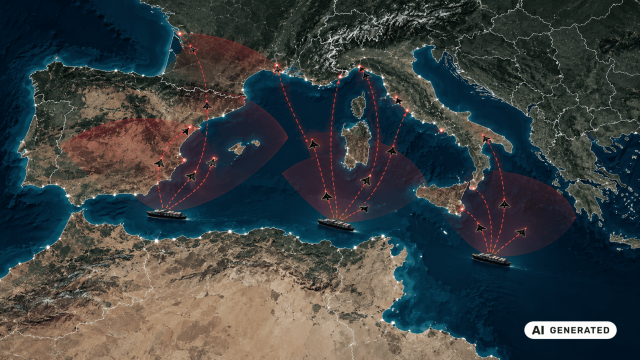
Reports of ship-launched drones fit into a broader pattern of Russian escalation. The Mediterranean can no longer be treated as Europe’s safe rear.
For many years, NATO’s southern flank viewed the Mediterranean mainly through the lenses of migration, energy security and naval competition. Russia’s war against Ukraine appeared to belong to a different geography: the Baltic, the Black Sea, Poland and the Alliance’s eastern border.
That distinction may no longer hold.
According to an investigation published on 23 September by the Spanish newspaper El Mundo, US intelligence services have informed several European governments of a possible Russian drone operation against Spain, France or Italy. The scenario described is as simple as it is disturbing: Gerbera drones concealed in shipping containers and launched from a merchant vessel a few hundred kilometres off the coast.
The report must be treated for what it is: an intelligence warning relayed by anonymous sources, not public proof of an operational plan already approved by the Kremlin. It would, however, be equally unwise to dismiss it as an isolated rumour.
The Wall Street Journal revealed that CIA Director John Ratcliffe’s August visit to Moscow was intended to warn Russia against attacking a NATO country. On 18 September, after bringing together intelligence chiefs and French party leaders, the Élysée Palace publicly warned of intensifying Russian hybrid threats and announced a plan to protect critical infrastructure and sensitive sites from drone and cyber attacks. A day earlier, Polish Prime Minister Donald Tusk told parliament that, according to available intelligence assessments, Russian plans also included hybrid drone and missile strikes against countries supporting Ukraine.
None of these statements confirms the specific Mediterranean operation. Taken together, however, they describe a strategic environment in which such a scenario can no longer be considered implausible.
The conclusion of Russia’s State Duma elections makes the timing even more sensitive. The vote was tightly controlled and offered no genuine anti-war alternative, but the Kremlin can nevertheless present United Russia’s victory as evidence of domestic stability and a political mandate to continue the conflict.
Three assessments published by RANE between 21 and 23 September point in the same direction. Moscow is likely to intensify attacks against Ukraine’s energy and logistics infrastructure while simultaneously accepting greater risks in its hybrid and covert operations against European countries. The resumption of high-level contacts with Washington does not necessarily alter that trajectory. For the Kremlin, diplomacy can proceed alongside military pressure rather than replace it.
It is precisely in the space between peace and open war that a ship-launched drone operation would acquire its strategic value.
The Gerbera is a relatively inexpensive aircraft, built from simple materials and used by Russia in several configurations: as a decoy to saturate air defences, as a reconnaissance platform and as an attack drone. According to the database maintained by Ukraine’s Defence Intelligence, it has sufficient range to reach coastal targets when launched from international waters. Its offensive version carries a much smaller warhead than a Shahed.
That limited destructive power helps explain its political utility. An attacker does not need to destroy an airport to disrupt its operations. Damaging a radar, hitting a storage facility, starting a fire or forcing the authorities to suspend flights could be enough. The material cost of such an attack would remain limited; its economic, media and psychological impact could be considerably greater.
One precedent demonstrates at least part of the method’s feasibility. In February 2026, while the French aircraft carrier Charles de Gaulle was visiting Malmö, the Swedish Armed Forces established that a drone had taken off from the Russian signals intelligence ship Zhigulevsk in the Øresund Strait. The Swedish Navy activated electronic countermeasures and classified the flight as a serious violation. It was not an attack, and there is no evidence that the drone was armed. The incident nevertheless confirms Moscow’s willingness to use naval platforms for unmanned aircraft operations near important Allied assets.
The Mediterranean also offers particularly valuable political targets. France, Italy and Spain possess some of Europe’s most important airports, ports, energy facilities and commercial corridors. Their economies depend heavily on uninterrupted transport and tourism. Under their respective electoral calendars, all three countries are also approaching significant votes in 2027.
In this context, the purpose of an incursion might not be to achieve a military result, but to demonstrate that national governments cannot protect their territory, generate public fear and turn support for Ukraine into a domestic political controversy. The difficulty of rapidly attributing a launch conducted from a civilian vessel would increase uncertainty and complicate NATO’s response.
Europe is not starting from zero. In February, the European Commission presented a plan to counter drone threats that includes shared testing capabilities, a European incident platform, joint procurement, annual exercises and a pilot project to improve maritime surveillance. NATO has announced investments of more than $40 billion in counter-drone capabilities over the next five years.
Technology alone, however, will not close the gap. Primary responsibility remains with the nation-states. Europe needs closer surveillance of shipping routes and suspect vessels; permanent coordination among intelligence services, navies, coastguards, customs authorities and port operators; layered protection for civilian infrastructure; and procedures that allow governments to respond quickly without paralysing entire cities.
Defending the southern flank does not mean militarising the Mediterranean or treating every merchant vessel as a threat. It means recognising that freedom of navigation and Europe’s commercial openness can survive only if its states retain the ability to control their own maritime approaches and airspace.
We do not know whether Moscow will implement the plan described by the Spanish sources. We do know that Russian hybrid warfare searches for the point at which a minimal investment can produce maximum political pressure. Southern Europe has considered itself far from the front for too long. That distance is no longer a guarantee.