





 Subscribe


On 21 September 2026, three members of the European Parliament, Adam Bielan, Mariusz Kamiński, and Carlo Fidanza, wrote to the European Union’s Commissioner for Foreign Affairs and Security Policy, Ms. Kaja Kallas, expressing concerns about the apparent use of the Brazilian judiciary against the regime’s political opponents and possible corruption within Brazil’s Supreme Federal Court. The three MEPs highlighted the activities of Alexandre de Moraes, a Supreme Federal Court Justice widely regarded as a staunch ally of the current Brazilian President, Lula da Silva.
Moraes Annulled Lula’s Conviction
Lula, the very left-wing leader of the Workers’ Party and Brazil’s President from 2003 to 2011, was convicted of corruption and money laundering in 2017. He was therefore barred from contesting the 2018 presidential election, which maverick right-winger Jair Bolsonaro won. He is a former military officer known for speaking bluntly, though sometimes tactlessly. Lula was convicted again in 2018 and 2019, and spent more than a year in prison. The most obvious charge against him was accepting bribes in the form of costly improvements to his beach house in exchange for lucrative government contracts. In 2021, Moraes was one of the Supreme Federal Court Justices who annulled Lula’s conviction on a procedural technicality (that he had not been tried in the proper locality). Conveniently, the Justices waited until the statute of limitations barred a retrial.
Moraes Sought to Silence Lula’s Critics
Lula was therefore eligible to run against Bolsonaro in 2022. During the campaign, Moraes, as President of the Electoral Tribunal, sought to silence Lula’s critics under the guise of suppressing ‘fake news’. When Brazilians on social media refused to comply, Moraes targeted the social media platforms. This brought him into conflict with Elon Musk, owner of X, who revealed that Moraes had ordered the suspension of accounts belonging to prominent members of parliament and journalists. The American journalist Glenn Greenwald, who resides in Brazil, has carefully documented Moraes’s abuse of power.
Lula narrowly defeated Bolsonaro (50.9 to 49.1 per cent). After the election, documents from people close to Bolsonaro were leaked to the press, showing that some of them discussed a military coup and that one even mentioned the assassination of Moraes (which, in other countries, would have meant that Moraes would have recused himself from the case). However, no link has been established between these rumblings and the deplorable riots in Brazil’s capital, Brasília, on 8 January 2023, when vandals attacked the headquarters of the Supreme Federal Court. Bolsonaro was in the United States at the time.
Moraes Convicted Bolsonaro on Flimsy Evidence
Moraes led the investigation into the riots. Although nothing directly linked Bolsonaro to them, he and three of his fellow Justices, all Lula supporters, convicted Bolsonaro in September 2025 of plotting a military coup. They sentenced the 70-year-old ex-president to 27 years in prison. One Justice, Luiz Fux, issued a 452-page dissent, arguing that the Court lacked jurisdiction, that there was no hard evidence of Bolsonaro’s active involvement in some half-baked plans by others, and that the prosecution had drowned the case in a flood of 70 terabytes of largely irrelevant, disorganised data, including 225 million messages.
Moraes Closely Connected to a Fraudster
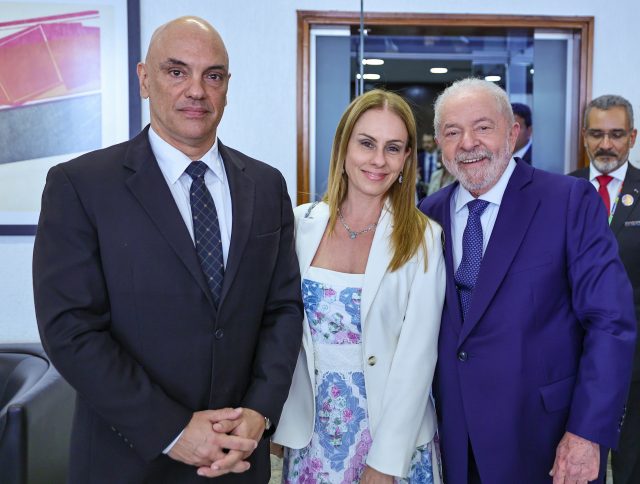
Bolsonaro is barred from contesting the 2026 election, so his son Flávio is running instead against Lula. His candidacy was temporarily damaged by the revelation that he had asked a now-disgraced financier, Daniel Vorcaro of the failed Master Bank, to donate to a documentary about his father. But another revelation has proven far more significant. Moraes’s wife, Viviene Barci de Moraes (in the photo above with her husband and Lula), had a three-year contract with Vorcaro’s Master Bank to provide legal consultations for US$25 million. Moreover, leaked messages show Vorcaro asking Moraes, shortly before his arrest, whether he should flee Brazil. These messages indicate a much closer connection between Moraes and Vorcaro than previously known. The concerns expressed in the three MEPs’ letter to the EU Commissioner for Foreign Policy and Security seem relevant.