





 Subscribe


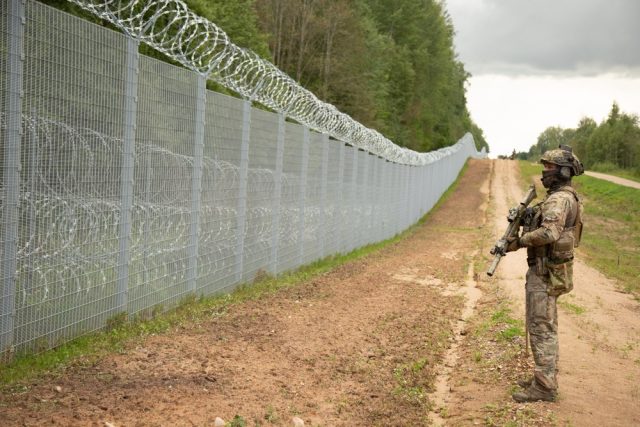
The confrontation on Latvia’s border with Belarus exposes a problem that Europe’s new return legislation cannot solve on its own. Irregular migration is declining overall, but hostile actors are increasingly testing what happens when border management becomes a matter of national security.
On 5 October, a group of twenty migrants approached Latvia’s border with Belarus, accompanied by masked men. According to a report by Lithuania’s public broadcaster LRT, the escorts threw stones at Latvian soldiers, while one of them displayed an object resembling a handgun and threatened to shoot. The soldiers withdrew to safety, and the migrants returned to Belarus. Latvian authorities also reported damage to surveillance infrastructure and the theft of border cameras in a separate incident. Whether the same individuals were responsible for both episodes remains unclear.
What happened was more than another attempted irregular crossing. It illustrated how a migration route can become the setting for armed intimidation and attacks against the equipment used to protect a national frontier. Border guards accustomed to dealing with smugglers and unauthorised crossings suddenly face decisions closer to those encountered in a security operation.
The timing could hardly be more revealing.
Just four days earlier, on 1 October, the Council of the European Union had given its final approval to a regulation intended to make the return of people without a legal right to remain in Europe faster and more effective. It introduces a European Return Order, strengthens cooperation between national authorities, provides for stricter measures concerning individuals posing security risks, and allows Member States to establish return hubs in third countries under agreements respecting international human rights obligations.
The reform addresses a genuine weakness in European migration policy. According to Eurostat figures published in May, 491,950 third-country nationals received orders to leave an EU country in 2025, while 135,460 people were returned to a non-EU country following an order to leave. These are annual totals rather than a single cohort, and therefore cannot be treated as a precise individual return rate. Nevertheless, they illustrate the persistent difficulty of translating an administrative decision into an actual departure.
There has been progress. In the second quarter of 2026, Eurostat recorded a 9.7 per cent year-on-year increase in returns to third countries. The new regulation should provide further means of making those decisions effective, although its provisions will begin applying according to different timetables after entry into force. Return hubs, in particular, will require agreements with the countries willing to host them.
Yet the confrontation in Latvia exposes the limits of treating the effectiveness of returns as the principal measure of border security.
A return order is issued within a legal procedure. A return hub is intended for people who have already received a return decision. Neither instrument is designed to prevent an armed individual from threatening soldiers at the frontier or destroying the cameras through which an attempted incursion might be detected.
The distinction becomes more important when the broader statistics are considered. Preliminary Frontex figures show that detected irregular crossings at the EU’s external borders fell by approximately 35 per cent during the first eight months of 2026. But on the Latvian-Belarusian border, national authorities recorded 11,989 people prevented from crossing irregularly between 1 January and 8 October, compared with 10,462 during the corresponding period in 2025: an increase of approximately 14.6 per cent.
These figures measure different phenomena and cover different geographical and reporting periods. Frontex detections should not be equated with attempts prevented by national border guards. That methodological distinction matters, however, precisely because counting irregular entries does not necessarily capture the operational pressure facing officers who prevent crossings.
A falling European total can coexist with a worsening security environment on a particular frontier.
The Belarusian dimension also extends beyond the October incident. On 15 January 2026, the Latvian National Armed Forces published information which, according to the military, demonstrated the involvement of Belarusian law-enforcement and military structures in directing migrants towards Latvia. The material included documents and communications equipment linked to a Belarusian serviceman, photographs showing Belarusian officials alongside migrants, and reports of electronic interference affecting communications and navigation systems near the border.
These findings do not establish the identity or command structure of the masked men involved in the latest confrontation. They do, however, provide a documented basis for the Latvian authorities’ wider assessment that migration is being deliberately instrumentalised.
Riga has responded accordingly. On 11 August, the government launched Operation VILKATIS, bringing together the State Border Guard, police, national armed forces and security institutions. On 6 October, the Cabinet decided to extend the operation until 31 December.
The government reported that two tunnels used for illegal crossings had been discovered and dismantled. It also announced that 155 criminal proceedings had been initiated in connection with the illegal movement of people across the state border and its organisation. More extensive surveillance, including the use of drones, forms part of the operation.
There is an important lesson in Riga’s response. When migration is exploited by hostile actors, the responsibilities of civilian border authorities increasingly overlap with those of intelligence services and the armed forces. That requires cooperation across institutions which have traditionally operated under different mandates, legal frameworks and operational priorities.
The European Union has not ignored this problem. In December 2024, the Commission formally addressed the weaponisation of migration and made more than €170 million available to strengthen surveillance capabilities in countries bordering Russia and Belarus. The EU Crisis and Force Majeure Regulation also expressly recognises situations in which a third country or hostile non-state actor facilitates migration with the intention of destabilising a Member State or the Union.
Nor is Latvia acting without European operational support. According to its State Border Guard, 66 members of the Frontex Standing Corps were deployed within Latvian border-guard units following the rotation at the end of September.
The foundations of a broader response therefore exist. The question is whether Europe is connecting them effectively.
In February, Latvia, Lithuania and Poland signed a joint declaration calling for stronger intelligence-sharing, early-warning mechanisms and coordinated action against instrumentalised migration and other hybrid threats. Their cooperation reflects a reality familiar to states on NATO’s eastern flank: an attack designed to exhaust one country’s resources can eventually place pressure on its neighbours.
That pressure can also reach the internal borders of the Schengen area. Poland’s notification of temporary border controls with Lithuania and Germany, renewed from 2 October, expressly cites persistent migration-related threats to public order and internal security. Those controls cannot be attributed to the specific Latvian incident, but they demonstrate how unresolved pressures on Europe’s frontiers can affect free movement elsewhere within the Union.
This should concern European conservatives in particular. Protecting national sovereignty and preserving the practical benefits of European cooperation are not competing objectives. The ability of sovereign states to control their borders is among the conditions that make an area without routine internal border checks politically sustainable.
The discussion held in Strasbourg on 6 October between Commissioner Magnus Brunner and the European Conservatives and Reformists Group pointed towards this broader understanding. The ECR Group reported discussions on strengthening Frontex, cooperation with third countries, return hubs and the growing challenge posed by drones and counter-drone capabilities.
These priorities belong in the same strategic conversation, although they should not be confused with one another. Return diplomacy deals with people who have no legal right to stay. Border surveillance and intelligence address threats before they penetrate national territory. Protecting critical infrastructure and countering hostile operations require still another set of capabilities.
A credible policy must also distinguish the people being instrumentalised from those organising the operation. Migrants may be manipulated, deceived or exposed to considerable danger by smugglers and hostile authorities. They do not become enemy combatants merely because others seek to exploit their movements. Respect for asylum obligations, individual assessment and fundamental rights remains essential, including when governments face deliberate provocations. That distinction strengthens the legitimacy of a firm response rather than weakening it.
The next opportunity to bring these strands together will come at the European Council on 15–16 October. In his invitation to EU leaders, dated 8 October, President António Costa highlighted the sustained reduction in irregular arrivals as evidence that European migration policy is delivering results. Significantly, he also called for greater preparedness and solidarity in responding to crises, including cases of instrumentalisation.
The two assessments are not contradictory. They describe different dimensions of the same challenge.
Europe needs an effective return system, including workable agreements with third countries. But it also needs the capacity to identify hostile organisers, protect border infrastructure, exchange intelligence quickly and support Member States facing coordinated provocations. Existing European instruments should be judged by the operational assistance they deliver, not simply by the number of strategies and regulations adopted in Brussels.
Above all, responsibility must remain clear. National governments retain their fundamental duty to protect their territory and citizens. European cooperation should strengthen their ability to fulfil that duty, particularly where the security of one Member State has consequences for the entire Union.
The new return regulation is a necessary correction to a system that has too often struggled to enforce its own decisions. It deserves to be implemented effectively. But the events on Latvia’s eastern frontier remind Europe that enforcing a departure order and deterring a hostile operation are not the same task.
Return hubs may help Europe decide what happens after an unsuccessful claim to remain. They cannot, by themselves, decide what happens when armed men appear at the border.