


 Subscribe


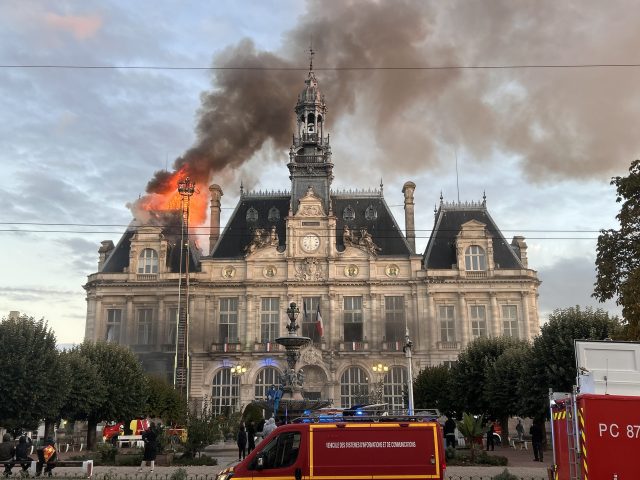
The destruction in Limoges forces Europe to make a choice: to enforce the law whilst the democratic institutions remain in force, or to risk a future in which communal violence and a coercive state are the norm.
Limoges town hall survived both world wars. The building which had been inaugurated in 1883 as a historic monument was set alight on the 17th of October during the disturbances surrounding the demonstrations. What had been the preserve of generations was in fact destroyed by a mob in the course of a single evening. The municipality’s condemnation was absolute: no complaint whatever could justify the attack.
The flames should worry Europeans beyond France. They pose a question which governments have allowed to become increasingly difficult to answer: what happens when the state fails to contain the disorder?
There are two particularly dangerous answers. One is that violence will trigger an organised backlash and draw the communities into a conflict which the state is simply not in a position to control. The other is that the sheer exhaustion and fear will create an appetite for a government which is prepared to restore order using powers which the citizens would previously have been quite happy to reject.
These paths can also converge. Escalating internal conflict can provide a justification for exceptional coercion; exceptional coercion in turn can generate further resistance.
Europe still has the opportunity to restore confidence in lawful authority through ordinary democratic government. It should use that opportunity before the political demand shifts from “enforce the law” to “do whatever it takes.”
When violence calls for reciprocity
A riot does not by itself constitute a civil war. A burned building is not sufficient evidence that one has begun. But neither observation should prevent us from examining how persistent disorder can develop into something more serious.
The key development is usually in arranging a response outside the state.
Residents who feel the police can’t protect them start to organise their own protection. Political groups take on an enforcement role. Criminal networks provide security on their own terms. Communities come to see their own safety as something that is contingent upon their ability to deter another community.
Each incident then gets a history. An attack becomes a response to a previous attack and the justification for the next. Those people who started out wanting protection find themselves in a conflict whose very continuation is required if they are to achieve that protection.
The summer 2024 riots in Britain were a stark illustration of how rapidly public disorder can take on a communal focus. Mosques and hotels housing asylum seekers were the targets of attack. The subsequent House of Commons inquiry into the riots recorded the violence (including attempts to break into asylum accommodation) and the tensions that developed between the protesters and the counter-protesters.
Conservatives should examine that experience without evasions. Concerns about immigration do not confer a private right to intimidate, attack or punish. A group claiming to defend its country can help destroy the common authority on which its country depends.
The state must protect citizens against violence regardless of the perpetrators’ political vocabulary. Otherwise, every faction will eventually discover a cause that supposedly entitles it to an exception.
Spain should recognise the process
For Spaniards, the possibility of political antagonism becoming civil conflict should require little imaginative effort.
Ninety years after the beginning of our Civil War, its memory remains politically abundant and practically underused. We argue over the past while neglecting some of its most disturbing lessons about the present: the vulnerability of institutions, the power of fear, and the speed with which neighbours can come to regard one another as enemies.
Religious persecution included the killing of Catholics because of their faith. Churches became targets. But the story also includes people who armed themselves, organised their own defence, and came to regard force as necessary for survival; not to mention Franco’s ultimate Alzamiento (Uprising), which sparked a full-on civil war for 3 bloody years.
The warning lies in that progression. Once people believe that protection depends on their own weapons, loyalties and capacity for retaliation, restoring a shared political order becomes much harder.
Contemporary conflict would not need to reproduce the territorial fronts of 1936. It could emerge unevenly, through recurring violence in particular districts, intimidation of institutions, attacks on places of worship, or competition for control of streets and transport routes. Ordinary life might continue nearby, even as some residents learned to organise theirs around the possibility of attack.
David Betz, professor of war studies at King’s College London, has examined the prospect of civil conflict in Western societies in works including Civil War Comes to the West. When I met him in Hungary approximately a year ago, I found his assessment deeply unsettling.
Europe has grown accustomed to taking both prosperity and democracy for granted, even as the foundations of both are weakening. A middle class that once expected security is slipping toward poverty, with homeownership increasingly out of reach. Democratic habits, meanwhile, require civic education, institutions that earn public trust, and governments that deliver on their promises. When democracy appears to offer little beyond managed decline, disillusionment should surprise nobody. Europe has also admitted millions of people from societies shaped by civilisational traditions substantially different from those of their liberal-democratic host countries. Their commitment to democratic values and procedures cannot simply be presumed, any more than it can among native-born Europeans who increasingly doubt the system’s legitimacy. Such commitments must be cultivated and sustained. We would therefore be unwise to treat either Europe’s prosperity or its attachment to democratic government as permanent.
The demand for order
Prolonged disorder changes more than the public’s appetite for authority. It can also change the scale of force required to restore it.
A government confronting sporadic violence still has options that may disappear once that violence becomes entrenched. If rival groups acquire weapons, organise retaliation and control neighbourhoods, restoring public authority becomes substantially more difficult. The same can happen without two organised sides: a powerful violent movement or criminal networks beyond effective police control can force the state to recover authority over territory it allowed to slip from its grasp.
At that stage, ordinary policing may no longer be sufficient. Officers must regain access before investigating offences; witnesses need protection before testifying; courts cannot function normally where those enforcing decisions face organised attack. Delay allows the problem to grow while weakening institutions expected to resolve it.
The resulting intervention may be extraordinary in both scope and severity. Military support, extensive security operations, large numbers of arrests and temporary emergency powers may become necessary to confront conditions that earlier, limited enforcement could have contained. Where violence has developed into sustained armed conflict, restoring order may require operations closer to counterinsurgency than conventional policing.
Necessity does not make every measure effective or legitimate. Even under severe pressure, governments must distinguish perpetrators from the populations among whom they operate, preserve individual responsibility and subject exceptional powers to meaningful scrutiny. Indiscriminate coercion can deepen the conflict it intends to end. But acknowledging those obligations should not obscure the central problem: recovering lost control can require far harsher measures than maintaining it would have required.
That practical escalation is accompanied by a political one. Frightened citizens become more willing to accept sweeping restrictions while governments gain stronger arguments for demanding them. Measures introduced as temporary necessities can become permanent features of government. The restoration of order may succeed while leaving society substantially less free.
Europe’s conservatives should understand timely enforcement as a means of preserving both security and political restraint. Acting now through effective policing, functioning courts and accountable government can prevent circumstances where available choices become much narrower and more brutal.
The longer a state postpones exercising its lawful authority, the greater the force it may need to recover it and the harder it becomes to contain once unleashed.
Italy and Portugal have made decisions
Recent events illustrate different ways in which governments can respond before disorder becomes entrenched.
Following the unrest in Milan, Giorgia Meloni’s government approved an additional 500 military personnel for the city under the existing Strade Sicure operation. The Italian Defence Ministry confirmed the reinforcement on October 20.
The presence of soldiers does not establish authoritarian government. Military support to domestic security can operate within an existing legal framework. Its deployment makes the seriousness of the situation visible: authorities have decided additional capacity is required to maintain control.
In Portugal, police cleared housing protest encampments from central Lisbon and Porto on October 20.
Those camps should not be equated with Milan’s looting. The distinction matters. Peaceful protest, unlawful occupation, criminal damage and organised violence require different responses. A credible government must make those distinctions and act accordingly.
Both cases show that public authorities can decide how to use public space. The choice is not limited to indefinite acquiescence or suspending democratic government.
Police operations, evidence-based arrests, timely prosecutions and legally authorised security reinforcements are instruments available to democratic states. Their effectiveness depends on adequate resources and willingness to use them consistently.
Waiting until circumstances require greater intervention is a political choice with its own consequences.
Spain’s grievances will not wait
Spain has ample reasons to avoid complacency. Housing consumes incomes that once supported independent lives and families. Young people postpone decisions their parents made earlier. Public services ask for patience while requiring growing resources. People who study, work, pay taxes and obey the law increasingly question what stability they can reasonably expect in return.
These grievances will not disappear through policing. Governments that restore a square to public use must still confront the housing crisis that brought people into it.
Failure to address economic problems cannot become a standing permission for coercion by crowds. Nor can maintaining public order become an excuse to ignore causes of discontent. A government must be capable of both enforcing the law and improving conditions under which citizens live.
My professional work on migration, from the Sahel to the southern United States and the Hungarian–Serbian border, has taught me that political determination has operational consequences. Governments that prioritise enforcement behave differently from those that repeatedly explain why they cannot achieve it. Capacity constraints, costs and legal disputes may remain, but serious government works through them. Repeatedly invoking them as an explanation for impotence eventually destroys the explanation’s credibility.
That is when two dangerous alternatives begin to attract support: private groups promising to act themselves and political leaders promising to act without restraints that supposedly disabled their predecessors.
The responsibility of the Spanish Right
For the Partido Popular and Vox, this should define the seriousness of the next opportunity to govern, come November 29th general elections.
PP must demonstrate that competent administration can produce changes proportionate to the problems it promises to repair. Voters will expect safer streets, credible enforcement and improvements in ordinary life. A better-managed disappointment will remain a disappointment.
Vox must show that its forceful language can acquire a workable legislative and administrative form. Its voters may accept difficult negotiations. They will find it harder to accept discovering that the original promise concealed an inability to deliver.
Both parties need to identify what can be done immediately, what requires sustained parliamentary work, and what depends on changing European or international arrangements. That preparation must precede government. Discovering every constraint after taking office is an effective way to resemble the people one promised to replace.
Failure would create opportunities for challengers further to the Right, some seeking votes and others attracted to forms of mobilisation less securely attached to parliamentary politics. Their advantage would be simple: they would have no record of government to defend, and another failure to exploit.
The answer is to demonstrate that democratic authority can act while remaining accountable for how it acts. Limoges should therefore be understood as a warning about the decisions still available to us. Persistent disorder can produce reciprocal violence. It can also persuade frightened citizens to surrender safeguards in exchange for promises of security.
Spain knows enough about the first danger. Europe’s history supplies ample knowledge of the second. Restoring order now, through lawful and democratic institutions, preserves our ability to choose the terms on which we maintain order. If governments squander that opportunity, the next demand for protection may come with far fewer conditions.