


 Subscribe


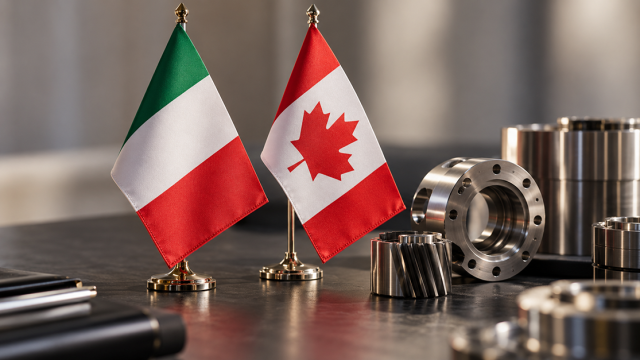
Toronto forum highlights Italian industrial strengths as both partners pursue stronger supply chains, technological cooperation and export growth.
Italy is looking beyond traditional export promotion to build a deeper industrial partnership with Canada, placing technology, economic security and investment at the centre of its commercial diplomacy. The Business Forum in Toronto offered a practical expression of that ambition, bringing institutions and companies together around sectors where Italian expertise can make a distinctive contribution.
Representing Foreign Minister Antonio Tajani, Undersecretary of State for Foreign Affairs Maria Tripodi attended the gathering organised by the Italian Foreign Ministry with the Defence Ministry’s National Armaments Directorate and the Italian Trade Agency. Its structure combined a plenary session, involving CDP, SACE, Simest and Unioncamere, with three thematic roundtables and business meetings.
Discussions covered advanced industry; energy, mining and infrastructure; and defence, aerospace and cybersecurity. These priorities suggest a relationship increasingly focused on productive capacity and strategic resilience, alongside the consumer goods that have traditionally helped define Italy’s international reputation. For Italian businesses, the opportunity is to demonstrate that national excellence extends well beyond fashion, food and design.
Tripodi presented Canada as a particularly important partner for diversifying supplies, strengthening economic security and developing industrial and technological synergies. She also identified the country as a priority within Italy’s Export Action Plan. The underlying argument is persuasive: complementary capabilities can generate more durable value than a relationship based solely on selling finished products abroad.
The figures supplied by the Italian Foreign Ministry reinforce that message. Italian exports reached €444 billion in the first eight months of 2026, increasing 5% in value compared with the corresponding period of 2025. Sales to markets outside the European Union rose 5.9%, while exports within the bloc increased 4.1%. Canada also contributed positively: Italian exports there totalled €3.82 billion between January and July, up 4.2% annually.
These are encouraging results, although growth in export value should not automatically be interpreted as an equivalent increase in physical volumes or profitability. Nevertheless, the Canadian performance supports Rome’s decision to devote diplomatic attention and institutional resources to a market offering scope for more sophisticated commercial relationships.
An established framework already exists. The Comprehensive Economic and Trade Agreement between Canada and the European Union has applied provisionally since September 2017. Separately, Italy and Canada endorsed a Roadmap for Enhanced Cooperation in 2024, covering priorities including energy security, innovation, trade and defence. Subsequent initiatives include an Energy Dialogue, cooperation on critical minerals and a joint advisory group on artificial intelligence.
That institutional groundwork matters because the forum’s most promising opportunities lie where sectors intersect. Mining projects require equipment, engineering and infrastructure; industrial modernisation requires automation and secure digital systems; energy development needs reliable supply chains. Italian companies capable of combining specialised manufacturing with technical services could become valuable partners across these connected activities.
Defence and aerospace add another strategic dimension. As NATO partners, Italy and Canada already share a framework for security cooperation. Expanding industrial collaboration could support that relationship, although commercial outcomes will depend on procurement requirements, technology safeguards and the competitiveness of individual proposals.
The immediate test is therefore execution. Business meetings must lead to credible projects, financing arrangements and sustained contact between companies. Smaller Italian firms, in particular, may benefit when institutional coordination helps them assess opportunities and establish dependable local partnerships.
For Rome, success would mean more than higher sales: it would establish Italian firms as contributors to Canada’s next phase of industrial development
Toronto’s significance lies in this shift from goodwill to industrial purpose. Canada offers Italy a setting in which commercial diversification and strategic cooperation can reinforce each other. Italy, in turn, brings a productive culture built around specialisation, adaptability and engineering skill. If both sides convert political alignment into practical investment, Italian enterprise has a strong chance to emerge as one of the partnership’s principal driving forces over the coming years.
Alessandro Fiorentino