





 Subscribe


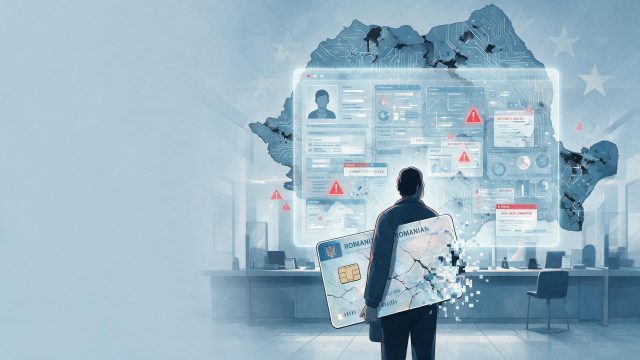
Romania is racing to digitize citizens’ medical records while its flagship digital ID project stumbles, burning through EU money and exposing how fragile the state’s IT backbone really is. The result is a dangerous mismatch: highly sensitive health data will move online in a system that still cannot guarantee that people are correctly identified, continuously connected, or even visible in the database.
Under the National Recovery and Resilience Plan (PNRR), Romania originally promised Brussels at least 5 million electronic ID cards (CEI) issued by June 2026, with 70 million euro allocated just for those documents and another 80 million euro for supporting digital services. In practice, roll‑out was delayed by years, and by mid‑2026 the country had only a bit over 2.3 million electronic IDs in circulation, less than half the initial target and with barely a year left on the PNRR clock.
Because Bucharest admitted it could not hit 5 million cards in time, the target was cut first to 3.5 million, with 21 million euro sliced from the PNRR allocation. A further revision lowered the funded ceiling to around 2.1 million CEI and dragged the available PNRR money down to roughly 29.4 million euro, meaning Romania has effectively given up more than 40 million euro (around 57% of the original budget) for free electronic IDs.
Starting with the 1st of September 2026, patients will be able to access a national digital platform called “E‑Sănătatea Mea”, where they can see their medical file, prescriptions, referrals and history of reimbursed services. At the same time, authorities are preparing to phase out the separate health insurance card, turning the new electronic ID into the main token used to identify insured persons in the system, even though the chip will not store health data, only a digital certificate used to authenticate into the platform.
During a transition period, the old health card and the new CEI will coexist, while access to the “E‑Sănătatea Mea” portal will be possible either through the ROeID digital identity app or by being validated manually at a doctor’s office. This means that in practice Romania will run at least three parallel identity regimes in healthcare: classic ID plus card, CEI plus card, and CEI plus digital wallet.
The optimism around the new portal ignores a long and public history of failures in the health insurance IT systems run by CNAS. The PIAS platform and its core SIUI component have suffered repeated outages since at least 2014, with official reports of 12 major “disruptions” in the first eight months alone and frequent uncounted slowdowns reported by doctors. There have been days when PIAS simply stopped working, forcing CNAS itself to announce that the platform was “unavailable” and pushing all services into offline mode.
Every outage has a human cost: when the card system fails, doctors cannot verify in real time whether a patient is insured, issue reimbursed prescriptions, or record services for later payment. In one documented case, a breakdown of the national health card system was estimated to affect roughly 150,000 patients and more than 20,000 doctors for every hour of downtime, with services forced into paper‑based, offline workarounds. In 2019, the national card platform was partially unusable for around 21 days, with CNAS extending reporting deadlines because the system could not handle normal loads.
Technical failures are only half the story. The other half is data integrity. CNAS has openly admitted that the system sometimes shows live patients as dead, or wrongly flags insured people as uninsured, issues it has tried to dismiss as “isolated cases.” Doctors and officials have also reported situations where patients disappear from family doctors’ lists, or appear registered with multiple general practitioners at the same time, directly affecting who gets paid and whether a patient can access free services.
The “E‑Sănătatea Mea” platform is supposed to sit inside this older PIAS architecture, which CNAS itself describes as overloaded and outdated. Every new feature adds more data, more users, more real‑time queries and thus adds pressure on a system that already chokes under routine monthly reporting and has historically required emergency derogations from the 72‑hour online reporting rule just to keep healthcare running. If the platform or the identity layer fails at scale, doctors will once again be told to “work offline”, but this time the offline gap will concern not just billing but access to entire medical histories and treatment decisions.
The new health architecture will treat citizens differently depending on what document they happen to hold and how digitally literate they are. Those with CEI and a smartphone can log into “E‑Sănătatea Mea” via ROeID, see their records, and navigate the system relatively smoothly, while others will rely on manual checks at the doctor’s office and may face longer queues, more bureaucracy, or outright confusion at every outage. In rural areas or among older patients, where CEI uptake and app usage are likely to lag, the risk is that a “modern” platform actually amplifies existing inequalities rather than closing them.
A credible strategy would start by treating identity and health data as critical national infrastructure rather than one more IT project: independent security and capacity audits of PIAS/SIUI, transparent publication of uptime and error statistics, and real accountability for missed service levels. Before binding the entire health system to CEI and “E‑Sănătatea Mea”, authorities could run long, properly monitored pilots that include rural clinics, chronic patients and emergency departments, where any glitch has immediate consequences, instead of declaring success after limited technical tests.