





 Subscribe


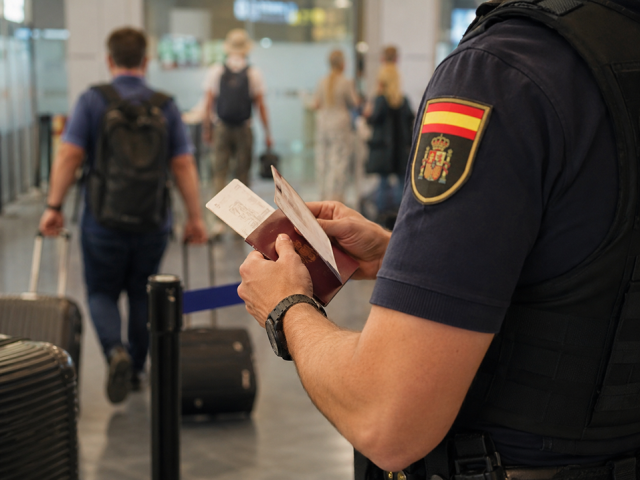
Random document inspections at Madrid-Barajas are the latest consequence of the diplomatic dispute between Rome and Madrid, raising fresh concerns over Schengen, freedom of movement and the political handling of migration
MADRID — Travellers arriving in Spain from Italy are finding themselves caught in the middle of an increasingly tense diplomatic dispute between two of the European Union’s largest Mediterranean countries. At Madrid-Barajas Airport, passengers disembarking from flights originating in Italy have been subjected to random document checks by Spanish police, a development that has caused surprise, frustration and, in some cases, significant disruption.
The controls are being carried out on a selective basis, with roughly one passenger in ten reportedly being stopped for identification checks after arrival. For European citizens accustomed to travelling between Italy and Spain without encountering border formalities, the sight of police officers checking documents immediately after a flight within the Schengen area has inevitably generated confusion.The measures cannot, however, be separated from the broader political confrontation that has developed between Rome and Madrid over migration and border security.
The dispute intensified at the beginning of August after the Italian government temporarily reintroduced controls on travellers arriving from Spain, citing national security concerns following the exceptional migration crisis involving the Spanish enclave of Ceuta. Prime Minister Giorgia Meloni’s government argued that additional checks were necessary to prevent possible repercussions for Italy, while stressing that the measures were intended to be temporary and targeted. The European Union subsequently reminded Rome that any temporary reintroduction of internal border controls within Schengen must be properly notified and justified.
Madrid reacted strongly.
The Spanish government accused Italy of taking a unilateral measure that undermined the principle of European solidarity and demanded that Rome restore normal border arrangements. When the Italian government declined to immediately withdraw the controls, Spain announced reciprocal measures affecting passengers arriving from Italy.From 8 August, Spanish authorities introduced temporary random controls at airports and ports for travellers coming from Italy, with the measure currently scheduled to remain in force until 7 September.
What began as a disagreement between governments has therefore become something far more tangible for ordinary Europeans: a police officer asking for identification at the end of what, until recently, would have been an entirely routine journey between two Schengen countries.
Passengers caught in a political dispute
At Madrid-Barajas, the reaction among passengers has ranged from resignation to irritation.
For many Italian travellers, particularly those who regularly fly within the European Union, border controls on arrival feel like an unexpected return to a Europe they believed had largely disappeared. The Schengen area has made the absence of systematic internal border checks one of the most visible symbols of European integration.That is why even limited and random inspections can carry a political significance far greater than the practical inconvenience they cause.
Travellers have expressed concern that disagreements between national governments are increasingly being translated into measures that directly affect citizens. The fear is not necessarily that the current controls will permanently dismantle Schengen, but that reciprocal restrictions could become an increasingly common political instrument whenever relations between EU governments deteriorate.
The Italy-Spain dispute is particularly striking because the two countries share many strategic interests. Both are major Mediterranean nations, both face migration pressures, both are important tourism markets and both depend heavily on the smooth movement of people and goods within the European Union.
Yet migration policy has increasingly divided Rome and Madrid.
The Meloni government has adopted a markedly restrictive approach to irregular migration and has repeatedly called for stronger protection of Europe’s external borders. Pedro Sánchez’s government, by contrast, has defended a different approach, combining border management with regularisation policies and a greater emphasis on legal pathways and integration.
Those differences had already produced political friction before the current crisis. In June, Spanish government sources sought to downplay reports of a confrontation between Meloni and Sánchez over migration, describing their exchange as a dialogue in which both leaders had simply presented their respective national positions.The events of recent weeks suggest that those differences have now moved beyond rhetoric.
When airport delays make matters worse
The frustration caused by the additional controls is being compounded by the ordinary problems of summer air travel.One passenger arriving in Madrid from Rome, for example, reportedly reached the Spanish capital more than three hours late because of technical problems affecting the flight. The delay caused the traveller to miss a connecting service for a holiday destination.
For someone already dealing with hours of disruption, arriving to find additional police checks inevitably contributes to the impression of a journey made unnecessarily complicated.The two issues should, of course, be distinguished. Technical problems and airline delays are not a consequence of the diplomatic dispute between Italy and Spain. But for passengers, the distinction can become almost irrelevant: delayed departures, missed connections and unexpected document inspections all form part of the same travel experience.And in the middle of the summer holiday season, when millions of Europeans are moving across the continent, even relatively limited additional procedures can amplify congestion and dissatisfaction.
A warning sign for Schengen?
The most important question raised by the dispute goes beyond the inconvenience currently experienced at Madrid-Barajas.Schengen does allow member states to temporarily reintroduce internal border controls in exceptional circumstances. The system was never designed to prevent governments from responding to serious security threats or extraordinary situations.But temporary controls are supposed to remain precisely that: exceptional, proportionate and limited.The danger arises when border measures become part of a cycle of political retaliation.
Italy says its original decision was motivated by security concerns connected with the migration emergency. Spain, meanwhile, has framed its own controls as a reciprocal response to Italy’s action. Madrid has also accused Rome of undermining European coordination, while the Italian government insists that protecting national security remains its responsibility.
Both governments therefore present their measures as justified. Yet from the perspective of passengers standing in an airport queue, the result is the same: a border that had largely disappeared has suddenly become visible again.
That should concern European institutions.
Freedom of movement is not merely an abstract principle contained in EU treaties. For millions of Europeans, it is experienced through the ability to board a plane in Rome, Milan or Naples and arrive in Madrid or Barcelona without feeling that they have crossed a traditional national frontier.The current dispute does not mean that Schengen is collapsing. Temporary border controls have been introduced by European countries on numerous occasions, often for security or migration-related reasons.Nevertheless, the confrontation between Italy and Spain demonstrates how quickly national political disputes can spill over into the everyday lives of citizens.
The priority now should be diplomatic de-escalation.
Rome and Madrid have legitimate differences over migration policy, border security and the management of irregular arrivals. Those disagreements deserve serious political debate. But two founding pillars of the European project — cooperation between member states and freedom of movement — should not become collateral damage in a contest of reciprocal measures.
For travellers arriving at Madrid-Barajas, the issue is already much less theoretical. A routine flight from one EU country to another can now end with an unexpected document check and the uncomfortable feeling that Europe’s internal borders, once considered increasingly irrelevant, may not be quite as distant as they seemed.
Alessandro Fiorentino