





 Subscribe


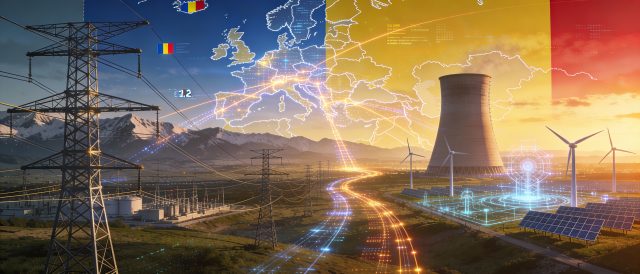
The European Union has embarked on its largest overhaul of energy infrastructure in history, promising a €1.2 trillion investment to modernize electricity networks by 2040.
Central to this transition is Romania, a prime candidate to evolve into a regional energy hub in the form of eight major “Energy Highways” intended to lower the cost of electricity and lessen the use of fossil fuels throughout the continent. Romania’s geostrategic location makes it a crossroads for EU energy security, linking Western Europe (via Hungary-Austria projects funded by €30 billion EU funds by 2035) to Black Sea gas routes like BRUA and Neptun Deep, nearly doubling interconnection capacity from 4,000 MW to 7,200 MW. As a pillar of stability in Central and Eastern Europe, it integrates renewables and nuclear expansions (Cernavodă Units 3-4) to diversify supplies. As energy specialist Ionela Cuciureanu points out, “Romania has to get its grid ready for rapid renewable change,” and by mid-2025 the battery storage can already contribute to close to 400 MWh.
The EU’s electricity prices hit a crucial point in 2024: when EU industry electricity prices hit €0.20 per kWh, while that in China, at €0.082, and in the US, at €0.075, the European Commission’s plan takes aim at an alarming point in time. The Romanian/European consumers could benefit massively from it, with the Commission predicting annual savings of about €40 billion when the electric grid modernization is finished. These investments bring a multiplier effect that is impossible to overestimate.
Valorem Consulting analysis says the annual €1.1 billion investments required to operate Romania’s distribution networks will have a cost effectiveness and economy impact of over €5.8 billion. Partner Bogdan Belciu says: “Investment in energy networks would set the stage for Romania to have cheap and sustainably produced power for itself–which would be attractive to industry: from data centers to artificial intelligence, metal processing and construction materials and petrochemicals. These are potential areas for Romania.”
Yet while ambitious promises, enormous obstacles stand in the way of progress. Dumitru Chisăliță, the President of the Intelligent Energy Association and a leading energy expert in Romania, has long been warning of Romania having a “long history of arrogance, conceit and incompetence” in implementing policies on energy. And his critique is part of a wider concern that Romania confuses debate with decision-making and reform with simulacrum of reform.
Renewable energy industry is sounding alarm bells about sudden introduction of new grid connection methods. The Romanian Wind Energy Association, Romanian Photovoltaic Industry Association and PATRES warn the system, which starts in January 2026, will “produce the same kind of problems for all energy projects over 5 MW, no matter the technology”. Grid connection is already the primary constraint to new project development due to legislative and bureaucratic constraints, and industry associations are asking for a three-year delay in the auction mechanism.
In Romania, said policy analyst Eusebiu-Valentin Stamate, “Political and economic uncertainty in Romania may slow the pace and stability of renewable energy development”. Changing political winds can push for a shift in sector priorities, resulting in delays or inconsistencies in policy implementation; rising costs, inflation, and supply chain disruptions could get in the way of financing and execution.
Energy Minister Bogdan Ivan has promised that dynamic pricing and smart meters could be able to lower consumer bills as much as 24%, citing international applications. Moreover, infrastructure and digital system investments are projected to bring technological losses down from the current level to the European average of 8-10%.
The European Union’s Energy Highways provide Romania and other EU consumers with an exciting and meaningful new pathway to cheaper and cleaner electricity and increased security for access to electricity. But success depends on overcoming bureaucratic inertia, expediting permitting and maintaining regulatory uniformity. As the European Bank for Reconstruction and Development has stressed, the “investment in grid modernization and the digitalization of the electricity grid is essential to manage the two-way flow of electricity from prosumers”.
Romania heavily supports Ukraine and Moldova both with electricity exports; more than 1,300 MW was supplied in crises like the Russian attacks on Ukrainian infrastructure in December 2025, where Romania’s hydropower and wind output enabled Moldova to redirect nearly 1,000 MW onward to Ukraine. In 2024, Romania exported 877 GWh (€110 million) to Ukraine and 698 GWh (€99 million) to Moldova, amid a net import position domestically. Romania is at a decision point, where its strategic role can either bring it to be a multi-regional energy centre or hinder it, due to policy failures and regulation ambiguity.
For Romanian and EU citizens, the stakes, measured in lower energy prices, jobs created and climate goals to be achieved, cannot be higher.