





 Subscribe


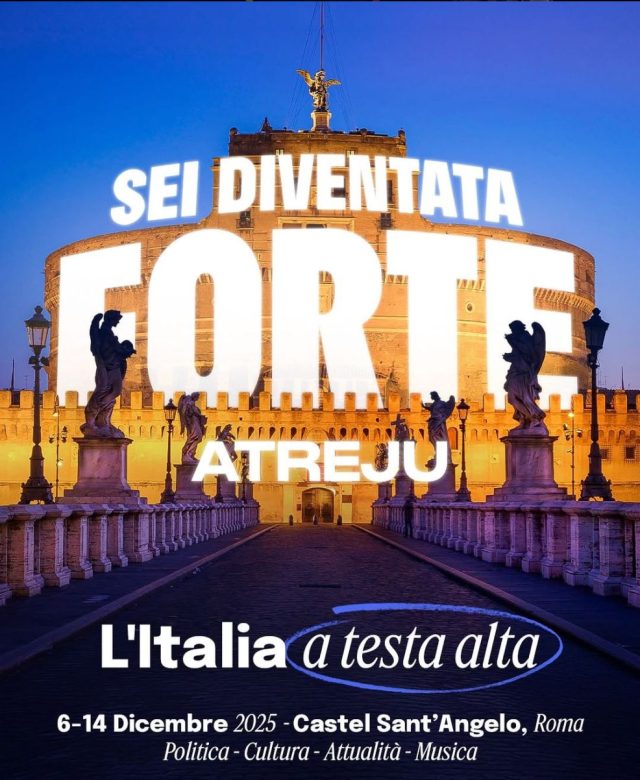
In December, in the heart of Rome, Italian politics will once again pass through Castel Sant’Angelo. From 6 to 14 December, a new edition of Atreju, the historic festival of the Italian right, will take place: nine days of debates, politics and militancy that have now become a fixed appointment not only for Fratelli d’Italia, but for the entire national political system.
This festival, born as the intuition of a handful of young activists, has over time become the place where the right calls everyone to debate.
Atreju, the festival that has forced everyone to show up
Atreju was created in 1998 as an event of Azione Giovani, the youth wing of Alleanza Nazionale. It is the festival of right-wing youngsters, but above all it is the festival where, every year, the right decides to invite “into its own home” even those who think the opposite.
Over the years, practically everyone has taken the stage at Atreju: Giuseppe Conte, a guest several times, even when he was prime minister, speaking in front of a clearly opposition-minded audience; Matteo Renzi, Enrico Letta, Luigi Di Maio, invited in 2021 to discuss with the right about institutional reforms, the economy, Europe, in an edition that gathered the entire Italian political spectrum in the same space. But also leaders of the “historic” left such as Romano Prodi and Fausto Bertinotti.
It is a deep cultural and political difference compared to the traditional festivals of the left, where opponents are invited less and less, and only when they serve the narrative of the “enemy”. Atreju, on the contrary, has built its strength precisely on the opposite idea: put everyone on stage and see who can stand the pressure.
Castel Sant’Angelo, 6–14 December: the right’s open house
The 2025 edition confirms and raises the stakes. Nine consecutive days, from 6 to 14 December, in the gardens of Castel Sant’Angelo, a stone’s throw from St Peter’s. Around the main stage, the classic Christmas village takes shape: stalls, debates, book presentations.
But the political – and communicative – point remains the same, as the Fratelli d’Italia leadership keeps repeating:
“Atreju is the place where opposing sides meet, with respect but without pulling any punches on ideas.”
It is on this ground that the new chapter of the clash between Meloni and Schlein unfolds.
Schlein’s move: “I’ll come only if I can challenge Meloni”
After refusing the invitation in recent editions, this year Elly Schlein changes her approach. The invitation from Fratelli d’Italia arrives once again and this time, from the Nazareno, a certain willingness emerges: the Democratic Party secretary is ready to step onto the Atreju stage, but on one condition.
Schlein does not want to be just another guest in a long list of debates; she demands a one-on-one “ring” with the prime minister. A choice that has its own logic: at a time when the opposition is divided and the much-trumpeted “broad camp” does not exist, the PD is trying to turn Atreju into a kind of presidential duel between her and Meloni.
Meloni’s counter-move: “I’m ready, but Conte has to be at the table as well”
The prime minister does not refuse, does not run away and does not lower the bar. She raises it.
In a message aimed at social media, Giorgia Meloni writes:
“I read that Elly Schlein has finally accepted Fratelli d’Italia’s invitation to take part in Atreju, but only in the case of a direct debate with me. Atreju has always been a home open to dialogue, even with those who think differently. I am therefore ready to debate with the opposition. But I believe that Giuseppe Conte should also take part in the debate.”
Meloni not only accepts the challenge of a debate, she also widens the frame: not a duel tailor-made to crown Schlein as “leader of the opposition”, but a three-way debate that also includes the leader of the Five Star Movement.
The prime minister also explains why: Conte, unlike Schlein, has already been to Atreju several times, “without setting conditions”, even when he was prime minister, and above all it is not up to the government to decide who the leader of the opposition is.
The result: the made-for-TV “duel” turns into a system-wide confrontation, in which the opposition has to present itself for what it really is today – not one opposition, but multiple oppositions, with different and often incompatible positions on Ukraine, economic policy, justice, Europe.
The boomerang for Schlein: the only thing holding the opposition together is “no to Meloni”
At that point, the ball is in the PD’s court. And here is where the short circuit happens.
While Giuseppe Conte immediately says yes – “I am always fine with debating and saying things as they are. I’m certainly not backing out now. I’m in!” – confirming his presence at Atreju even after the Democratic secretary’s retreat, Schlein stiffens.
Faced with the prospect of sharing the stage with Meloni and Conte, the PD leader changes tone and accuses the prime minister of “running away” from a face-to-face meeting.
But it is precisely here that Meloni’s move shows its full effectiveness. The prime minister has accepted the debate, broadened it, and has in fact acknowledged that the opposition is plural and cannot be reduced to the PD secretary alone. By doing so, she has put Schlein in front of a crossroads: either accept sitting at a table where the opposition appears divided on substance, or step back, taking on herself the political responsibility for blowing up the entire debate.
In the end, in practice, the three-way debate will not take place: Schlein pulls out, Conte confirms he will attend, Meloni sticks to her position. And the narrative that sticks in public opinion is simple: it was not the right that dodged the debate, but those who wanted to decide alone the format and setting of the discussion.
Atreju still matters
When the lights of the Castel Sant’Angelo village are switched on in December, Atreju will go back to doing what it has done since 1998: putting the right at the centre of the game and forcing everyone else to decide whether to step onto the field or stay in the stands protesting.
This year, Elly Schlein’s choice and Giorgia Meloni’s response have already fixed a very clear picture: on one side a government that uses its own festival as a place for open – even “uncomfortable” – debate with its opponents; on the other, an opposition that, when it does not fully control the playing field, prefers to pull back.
And in a season when Italians are asking for seriousness, coherence and vision, it is no small detail that the right’s festival – at Castel Sant’Angelo, in the heart of Rome – continues to be the place where everyone is invited. Those who decide not to show up must take responsibility for it. In front of the party faithful – but above all, in front of the country.