





 Subscribe


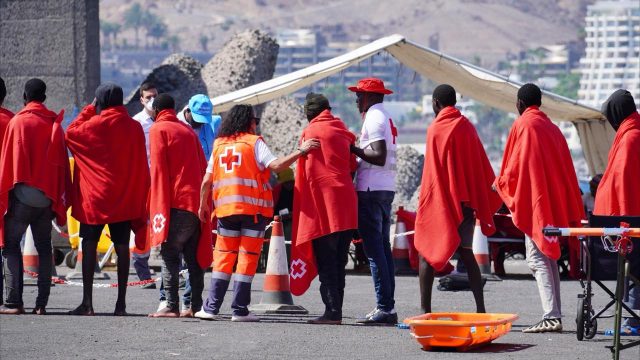
The shift in Europe’s approach to border control is beginning to produce tangible results. In the first four months of 2026, irregular crossings at the external borders of the European Union fell by 40% compared with the same period the previous year, dropping to just over 28,500 detections. The figures come from preliminary data released by Frontex, the European Border and Coast Guard Agency, and reported in Italy also by Corriere della Sera. It is a clear figure, difficult to dismiss as a one-off, and it captures a trend that is political before it is statistical: when Europe decides not to suffer migration flows passively, but to govern them, results follow.
The decline concerns some of the main routes into the continent. According to Frontex data, the Central Mediterranean remains one of the most heavily used routes, with around 8,500 crossings in the first four months of the year, but it still recorded a 46% decrease. The Eastern Mediterranean also saw a decline of 32%, with around 8,400 detections. Libya remains one of the main countries of departure, while among the most frequently detected nationalities are people from Bangladesh, Somalia, and Sudan.
These figures tell a precise story: irregular migration is not inevitable, nor is it a historical fate to be managed with resignation. It is a political, diplomatic, and security issue that can only be addressed through a comprehensive strategy. For years, Europe was dominated by the idea that border control was almost something to be ashamed of, a concession to the right, a taboo to be hidden behind abstract formulas. Today, however, the direction appears to have changed. The question is no longer whether to defend the Union’s external borders, but how to do so more effectively.
Within this framework, Italy’s approach finds clear confirmation. From the outset, the Meloni government has built its migration policy around several firm principles: fighting human traffickers, cooperating with countries of origin and transit, strengthening the external dimension of the European Union, and moving beyond emergency management. No longer a passive handling of arrivals, but an attempt to act before departures take place, in the very places where criminal networks organize human trafficking and turn desperation into profit.
This is the real political novelty. Italy has not merely asked other Member States for solidarity, as had often happened in the past. It has sought to change the European agenda, pushing Brussels to view migration not only as a matter of internal redistribution, but as an issue of security, sovereignty, and Mediterranean stability. This approach is now gaining increasing ground in the European debate, especially on returns, agreements with third countries, and the possibility of testing new models for processing applications for international protection.
Of course, the figures do not allow for triumphalism. The Mediterranean remains a tragic route, and deaths at sea have continued to be recorded in the first months of 2026. Precisely for this reason, however, the reduction in irregular departures cannot be treated as a minor development. Fewer departures also mean fewer people handed over to traffickers, fewer journeys on unsafe boats, fewer shipwrecks, and fewer tragedies. The truly humanitarian policy is not the one that intervenes only when the boat is already at sea, but the one that prevents traffickers from filling it in the first place.
This is where the distance between two opposing visions becomes clear. On one side are those who continue to regard every containment measure as a moral violation, while ignoring the fact that the absence of control fuels the criminal market of departures. On the other side are those who argue that legality and humanity are not opposing concepts, but complementary ones. Defending borders does not mean abandoning the right to asylum, nor does it mean turning a blind eye to international crises. It means distinguishing between those who are entitled to protection and those who enter illegally, between regular migration and human trafficking, between sustainable reception and organized chaos.
In this sense, Frontex’s data reinforce a political conclusion: Europe can reduce migratory pressure only if it chooses a policy of responsibility. What is needed are solid agreements with North African countries, investment in countries of origin, faster procedures, effective returns for those who have no right to remain, and genuine control of the external borders. This is the path Italy has tried to indicate in recent years, often amid ideological resistance and prejudiced criticism.
Now, however, the numbers speak for themselves. Irregular crossings are falling, the main routes are recording significant decreases, and the European debate is increasingly moving toward the principle that Rome has long defended: migration must be governed, not endured. For once, Europe seems to have understood that defending borders is not a sovereignist obsession, but a basic condition for any serious migration policy.
The challenge now is to consolidate this result. A decline in the first months of the year may indicate a trend, but it is not enough on its own to solve a structural phenomenon. The real test will be the European Union’s ability to turn these numbers into a stable policy: less propaganda, more control; less rhetoric, more cooperation; less hypocrisy, more responsibility. If this is the direction taken, 2026 could mark not only a decrease in arrivals, but the beginning of a new European season on migration.